A Night at the Opera
DeMatteis' early years on Marvel's superhero properties yielded a result that is difficult to assess aesthetically: what, exactly, was he aiming for, and what would constitute success? While the 80s were when his career as a professional comics writer took off, his first Marvel superhero stories read like an extended apprenticeship. Their very awkwardness is yet another feature that connects him with the best Marvel work of the previous decade. In Marvel Comics in the 1970s, I argued that most of the best comics I discussed required a kind of curation: as good as they were, they were not, like Watchmen or Maus, books that you could simply hand to a non-comics reader and expect them to appreciate. This was not only because of the obstacles posed by continuing, non-stop monthly storytelling (i.e., the stories were not designed to stand on their own), but also a result of adherence to certain conventions of mainstream comic book storytelling that would be jarring to the uninitiated. This includes a tendency towards histrionics and melodrama that can be effective with the right audience, but might seem like camp to less friendly or forgiving readers.
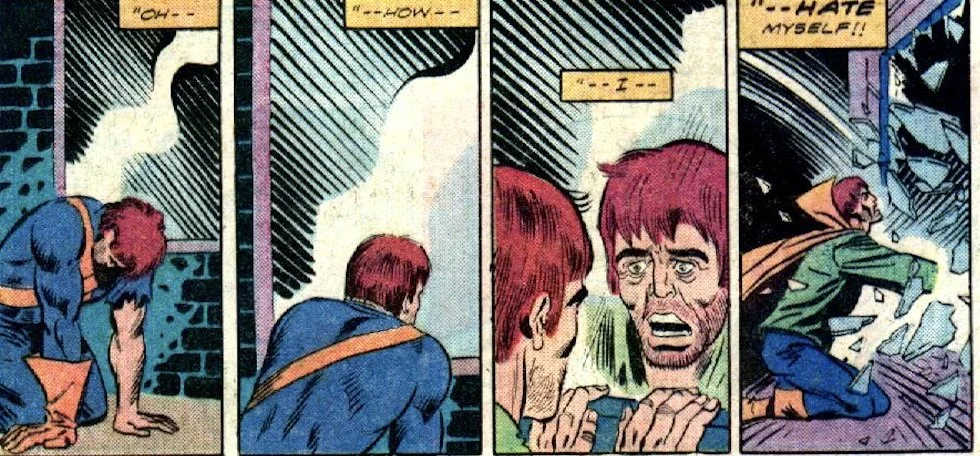
The earnestness I alluded to in the previous entry combines with an intense emotionality, a recurring focus on self-discovery and trauma, and an unabashed propensity for melodrama that reward the reader's empathy while requiring a high tolerance for a lack of subtlety. Subtlety, though, was never a hallmark of Marvel's superhero output (Gerber was capable of it, but not consistently), nor would it be fair to expect it. To appreciate the best of Marvel in general, and DeMatteis in particular, is to recognize that subtlety is not a Marvel value. Instead, just as Stan Lee argued for the "illusion of change" rather than change itself, much of Marvel's most sophisticated superhero output cultivated an illusion of subtlety (through sophisticated references and storytelling techniques) that was nonetheless wielded like a blunt instrument. And this is what DeMatteis excelled at, particularly in his runs on The Defenders and the Spider-Man line.
In The Defenders and Spectacular Spider-Man (as well as a number of his later comics, such as DC's Doctor Fate), this translates into a tendency not just to telegraph moments or revelation or character breakthrough, but to set them off visually, verbally, and even typographically. DeMatteis favored the use of panel layouts that would, at key points, slow down time and close in on faces, while entire sentences would be broken up into words and phrases, spread out over the panels, often with oversized, bold fonts. It is a verbal/visual approach to subjectivity and theme that might be characterized as operatic. As in an opera soliloquy, time comes to a near stop, with all the emphasis on the body, sound, and character of the soloist. Like the Stan Lee approach to interiority I discussed in Marvel Comics in the 1970s, it represents the interior by turning it into the exterior: verbalizing and demonstrating in a revelatory manner that, like a soliloquy or a song-and-dance number in a musical, requires the audience to suspend their adherence to naturalistic storytelling for the duration of the interruption.
Next: How to Play with Your toys