That Seventies Writer
Chapter Four:
Grace Notes:
The Early Comics of J.M. DeMatteis
That Seventies Writer
Of all the writers who were part of the next generation of Marvel creators,J.M. DeMatteis was the one with the deepest roots in the Marvel comics of the 1970s. Granted, Claremont actually was a writer at Marvel in the 1970s, but his work helped set the company on the path that would define the 1980s. DeMatteis, who started his career doing fill-ins and obscure titles at DC before moving on to fill-ins and obscure titles at Marvel, combined Gerber's sense of the absurd, Englehart's preoccupation with transcendence, and the general Seventies Marvel emphasis on interiority to breathe life into neglected Marvel characters while never skimping on the melodrama that was the company's stock in trade. But where his predecessors had grown up on both Stan Lee and French Existentialism, DeMatteis's sensibilities were formed by Seventies Marvel, the Russian classics, and an attachment to the hippie ethos that yielded a deep commitment to New Age spirituality. The resulting comics, even while often overwrought, displayed a sincerity that was a refreshing counterpoint to the "grim and gritty" spirit that would eventually dominate mainstream comics in the late 80s and early 90s.
Despite his relatively large output at Marvel between 1980 and 1987, DeMatteis is not necessarily thought of as a "Marvel writer." While two of his Marvel projects from that decades are widely considered classics, only one of them, a six-part Spider-Man story initially called "Fearful Symmetry" and better known as "Kraven's Last Hunt," is set in the Marvel Universe. The other, the twelve-issue limited series Moonshadow, was the pride of the company's creator-owned Epic imprint before being reprinted twice by other publishers, first by DC's Vertigo line (1994-1998), then by Dark Horse (2019). Subtitled "A Fairy Tale for Grown-Ups," Moonshadow would establish DeMatteis as one of the then-rare comics writers who could work successfully in the liminal space between children's literature and adult entertainment. Years later, his whimsical and moving fantasy series Abadazad (with art by Mike Ploog) was so compelling that, when its publisher, Crossgen, went bust after releasing only three issues, Disney bought the entire company in order to get the rights and allow DeMatties and Ploog to continue the story in another format. [1].
In the decades since his initial tenure at Marvel, DeMatteis has brought out a number of creator-owned projects with numerous publishers, but he is probably best known for his work at DC. There, he formed an ongoing partnership with artist turned writer Keith Giffen. The team built a reputation on their revival of the Justice League (with outstanding art by Kevin Maguire) before eventually teaming up on several other projects. Their collaboration brought out a side of DeMatteis that was much less prominent in this early Marvel work: Giffen and DeMatties were known for their hilarious dialogue and facility with farcical plots. Starting in the 1990s, DeMatteis would deploy his strengths with both emotionally-laden and humorous material as one of the most successful writers to combine a career in comics and animation, penning numerous episodes for both DC's and Marvel's cartoon adaptations, as well as writing six direct-to-video DC superhero features (mostly, but not entirely, adaptations of well-known comics storylines).
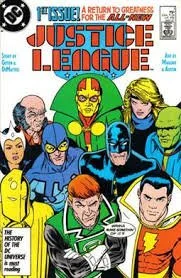
Not a Marvel comic
There is no shortage of humor in DeMatteis's work at Marvel in the 1980s; Moonshadow found an appealing balance between laughter and pathos, while his two "Greenberg the Vampire" stories were at least intended to be funny. Still, DeMatteis' early superhero comics were, like much of his solo writing to follow, intensely earnest. It is an earnestness that is, in itself, rather ironic, since so much of DeMatteis' output in these years involved playing in the sandbox of one of his idols, Steve Gerber. Not that Gerber himself was unaware of the importance of being earnest; his best work was evidence of heartfelt conviction. But Gerber's approach was always sharpened by world-weariness and an acerbic wit. Unlike Englehart's heroes, Gerber's characters were all but incapable of transcendence. DeMatteis was always intrigued by the possibility of redemption, for both the heroes and their antagonists.
While at Marvel, DeMatteis was simultaneously joining his more adventurous colleagues in pushing the boundaries of genre and form (with uses of silent panels and complex voiceovers reminiscent of Alan Moore) and demonstrating an ethos that was out of step with what would prove to be a harsh and cynical decade. DeMatteis was thoughtful, clever, creative, and funny, but he was also thoroughly and unapologetically uncool. To be cool requires at least an illusion of distance and indifference, qualities in which DeMatteis would occasionally show interest, but only for the purposes of doubling down on the important of sincerity and heartfelt spirituality.
DeMatteis's time at Marvel included a four-year run on Marvel's most earnest hero, Captain America. It was not a match made in heaven; while DeMatteis added a number of enduring characters to the Captain's mythos (particularly by extending the backstory and family relationships of his archenemy, the Red Skull), a cursory Google search for the best Captain America storylines or collections rarely includes the DeMatteis era. The character needs some sort of edge or foil to rescue him from flag-waving self-seriousness, and DeMatteis never quite found it. [2]
This chapter will instead focus on the Marvel comics that were a better fit for DeMatteis's sensibilities. Within the Marvel universe, that means primarily his run on The Defenders, along with ancillary titles that shared some of the series characters (The Gargoyle, Marvel Team-Up), as well as the aforementioned Kraven's Lost Hunt. We will also examine his work for Marvel's Epic imprint, consisting of the miniseries Blood and, most important, Moonshadow. His superhero output during these years constitutes DeMatteis' first published attempts at broaching the themes and character arcs that he would develop throughout his comics career (or at least in the comics that were not primarily intended as humor): guilt, redemption, and the search for enlightenment. While these themes are also present in Moonshadow, they take second place to DeMatteis' version of the Bildungsroman. These "Songs of Innocence and Experience" (DeMatteis specifically invokes Blake's poems at key points in the series) are also a key feature in DeMatteis' later comics, and are the perfect complement to his tales of guilt and redemption. Put a bit crudely, they represent two halves of the human/heroic lifecycle that the writer never tires of exploring: the move from childhood to maturity (innocence/experience) and enduring the weight of sin and regret (guilt and redemption). Ideally, the endpoint of each of these phases is the same: enlightenment, however ineffable, foolish, or temporary, whose value only increases as the hero recognizes how ephemeral true enlightenment actually is.
Next: A Night at the Opera