Chapter 2:
Back to Basics:
John Byrne and Walt Simonson
After Kirby
At the same time that Marvel was retrenching within corporate hierarchy and editorial-driven storytelling, there was a counter-trend: the rise of the writer/artist. The history of the medium in North America is, of course, filled with writer/artists: Will Eisner and Carl Barks, certainly, and, starting in the late 1970s, Dave Sim, Wendy Pini, and Howard Chaykin, with many more to follow. But the writer/artist was a rarity at DC and Marvel. After years of (at the very least) co-writing Fantastic Four with Stan-Lee, Jack Kirby finally got the chance to write his own material in the 1970s, first at DC (the Fourth World family of titles, The Demon, Kamandi: Last Boy on Earth), then upon his return to Marvel (The Eternals). But these titles, many of which are considered classics and huge contributions to the mythologies of both companies, are easy to admire for their art, imagination, and audacious scope, but harder to love for their actual writing. When they collaborated, Kirby may often have been the driving force on the plot, but Lee wrote the text that appeared on the page. Delivering a believable and comprehensible script was a special challenge for Kirby, whose genius as a penciler was not matched by a way with words.
Three men made their mark at Marvel as writer/artists in the 1980s: John Byrne, Walt Simonson, and Frank Miller. Miller's work is the subject of the next chapter; this one will focus on Byrne and Simonson. But all three of them had made names for themselves as artists before adding (solo) writer to their credit; Simonson had been working on a sole-authored graphic novel since the 1970s (The Starslammers), but most of his mainstream work did not give him a writing credit. Byrne, too, had long been a popular artist before taking on Fantastic Four, but his run on X-Men was a true collaboration, with Byrne and Claremont both working on (and fighting over) the plot, and Byrne credited as a co-writer. Miller's leap from artist to writer/artist was much quicker: he was only beginning to develop a following on the poorly-selling, bimonthly Daredevil (scripted by Roger McKenzie) before taking over the writing reigns after barely a year on the title. Though Miller would go on to provide art for other writers (most famously his collaboration with Claremont on the first Wolverine miniseries), his reputation in the industry really begins with the first book that he wrote and drew.
Simonson was born in 1946, and Byrne in 1950. The comics of the 1960s (including the Lee & Kirby Thor and Fantastic Four) would have been part of their formative reading experiences. Their artistic careers began in the 1970s, with Kirby's influence evident in their line work. Simonson had already drawn Thor a few years earlier (when Len Wein was writing the book), while Byrne handled the art chores on Fantastic Four when Marv Wolfman was the writer in 1979 and 1980, and had even written and drawn a two-issue story for issues 220 and 221, less than a year before he took over the series. No one could ever call them newcomers to their respective titles.
Byrne's first issue as the regular writer/artist/colorist of Fantastic Four (232, July 1981) was entitled "Back to the Basics,!" an upfront declaration of intent that, to a lesser extent, also held true for Simonson's run on Thor. Both Thor and the Fantastic Four were beloved characters who were central to Marvel universe, but had seen better days. I have been quite clear about my admiration for some of Marvel's 1970s output, but there is a reason that neither of these series played a significant role in my previous book. The general critical consensus is that each comic suffered greatly when Lee and Kirby moved on. Kirby departed Fantastic Four after issue 102 ("The Strength of the Sub-Mariner," with inks by Joe Sinnott, September 1970) and Lee followed two years later after issue 125 ("The Monsters Secret!" by Lee, John Buscema, and Sinnott). Kirby left Thor after issue 179 ("No More the Thunder God!", by Lee, Kirby, Colletta, and John Verpoorten, August 1970), and Lee stayed on through issue 192 ("Conflagration!" by Lee, Buscema, and Sam Grainger, September 1971).
This is not to say that there weren't good Fantastic Four or Thor stories after Lee and Kirby went their separate ways. I would happily make the case for Roy Thomas' Fantastic Four 1975-1977 collaboration with a young George Pérez, or for Thomas's tenure on Thor from 1978 through 1980, a storyline completed by Mark Gruenwald and Ralph Macchio. In each case, Thomas and his artistic collaborators were engaged in the expansion of each series' mythos. Thomas brought an intriguing "mix and match" approach to the FF, combining familiar tropes and characters such as the Negative Zone and Galactus with Counter-Earth and the High Evolutionary, while also expanding the FF's supporting cast (bringing back Thundra and Medusa, but adding Luke Cage, Tigra, Frankie Raye, and the occasional talking gorilla). On Thor, Thomas simultaneously doubled down on Norse mythology (the admittedly-tired Ragnarok, but also Wagner's Ring cycle) and incorporated Kirby's Eternals, whose 19-issue series had unfolded outside of Marvel's main continuity. The result seemed to draw a line under the Lee and Kirby Thor (and the Seventies stories that followed), reimagining the Thor mythos and putting an end to two decades of Thor tropes and stories. By the time the dust had settled, Ragnarok appeared to be off the table, and such old standbys as the Odinsword and the Destroyer were gone.
Yet the comics that immediately followed Thomas's run on each title were not particularly inspired, while the issues of each series that came out between the Lee/Kirby era and Thomas's stories were, on the whole, forgettable. In Fantastic Four, the only element of 70s storytelling to really stick was Franklin Richard's superpowers (established by Thomas in an earlier run). They were key to one plotline that still resonates to this day: when they threatened to destroy the world, Reed shut down his son's mind, leading Sue to file for divorce. Both Franklin and his parents' marriage got better, but the boy's volatile powers and Reed and Sue's occasionally volatile marriage became perennial features thereafter. Thor, on the other hand, was trapped in a set of unproductive narrative loops as the book changed hands from creative team to creative team: Ragnarok, Odin dies or disappears, and Thor's loyalties are torn between Earth and Asgard. An otherwise pedestrian storyline by Len Wein, John Buscema and Joe Sinnott introduced the Time Twisters and the Time Keepers, characters who seemed destined for oblivion once the plot was over (they were literally erased from existence). But Gruenwald brought them back in What If? and they eventually played a key role in the hit Marvel streaming series Loki. On the whole, however, the Seventies were not kind to our heroes.
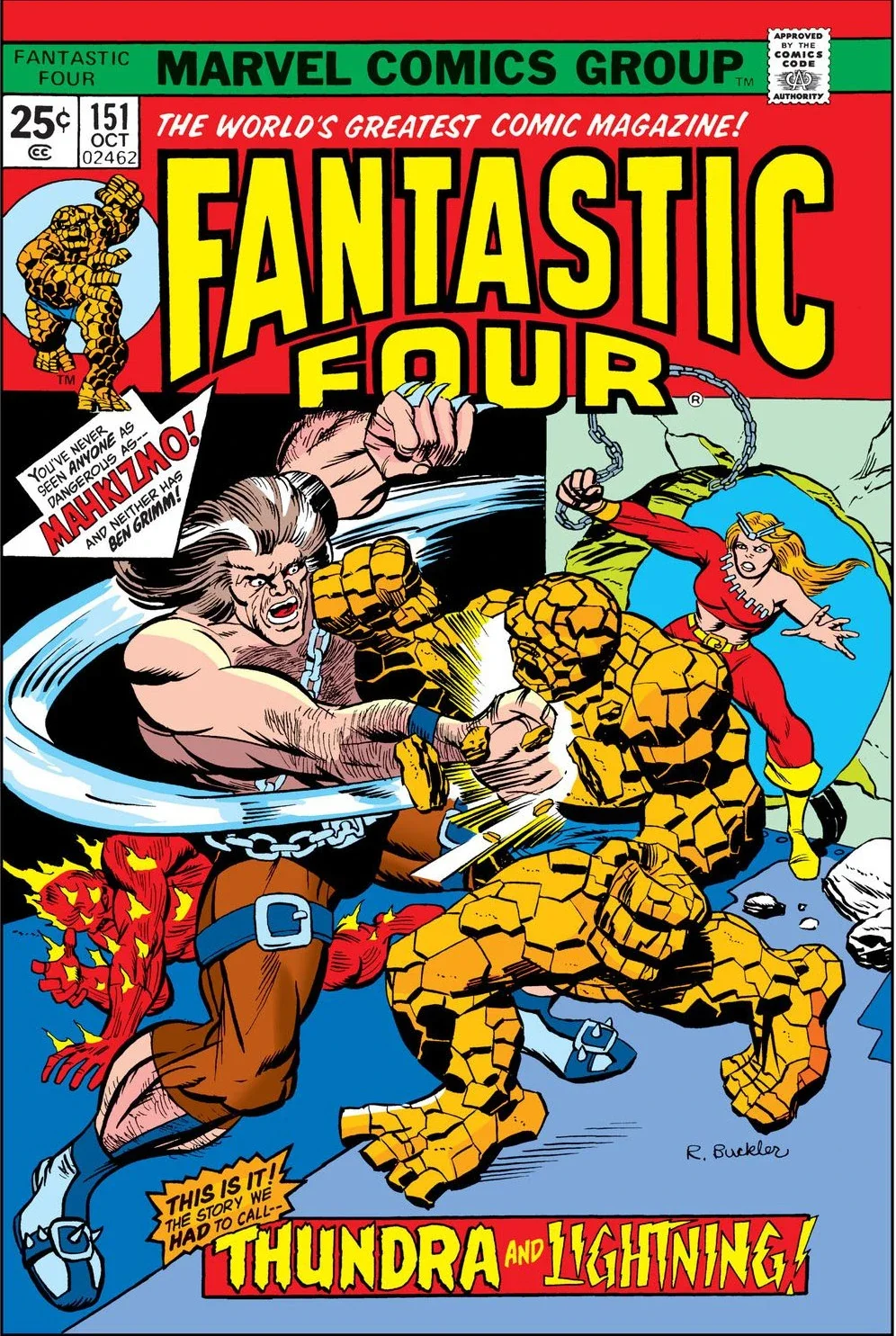
Don’t expect to see this in the next Fantastic Four movie
Half a century later, it takes an effort to realize the seismic shift caused by Kirby's departure and Lee's retreat from writing. With Steve Ditko long gone, what would happen without the people responsible for making Marvel what it was? When given the opportunity to rethink Fantastic Four and Thor, both Byrne and Simonson decided to jettison the ballast of their Seventies adventures and go back to the source. This did not, however, mean simply aping Lee and Kirby (although Byrne at times comes closer to that than Simonson); that would be a losing strategy based on a failure to recognize that the medium, industry, and readership had changed since then (although this would be precisely the approach taken by Tom DeFalco and Ron Frenz when they succeeded Simonson on Thor, inaugurating a new era of intense mediocrity). Instead, Byrne and Simonson's comics were a rethinking of the Lee & Kirby era, borrowing what they found most appealing in the older comics while bringing a more current sensibility.
Next: Revival of the Fittest