John Byrne and the Fantastic Four were made for each other. Or perhaps John Byrne was made by reading Fantastic Four when he was younger. After his years-long collaboration with Claremont produced a comics run almost universally considered a classic, Byrne was tired of arguing with the writer over the book's direction and ready to strike out on his own. Certainly, no one could doubt his facility with superhero team books, and Fantastic Four was long overdue for a fresh approach.
But just how fresh was Byrne's approach? In the decades since completing his tenure on Fantastic Four, Byrne has written and drawn a number of comics that allow us to rethink the apparent primacy of nostalgia in his years on the series. Byrne makes no secret of his love for the comics of his youth (and even the comics before that), but this is neither unique to Byrne nor an automatic strike against him. Roy Thomas is the king of productive superhero nostalgia; his return to the World War II-era Justice Society and their superpowered offspring was the best thing anyone had done with the Golden Age characters since the Golden Age ended. True, some of Byrne's recent work seems to be nostalgia for nostalgia's sake; he has spent years writing and drawing Elswehen, his vision of what would have (or should have) happened to the X-Men after he left the title. Claremont has done similar projects, but Byrne's is a labor of love. Released in single-page black-and white installment on his website, Elsewhen was essentially unpaid fan fiction that happened to be produced by one of the X-Men's most popular creators before Marvel finally decided to publish it.
But Byrne's true passion is for a nostalgia that manages to look forward even as it looks back. This explains his fondness for time travel stories. His creator-owned Next Men franchise is not exactly an exercise in fannish nostalgia, since none of these characters existed before he introduced them, but the entire saga is predicated on the contrast between the virtual reality in which his characters had been raised, the much less appealing "real world" in which they find themselves, a terrible dystopian future, and the time paradox that structures their very existence. His twelve-issue Lost Generation series at Marvel reinvents forgotten Golden Age characters while adding several of Byrne's own, again as part of a time paradox that involves the future (our present) as much as it does the past. The clearest expression of Byrne's combination of past comics glory with a future timeline that still manages to seem retro is his three sets of "Generations" comics about Superman, Batman, and their eventual descendants. The first miniseries lets Byrne play in the Golden Age sandbox, setting up the conceit that all of the characters (except Superman) age in real time. Byrne can revisit familiar DC eras with a twist (some of the stores are about the next generation of heroes), at the same time chronicling the far-future adventures of both a series of next-gen Batman and Supermen while also continuing to follow the original World's Finest heroes who conveniently turn out to be functionally immortal. Byrne uses the simplicity of the Golden Age and the goofiness of the Silver Age to imagine a future DC universe that looks a lot like its past.
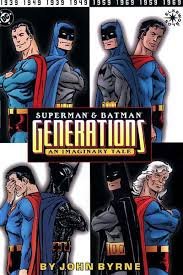
Superman’s facepalm is a classic
Long before any of these stories, Byrne's Fantastic Four is guided by a similar principle. In this case, the forward-looking potential of nostalgia is less immediately clear. The futuristic and time travel elements are absent from his early stories, and it is quite likely that, unlike in the Superman/Batman Generations stories, this was not part of Byrne's initial plan. More important, Fantastic Four was a monthly comic that Byrne wrote and drew for five years (not including The Thing spin-off comic that he wrote for three of those years)--this is Byrne's longest continuous run on any title in his entire career. It was also the longest such run on Fantastic Four since the nine-year-long Lee/Kirby era that launched the title.
Byrne's Fantastic Four initially landed in a liminal space between homage and inspiration, with the Lee/Kirby influence so pronounced that it could have signaled a limited imagination. Indeed, Byrne's years on the comic parallel the course of the first few dozen Fantastic Four stories from the 1960s: one-and-done stories eventually gave way to longer storylines and more complicated narrative arcs. Yet for all that the Lee/Kirby stamp was evident everywhere, Byrne's Fantastic Four was not the equivalent of Gus Van Sant's frame-by-frame reshoot of Alfred Hitchcock's Psycho. Byrne spent his first year on the book happily recapitulating the Lee/Kirby formula in order to isolate the elements that could still work for the 1980s. He had to look backward before he could look forward.
Next: Basic Training