Which brings us back to "Back to the Basics!" (Issue 232, with inks by Bjorn Heyn (an anagram for John Byrne, July 1981). Of all the enemies he could have pitted against the Fantastic Four, Byrne chose Diablo, a gaudy, mustachioed alchemist who is only slightly easier to take seriously than Stilt Man or King Tut. Nor does it seem as if Byrne needs us to pretend that Diablo is in the big leagues; the first two pages of the issue are devoted to the sort of melodramatic monologue that would make Syndrome from The Incredibles blush. The fact that his soliloquy is interrupted by his cranky landlady only adds to the campiness (not to mention that Diablo hides under the name "Mr. Olbaid").
But Diablo suits Byrne's needs perfectly, because he allows the issue to function as a showcase for Byrne's version of the team. Why else would the splash page consist simply of Diablo hovering over what looks like a birthday cake with Fantastic Four ornaments on top? ("Soon I shall destroy them as easily as I have conjured their images!") There is no immediate motivation for Diablo's attack, nor any sense of his personality beyond his obvious evil and his sense of endless grievance. Diablo is a fitting antagonist because his magic power is the same as Byrne's: he can reduce complex compounds to their fundamental elements.
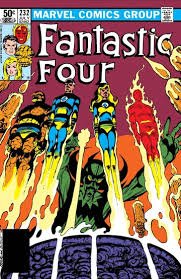
Order your Fantastic-Four-themed birthday party package now!
Diablo's plan of attack is "basic" in every sense of the word: he sends manifestations of the Four Elements to fight the FF. This, in turn, makes literal what was already a fairly common interpretation of the team's powers as based on these same elements. The Human Torch is, of course, fire, the Invisible Woman is air, the Thing is earth, and the flexible Mr. Fantastic is water. Subsequent alternate universe version of the Fantastic Four will state this quite plainly (1602, Ultimate Fantastic Four), but Byrne is the first to turn this particular fan reading into plot. The Four Elements are part of Byrne's mission statement, isolating the defining features of each member of the foursome as a machine for storytelling.
The actual battle unfolds like a lesson in Superhero 101: when each member of the team is attacked individually, they are outmatched: the Thing can't punch his way out of water, Sue is overpowered by a super-strong golem, Johnny can't beat the air elemental, and Reed is nearly burnt to a crisp by a being made of fire. Naturally, the solution is what it always is in a team book: they switch opponents. Usually, this tactic works when a hero is initially matched against someone with similar powers, but in "Back to the Basics!" they key is to have them match their counterparts head on. This becomes part of Byrne's implicit Fantastic Four manifesto, in that each member of the FF wins through the application of their own power, defeating an entity that shares their strengths. In triumphing over the essence of fire, for example, Johnny reaffirms his own elemental power as the human embodiment of flame (i.e., the Human Torch). Byrne truly brings the comic "Back to the Basics" by reasserting the basic principle of each of the four characters.
In doing so, Byrne also begins the process of redefining Susan Storm by exploring the implications of her powers. Lee and Kirby had made sure that using her force fields weakened Sue; again and again, pressure on her fields made her faint into Reed's arms. Now Sue keeps her costume invisible under her clothes and starts to use her powers more creatively, forming them into different shapes for combat, defense, and even mobility. Just a few years later (but while Byrne was still on the book), Sue would be tearing apart Dr. Doom's ship with her force fields, leading Doom to declare that the Invisible Girl was actually the most powerful member of the Fantastic Four.
It all starts, however, with giving her a new haircut. Not the most momentous change, of course, but Sue had been locked into the same 60s hairstyle that Kirby gave most of his female characters. More to the point, the hair salon scene goes a long way towards giving Sue some much needed sharp edges:
Milo: Suzie, baby, this new cut is gonna make you look twenty years younger!
Sue: Wonderful, Milo. I'm sure my husband will love being married to a child.
Milo: Aren't we just too cutting today! Here, let me comb it out and you'll see for yourself.
Sue: Isn't the Veronica Lake look a trifle passé, Milo?
Apparently not, since Sue will be wearing that look for the next few years. And unlike with just about any other female comics character, there is something amusing about starting out with the physical appearance of a hero who goes by the name "Invisible Girl."
There is something else going on in these early pages, which consist of four different scenes reintroducing the protagonists in their private lives before the elementals' attack pushes them into hero mode. Not only does "Back to the Basics!" serve as an easy introduction for new readers, it also starts out as a scene-by-scene analogue of the series' very first issue. After a brief panel with Reed Richards in the Shadows, Lee and Kirby show the Invisible Girl having tea with a friend, and then going invisible when she sees the Fantastic Four flare calling her into action. Next comes The Thing, then Johnny, and then Reed, the same order Byrne uses in "Back to the Basics!" Even the rather vanilla elementals recall the generic monsters the team fights in the first issue after the recap of their origin. Fantastic Four 232 is so retro that it is almost daring, even as the occasional character beats (the casual leveling up of Sue's power set and personality, Ben's resigned heroism when he gives the scuba tank that had been keeping him alive to a woman who needs it more) suggest that the series might be doing more than looking to the past.
Next: Ego Psychology