In his first year on the book, Byrne navigates between nostalgia and forward momentum while keeping within the structural framework of the first Lee/Kirby year: no sagas or even trilogies, but stories that unfold over the course of a single issue (with developing subplots, of course). Even the plot that spans issues 234 and 235 has a hard reset at the end of the first part, effectively turning each issue into its own almost freestanding story. Byrne's first year is one of discovery and revelation: showing the readers who the Fantastic Four are, delving a bit deeper into each of them, and extending the theme of self-discovery to ancillary characters and villains.
How fitting, then, that the antagonist in the aforementioned two-parter is a longstanding Marvel character whose name is actually "Ego." Ego the Living Planet is one of Lee & Kirby's goofiest enduring creations: a sentient biosphere who makes his identity clear by manifesting the face of an old, bearded man across on entire facet of his planetary surface. Hanging in space like a cosmic Christmas tree ornament, Ego is difficult to take seriously (which is why the version of him featured in the movie Guardians of the Galaxy Vol. 2 is a humanoid extension of this planet-wide intelligence, played by Kurt Russell), but Byrne manages it by leaning into the spectacular Kirbyness of his design in the second part, and in the first by showing only the catastrophic effects of Ego's proximity to Earth, saving Ego himself for the final page.
The title of issue 235 is "Four against Ego!" (October 1981), both a straightforward description of the conflict and a comment on the Fantastic Four's team dynamics. It begins with the Thing carrying part of a propulsion unit deep within Ego's core. He is alone because, as they marched deeper into the planet, each of the other team members succumbed to the mounting heat and pressure: first Reed, then Sue, then Johnny. Of the three, only Sue resisted the inevitable, but ultimately, Ben would have to travel alone. Where Ego is a giant living organism that tries to consume any interlopers who land on him, the Fantastic Four our a cohesive unit composed of four very different, very individual parts who are capable of both acting together and, when necessary, acting alone on behalf of the group. Their strength is in their ability to be independent, but also to check their egos when necessary for the task.
"Four against Ego" is part of a diptych with the previous issue, "The Man with the Power!" (234, September 1981), in which the FF are relegated to secondary characters. Just as "Back to the Basics!" followed the very first issue of Fantastic Four by combining superheroics with the generic monster stories Lee and Kirby had been doing for years, "The Man with the Power" is a throwback to the self-contained science fiction stories Lee had produced with Steve Ditko. It would be hard to seem more ordinary than middle-aged Skip Collins, but thanks to his involuntary participation in an atomic bomb experiment while in the army (nuclear power being the inciting cause of all manner of sci-fi hijinks in the comics of the 1950s and 1960s), he is the "man with the power" indicated by the issue's title. All he has to do is wish for something, and in nearly all cases, it happens. His messy house is suddenly clean, he gets out of a traffic jam by wishing he had left a half an hour early, and gets around a locked door by wishing he had left it unlocked. But all of this happens without any awareness on his part--he is all power and no ego. When Ego nearly destroys the world, it is his desperate wish for things to go back the way they were before that completely resets the timeline (at least locally). HIs powers conveniently burned out in the process, Skip will never know the role he played in saving the planet. Neither will the FF, in that Byrne never reconciles their memories with the untouched cityscape that awaits them, but this is a minor detail. In two linked issues, Byrne has resurrected both a goofy Silver Age cosmic threat and the humanism that characterized the comics of the 1960s.
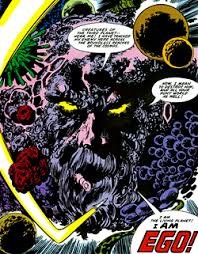
Dude, you’re. a planet with a beard. Have some shame
This two-parter was also a preview of things to come. Byrne clearly has a soft spot for the many Silver Age Marvel and DC stories that I call "drive-by sci-fi:" an alien or hidden civilization is discovered or revealed, the heroes' interactions with them range from conflict to misunderstanding to cooperation, and some sort of ironic twist rounds out a story of an alien encounter that is given no more than a single issue to develop. This is the template for most of the issues that the FF spend in the negative zone (Issues 251-256, February-July 1983), meeting unremarkable and interchangeable aliens one month after another. It is the pattern followed by "The Eyes Have It!" (issue 237, December 1981), when a spindly giant woman they nickname "Spinerette" turns out to be a misunderstood alien trying to find her way off the planet, and in Fantastic Four Annual 17 ("Legacy, September 1983),when the team is attacked by the inhabitants of a small town who have been mutated by drinking Skrull milk (again, don't ask). But as time goes on, Byrne starts to prefer somewhat longer arcs, placing greater emphasis on the character growth than he had already begun early in his run. In particular, he is takes great care to flash out the personality of Susan Richards, explore the ramifications of Franklin's powers, move Ben and Alicia out of their decades-long rut, and redefine the role of Galactus in the Marvel Universe.
Next: Family Ties