Considering Byrne's reverence for the Fantastic Four's roots, ending Ben's and Alicia's relationship was a surprising move. He threw a wrench into things early on; thanks to some complicated (and temporary) sci-fi shenanigans, a no-longer-blind Alicia finally sees Ben as the Thing with her own eyes. She tells him what should be obvious to anyone who has been paying attention: if she has been able to sculpt perfect replicas of the Thing all these years, she already knows what he looks like. But rather than calm his doubts, this revelation only exacerbates them: now (in yet another call-back to a forgotten early phase of FF history), Ben is convinced that she loves him only because he is the Thing. What at first looks like an uninteresting twist on a familiar dynamic (Ben is still hesitant to commit to Alicia, but now for the opposite reason), turns out to reveal not only a basic flaw in their relationship, but also to explain why Reed's many attempts to cure Ben have never worked. Subconsciously, Ben will not let them work, because he believes he will lose Alicia. Even this twist allows Byrne to indulge in still more nostalgia: when Reed tries to cure Ben, he reverts to the lump form he had during the series' first few issues.
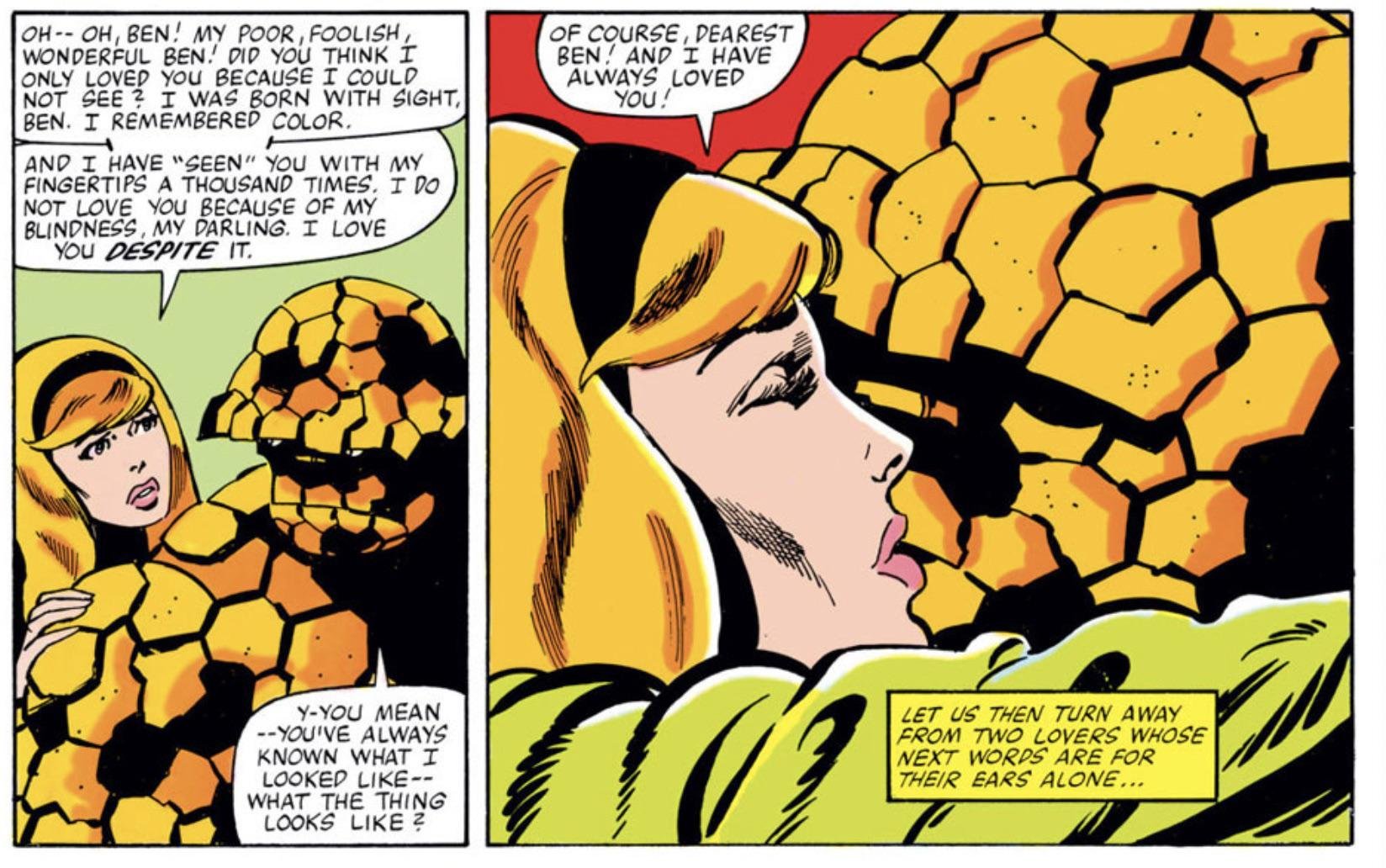
Well, duh
These plot developments are emblematic of Byrne's approach: he goes back to the comic's past in order to move the series forward in unanticipated ways. in the aftermath of the Secret Wars crossover, Alicia discovers that Ben has chosen to stay on the "Battleworld" created by the all-powerful Beyonder. Later we learn that Ben has discovered that he has always had the ability to change forms at will, but that his love for Alicia had kept him back. Not only does this end their relationship and change Ben's status quo, but it paves the way for She-Hulk to become part of the team for an extended run (and to remain within the FF's orbit to this day). Even more shocking is the budding romance between Alicia and Johnny, a controversial development that will eventually be undone by the unlikely, post-Byrne revelation that the Alicia with whom Johnny fell in love was actually a shape-shifting Skrull who replaced her while the FF was on Battleworld.
Ben's departure and the arrival of She-Hulk let Byrne reconsider the notion of the team as a family. He is putting his own spin on yet another classic FF trope, the replacement of one of the team with an outsider. Lee & Kirby had the Inhuman Crystal (and Johnny's then-girlfriend) step in for Sue during her pregnancy and Franklin's babyhood; later writers would bring Thundra, Tigra, and Luke Cage into the mix (with Luke also replacing Ben after a transformation left him temporarily powerless). She-Hulk cannot help but be aware that she is not a member of the family, but the fact that she has replaced Ben, the only person on the team who is not related to the rest by blood or marriage, is a reminder that, for the FF, family can be a matter of elective affinity.
Byrne boldly takes on the challenges and rewards of a book that has placed so much emphasis on the characters' status as a family. Lee and Kirby had done something close to unprecedented with Sue's pregnancy, permanently changing the status quo while also anchoring the book in biological time once Franklin was born. Franklin was always a problem for the Fantastic Four (both the team and the book). Even his birth was only made possible by bringing a device from the Negative Zone that would allow both mother and child to survive labor. He then becomes a point of vulnerability for the heroic team (who must make sure he is not hurt in their battles) and a storytelling problem for the creative team. Franklin Richards was born in 1968, which would make him 57 in 2025. Obviously, none of Marvel's characters age in real time, but how long could Franklin remain a baby or a toddler, and what were his writers and artists to do with him?
Ever worse, Franklin was not just any child; he also happened to possess godlike, potentially world-destroying powers. As a result, Franklin could pivot on a dime from hostage to all-purpose plot device, neither of which held much storytelling promise thanks to overuse. Byrne' solution was a tour de force of plot efficiency: in just one issue, Franklin aged himself to adulthood, figured out why Ben couldn't be cured and reverted him to his more familiar Thing form, and turned himself back into a now powerless child. It was the boy's last hurrah as a Franklin ex machina (at least before the arrival of subsequent creative teams), and Byrne used it for all it was worth.
Byrne, in fact, used weakness and vulnerability to emphasize the team's familial nature more than anyone had since the Lee/Kirby era. Sue gets pregnant not long after Franklin becomes a normal child, leading the Richards to conclude that the Baxter Building might not be the safest place for their offspring. Once again, Byrne returns to familiar story beats, but with a twist: Ben worries that if Reed and Sue move out, it will be "the end of the Fantastic Four" (a phrase that had long since worn out its welcome from overuse), but Reed reassures him that they will just commute. And, once again, cosmic radiation (combined with their time in the Negative Zone, ironically the source of Sue's and Franklin's salvation when she gave birth the first time) renders her pregnancy high-risk. This time, however, things take a darker turn: what may be the first superhero miscarriage in mainstream comics. Byrne gives this event the space it needs, showing Sue's struggles to rebuild her life in the aftermath. Unfortunately, the story takes a bizarre, if familiar, turn
Next: With Malice Aforethought