Sue's miscarriage is a challenge to her defining characteristic in the Fantastic Four: she is, first and foremost, a mother. This is also the biggest weak spot in her characterization; when writers doesn't know what to do with Sue, they emphasize the maternal. Byrne had certainly done the same, going a far as having Sue defend her choice to prioritize motherhood and family during an interview with a thinly-veiled Barbara Walters. What could have been a relatively subtle exploration of loss degenerates into the first of three times Byrne replays the Dark Phoenix scenario during his Fantastic Four run. [1] Byrne runs Sue through many of the same paces as he and Claremont had set for Jean Grey: trauma, seduction, brainwashing, sinister wardrobe changes, and an evil new persona.
Jean's vulnerability was her vast capacity for love (Scott tells Dark Phoenix, "Jean, you are love!" ("Child of Light and Darkness!); her embrace of her dark side is also the story of a buttoned-up young WASP's acceptance of her own sexual power. Sue, of course, is Motherhood incarnate, and her descent into darkness is powered by maternal loss. Just two issues after her miscarriage, Sue is still trying to come to terms with her loss, with Byrne putting Sue's hair in a severe ponytail that accentuates her somber mood in every panel. Reed forbids Sue from joining them on a mission before she has "sufficiently recovered;" after the team leaves, Sue's fury at being sidelined grows, and she lashes out with her powers, destroying Reed's lab "Skyfall," Fantastic Four volume 1, 269, by Byrne, August 1984). She immediately regrets her loss of control, which had frightened Franklin and caused millions of dollars in damage ("Planet-Fall," Fantastic Four volume 1, 270, by Byrne, September 1984). In the next issue, she seems like her old self (even if her new, tragic mullet might suggest otherwise).
Sue's trauma is on the back burner until the (re)introduction of one of Marvel's most poorly-conceived villains: the Hate-Monger. In the past, the Hate-Monger (whose name accurately describes his shtick) has been revealed to be either a clone of Adolf Hitler or Hitler himself; on other occasions (as is the case here), he is someone temporarily assuming the identity in order to sow chaos. The problem with the Hate-Monger is the same as the problem with the Sons of the Serpent (Marvel's analogue for the KKK): like the Sons, he is used at first as a condemnation of racism, but is inevitably revealed to be a cynical manipulator exploiting racism for his own purposes. This scenario usually equates angry people of color with the racists who persecute them, sometimes even showing them to be allies.[2] As part of the legacy of Marvel's Sixties-era liberal humanism, this approach downplays racism by instrumentalizing it. Racism is never the real problem after all.
And it is certainly not the real problem when the Hate-Monger returns to the Fantastic Four. He is a a shape shifter who can easily switch from Aryan white supremacist to Angry Black Woman, all in the name of an agenda that has nothing to do with social injustice. In actuality, he is the pawn of Psycho-Man, an emotion-manipulative villain from the subatomic Microverse. Thus Psycho-Man, in addition to masterminding the race riots causing turmoil in New York, is playing Mastermind to Sue's Phoenix: taking advantage of her psychological vulnerabilities to turn her into a villain.
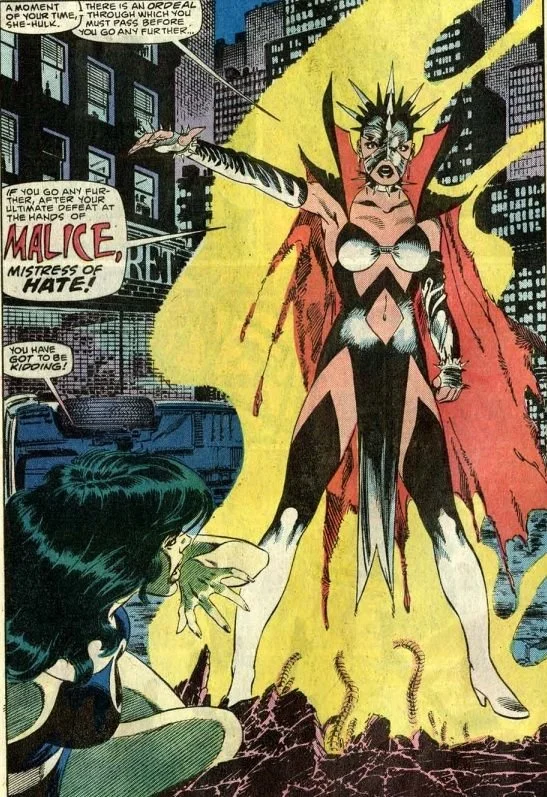
Now called Malice, Mistress of Hate, Sue wears a fetish outfit that even the Black Queen would have been too embarrassed to try on: a bikini paired with thigh-high, skin-tight boots, and a spiked dog collar matched with a spikey leather mask that made her look like an evil bondage cactus. The clever part of this transformation is what Byrne does not show: by leaving out the transparent lines typically used to depict Sue's force fields, he makes Malice's powers look mysterious and novel. It is strange that her teammates are fooled, since presumably they never saw these transparent lines in the first place, but, to be fair, Malice is using her powers more aggressively than Sue typically did (spikes were not just a fashion choice for her).
By this point, Byrne has done more than anyone before him to emphasize Sue's sheer power, yet he still falls back on embarrassing gender politics to resolve the plot. When Reed realizes Malice is actually his brainwashed wife, he cures her first by negging her ("Do you truly believe your pathetic force-fields are of any use against the Fantastic Four? /Please, don't make me laugh in your face, Susan. You'd have been killed outright years ago.../but for the rest of us carrying you," then by slapping her in the face ("Susan, I said shut up!"). Misogyny works like magic: Susan is free.

This from the smartest man on earth, mind you
But she is not exactly her old self. She wants revenge, and eventually gets it, turning Psycho-Man's own devices against the villain and inducing a mental breakdown. And she has come to an important conclusion:
I'm not [the same], not after all that's happened to us. Not after what the Psycho-Man did to me.
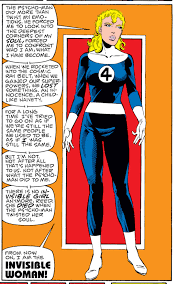
There is no Invisible Girl anymore, Reed. She died when the Psycho-Man twisted her soul.
From now on, I am the Invisible Woman! ("Revolution!", by Byrne and Al Gordon, Fantastic Four vol 1, 284, November, 1985).
Took you long enough
It has taken over forty years to give Susan Storm Richards a superhero name appropriate to her status an adult (as opposed to Peter Parker, who started calling himself "Spider-Man" while he was still a 16-year-old high school student). Jean Grey stopped being Marvel Girl thanks to death and resurrection, and in any case, her new superhero name sidestepped the question by dispensing with the need for an attestation of her gender or age (no one saw the need to call her "Phoenix Girl" or "Phoenix Woman"). Byrne himself had Sue dismiss the suggestion that she changer her name to Invisible Woman three years before, in the same issue when Franklin prematurely reached adulthood ("Childhood's End"). It is not enough that Sue was old enough to no longer be a girl, or that she was an adult, a wife, and a mother. Womanhood is not attained through achievement, marriage, or reproduction: only trauma justifies her new name. It is not exactly a shining moment in Byrne's tenure on Fantastic Four. This plotline began with a rare exploration of loss (Sue's miscarriage), but took a regrettable turn when it could only validate Sue's suffering by compounding it with the violation of her psychological integrity.
Note
[1] The second is a brief intrusion into the ongoing storyline, with the resurrection of Jean Grey and revelation that she was never the Phoenix to begin with; the third is "The Trial of Reed Richards" (discussed below).
[2] A particular low point: when Daredevil rescues a black woman from an attack by white supremacists, she responds by punching him in the jaw: "Don' touch me! I don't want no jive honky touchin' me!" ("With Malice Towards All!" Fantastic Four vol 1, 281, by Byrne and Jerry Ordway, August 1985).
Next: The Morality of the Status Quo