The advancements Byrne makes with the book's central characters (setting his aside his fumbling of Sue's trauma) stand in curious contrast with his much more conservative approach to the FF's villains. The standard critique of superhero comics for its insistence on maintaining the (capitalist, liberal democratic) status quo may apply here, but with a twist: Byrne's Fantastic Four is a sustained argument against interventionism and in favor of allowing the antagonists a great deal of leeway to act in defiance of conventional moral norms. Byrne redefines the tyranny of Doctor Doom and the serial genocides of Galactus as situations best left alone.
In the 200th issue of Fantastic Four, Dr. Doom's suffered a defeat worse than any he had borne before: not only do Reed and the team foil his plans, but they inadvertently drive Doom insane and allow the Latverian rebel opposition to come to power. Freed from Doom, Latveria was now to become a democracy. Byrne would not stand for this, but rather than simple show Doom reconquering his homeland (an even that longtime readers must have known was inevitable), he has Doom coerce the Fantastic Four into helping him return to power.
It was an intriguing plot twist, having the FF team up with their enemy to restore a dictator to power, and it is a choice that reads differently in the twenty-first century. When Marvel published "This Land Is Mine!" (Fantastic Four volume 1, 247, October 1982), it was still the height of the Cold War. The title may have felt like an autocratic rejoined to Wille Guthrie's "This Land is Your Land, This Land is My Land", or a bizarre echo of the theme to the 1960 film about the founding of the state of Israel ("This Land is mine, God gave this land to me"). Decades later, the failure of democracy in a post-Doom Latveria reads like a critique of American interventionist "regime change." Certainly, it's a novel approach to a political situation that had always been represented in a highly simplistic manner (Doom is a tyrant, his people need to be free). But it is also a moment that perfectly encapsulates both Byrne's tendency to leverage a novel development for the purposes of returning to the status quo as well as the artist's own role in the conflicts in the industry in which he worked.
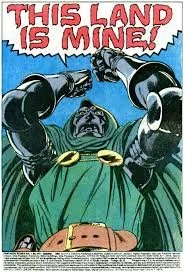
Not the best land acknowledgment, mind you
This was, after all, the height of Jim Shooter's reign as Editor-in-Chief, when the number of former Marvel creators complaining about his allegedly dictatorial management continued to grow. Shooter, we should recall from the Introduction, in his own writing tended to create godlike, autocratic antagonists whose intentions were too often misunderstood (Michael in The Avengers, and, in just a few years, the Beyonder in Secret Wars and Secret Wars II). Though Byrne would eventually leave Marvel for DC, as well as for creator-owned work, at the time Byrne was a staunch supporter of Shooter and of Marvel's policies. In the March, 1982 issue of Comics Scene (2:57), just a few months before "This Land Is Mine!" hit the stands, Byrne published an op-ed with a pull-quote that became notorious: "I am a cog in the machine which is Marvel Comics and I rejoice in that." [1]
The world of Byrne's Fantastic Four is one where things simply have to be the way they are. While retaining the basic structure of the superhero story (good guys vs. bad guys), Byrne sidesteps questions of politics, ethics, and morality simply by indicating that "it's complicated." This, even more than the repeated returns to the Lee/Kirby well, is the essence of Byrne's conservatism. Things can (and should) be changed when it comes to the characters lives: new haircuts and traumas for Sue, a bad breakup for Ben and Alicia, a new romance for Alicia and Johnny, while Reed...Reed is always just Reed. But when it comes to the larger problems, despite their status as adventurers and explorers their actions and hesitation recall the question that haunted J. Alfred Prufrock: "Do I dare disturb the universe?" More often than not, the answer is no.
Making the case for Dr. Doom's return to Latveria is not all that difficult, because Byrne stacks the deck. He presents a Latveria in decay, its citizens terrorized by the same oppressive mechanisms Doom himself had developed. They miss Doom, and love him; Doom will bring back prosperity and make Latveria great again. Making the case for Galactus will be much more complicated.
Next: Earth: It's What's for Dinner!
Note
[1] A year later, Steve Gerber and Jack Kirby would include a savage parody of Byrne in the fourth issue of Destroyer Duck, the comic they published with Eclipse to fund Gerber's lawsuit against Marvel over the rights to Howard the Duck. The Cogburns (who looked suspiciously like the Marvel artist) were facsimiles of a now-dead Godcorp employee, designed to work "under conditions a man with any real sense of self-worth would refuse to tolerate)." When a Cogburn dies, its spine tears free of its body and implants itself in another spineless facsimile. Each new Cogburn looks like and acts like the previous one: all macho bluster to compensate for its complete lack of genitalia (i.e., not just spineless, but also dickless).