No wonder that Spider-Man's first scene in "Fearful Symmetry" involves the death of a character so minor that readers could be forgiven for assuming he had never actually appeared in a comic before: the two-bit thug and informer Joseph Facello, whom DeMatteis had introduced five years before in an issue of Marvel Team-Up [1]. Even Spider-Man cannot initially understand with this man's death has moved him so, to the extent that his apparition will even haunt Peter later in the same issue. There is, however, one minor point about Joseph Facello: in this comic, he is only referred to by his nickname: Joe Face. "Fearful Symmetry" is haunted by Faces (named Joe or otherwise), faces that serve as screens for the protagonists's projections. Joe Face reminds Peter of his mortality, in a way that Peter connects with the recent death of his friend Ned Leeds (who at that point may or may not have also fought Spider-Man while wearing the mask of the Hobgoblin). [2] When Spider-Man first stares down the barrel of Kraven's gun, a four panel-sequence shows him in the first and third, Joe Face in the second, and Kraven in the fourth. They are framed by two sets of narrative boxes, the upper in red, the lower in yellow. The bottom row reads:
Yesterday, Ned Leeds
Today, Joe Face.
Tomorrow
Aunt May? Mary Jane?
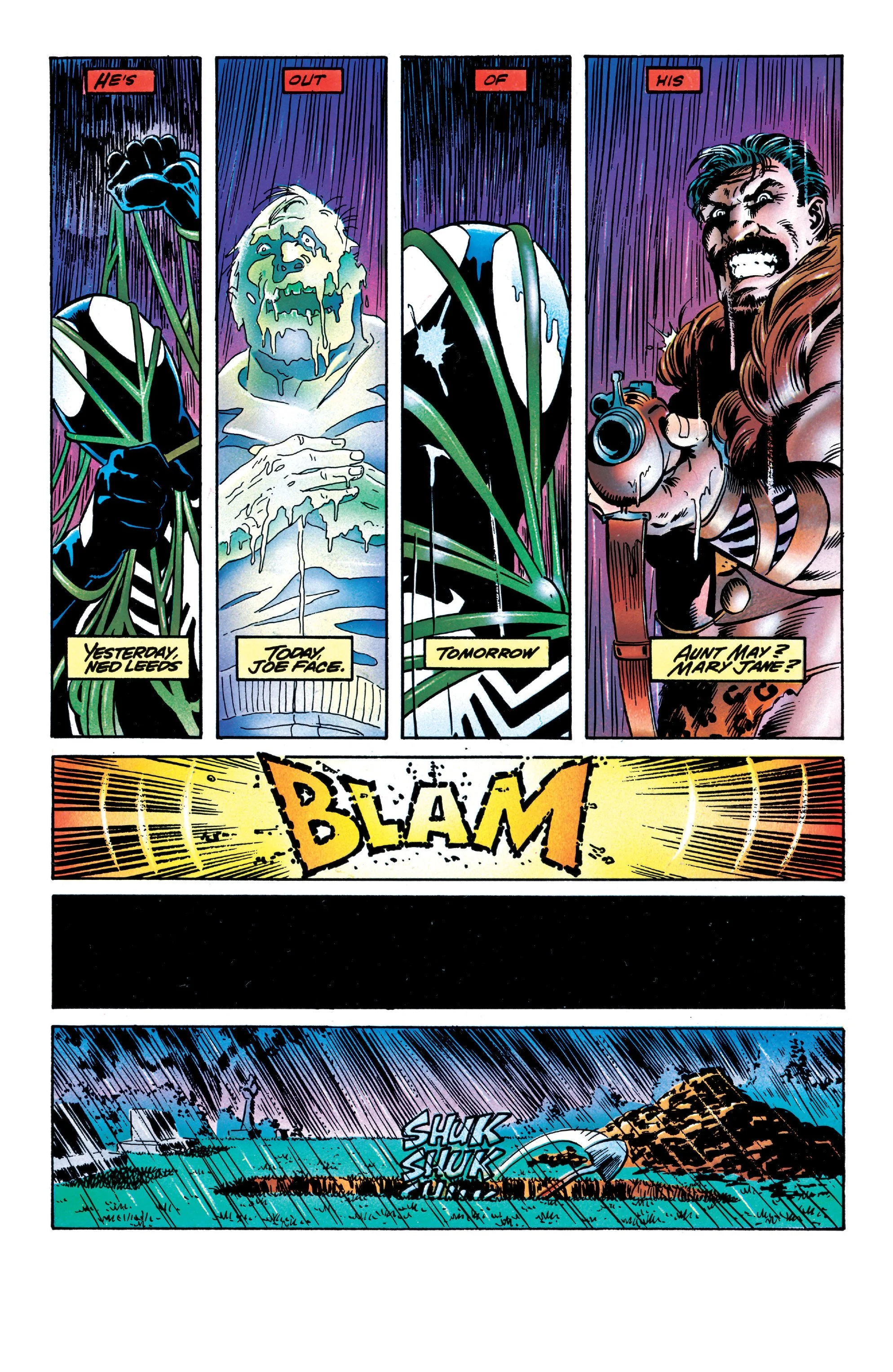
If it were not for the deaths of Joe and Ned, Spider-Man's confrontation with mortality in Fearful Symmetry would be entirely dependent on external factors (Kraven's hunt), but DeMatteis has primed Peter to brood about own death before he is even aware of Kraven's actions. Like his totemic reinterpretation of both Kraven and Spider-Man, DeMatteis's focus on death brings into focus something that has long been a fundamental feature of Spider-Man's world. Batman's origin may be rooted in the psychological trauma caused by witnessing his parents' murder, but for Spider-Man, the deaths and near deaths of his loved ones verge on a narrative repetition compulsion. The (off-panel) trauma of his own parents' deaths is repeated and compounded by his indirect culpability in the death of his beloved Uncle Ben and further deepened by the murder of his girlfriend, Gwen Stacy. Moreover, his Aunt May's almost monthly brushes with death heighten his tragic sense of object impermanence.
This preoccupation with death frames the story's "Fearful Symmetry" (well, that, and DeMatteis' embarrassing rewrite of William Blake's "The Tyger" as "Spyder Spyder, burning bright, in the forests of the night"). Peter fears it, Kraven welcomes it, and, in his role as the third element balancing the other two, Vermin hungrily makes and consumes the dead. Indeed, Kraven's obsession and psychic link with the "Spyder" is not only about death and rebirth (a favorite DeMatteis theme), but about body and soul, or rather, the body as corpse that once housed the soul (and may house it yet again). Corpses and spirits abound in "Kraven's Last Hunt:" in Joe's case, we see both; in Ned's and Uncle Ben's, the spirit (that always points back to the corpse), Peter's seemingly dead and buried body, and the actual corpse and burial of Kraven the Hunter.
The distribution of these bodies and souls is facilitated by the story's outstanding layouts, which slow the action down when necessary, often to focus on the bodies, and to reinforce the parallels among the three protagonists. Many of these panels are unusually vertical, in the service of the primary motif of "Kraven's Last Hunt": the continual movements below and above ground as the visual representation of death and rebirth. It all begins with Spider-Man's burial at the end of the first chapter. The second installment has Vermin dragging a victim into the sewers and climbing out on the last page. The third shows Kraven in Spider-Man's costume, leaping from high buildings, then fighting Vermin in the sewers and carrying him out. Peter's return is teased throughout both issue, with still shots of his grave and the occasional words "Mary Jane," until the fourth chapter, when Peter imagines himself inside a spider underground, then as his human self breaking out of the spider's carapace, climbing up a long tunnel and seeing Kraven shooting him in the face, until finally, Spider-Man himself, in full costume, breaks out of his grave.
Notes
[1] "Small Miracles (Marvel Team-Up 127, March 1983, with art by Kerry Gammill and Mike Esposito). This special Christmas story showcases DeMatteis at the height of his sentimentality, with the Watcher silently guiding Spider-Man to save the life of a young woman. The story actually ends with Uatu shedding a single tear of joy at this brief moment of fellowship with humanity.
[2] The Hobgoblin's true identity was a convoluted saga. Ultimately, Ned was posthumously revealed to have been one of the men who wore the villain's costume.
Next: One-Sided Symmetry