Only by the fifth chapter do we see that the "fearful symmetry" of the title extends to Kraven's shocking move at the end of the first: shooting Spider-Man in the face. Four chapter later, Kraven turns the gun on himself. Peter spends half the story fighting his way out of the grave; Kraven turns out to have spent the same time inexorably heading towards his own.
Attitudes towards suicide have changed dramatically in the intervening decades. Fears of social contagion have circumscribed its representation in recent years, out of concern that younger and more vulnerable audiences might copy a character's actions. Arguments about social contagion are particularly fraught for the comics industry, which was nearly destroyed by a 1950s moral panic about the effects of comics on at-risk youth. The research that helped inspire the panic (primarily Dr. Frederic Wertham's 1954 book Seduction of the Innocent) is highly suspect; not only did it not conform to standards of objective research, the very categories of deviancy with which Wertham operated are no longer recognized (most famously, he was concerned about superhero comics' somehow promoting homosexuality among its readers). While one cannot claim complete scholarly consensus about suicide contagion, the stakes are high enough that media producers now err on the side of caution. By the early twenty-first century, adding a notice about resources for those contemplating suicide is a commonplace practice.
Marvel did get letters accusing the company of encouraging suicide, which bothered DeMatteis enough for him to reunite with Zeck and revisit the Kraven story in the 1992 short graphic novel Soul of the Hunter (inks by Bob McLeod). Even if this did not violate the current study's time frame, I would be reluctant to include this book in an analysis of Kraven's Last Hunt. It represents a later rethinking of the story, abandoning the original's ambiguity about any supernatural elements. Here, Spider-Man is haunted by the ghost of Kraven, told by a mysterious entity that he has a "spiritual bond" with the now-dead villain, and ultimately moved to release Kraven's soul from limbo (even going as far as hugging it out with his ghost). [1] While Soul of the Hunter revisits many of its predecessors story beats and motifs, it completely surrenders to the sentimentality that DeMatteis managed to hold at bay in Kraven's Last Hunt. [2]
It is completely reasonable to postulate some sort of "spiritual bond" between Peter and Kraven, given the apparent echoes in their thoughts and delirious ravings at various points in the story. But leaving this connection ambiguous opened up Kraven's Last Hunt in a way that helps make sense of the Hunter's actions in the penultimate issue. Kraven, we should recall, was a bottom-of-the-barrel villain. If readers at the time were asked to name Spider-Man's archnemesis, they would surely have started with the Green Goblin and Doctor Octopus, moving through the Hobgoblin, the Scorpion, the Lizard, and the Shocker before remembering Kraven. Before DeMatteis brought him back, Kraven had fought Spider-Man only six times in twenty-three years of publication; Kraven's Last Hunt was such a breakthrough that the character has actually appeared more times after his death than he did before he killed himself (a sentence that only makes sense in superhero comics). DeMatteis introduces a Kraven who is absolutely obsessed with Spider-Man, and a Peter Parker for whom Kraven was always an afterthought.
DeMatteis conveys the simultaneous similarities and distance between their perspectives through a technique commonly associate with Watchmen: parallel narration from multiple sources. [3] In any given panel, we might see Kraven's, Spider-Man's, Vermin's, or Mary Jane's thoughts represented in their own caption boxes. Spider-Man's tend to be yellow, while Kraven's are orange (and in a different font). DeMatteis does not go as far with this as Moore; he does not have narrative lines whose connection to the images in the panel is thematic rather than diegetic. Rather, DeMatteis wants us to remain in his characters' heads whenever possible. Mary Jane's thoughts are about her search for Peter, and at times they make a nice counterpoint to the visuals; in the second issue, she frets about her missing husband while chasing after a rat she finds in her apartment. As she repeats to herself that Peter is not dead, she smashes the rat into a pulp with her boot. Vermin thinks about food, tries to remember his former life, and rallies enough courage to venture out of the sewers. Before his burial, Peter uses the captions to give voice to his anxieties; once he is underground and hallucinating, his narration grows more intense (and more like Kraven's). Kraven's narration is nearly always poetic, and, while still maintaining a connection to the action on the page, more abstract.
The intensity of Kraven's voice is so compelling that it is easy to forget how odd his obsession with Spider-Man actually is. Kraven's delusions are multiple, starting with his identification of Peter Parker with a primal spider totem that, at least at this point in Spider-Man's adventures, has never been in evidence. But he also has an inflated sense of his own importance. Given the infrequency of their encounters, it is as though Kraven were existing in another comics universe entirely, one in which he was recognized as Spider-Man's arch-nemesis. Kraven acts on his firm belief in their primal bond that is central to his head canon, and, at least for the duration of Fearful Symmetry, he makes his fan fiction real by tramping on the rules that usually govern a Spider-Man story. From Peter's perspective, he comes out of left field, ranting about things that make no sense, and, rather than monologue or set up a complicated death trap, simply shoots him and buries him.
When DeMatteis reintroduces Kraven in the opening pages of the first issue, it is with a full-page spread of a naked hunter staring at the reader. An arresting image, it is a perfect with Kraven's monologue, a poetic, self-aggrandizing and melancholy aria about Kraven himself. We learn of his intense self-regard, his disdain for the modern world, but, most of all, his fixation on Spider-Man:
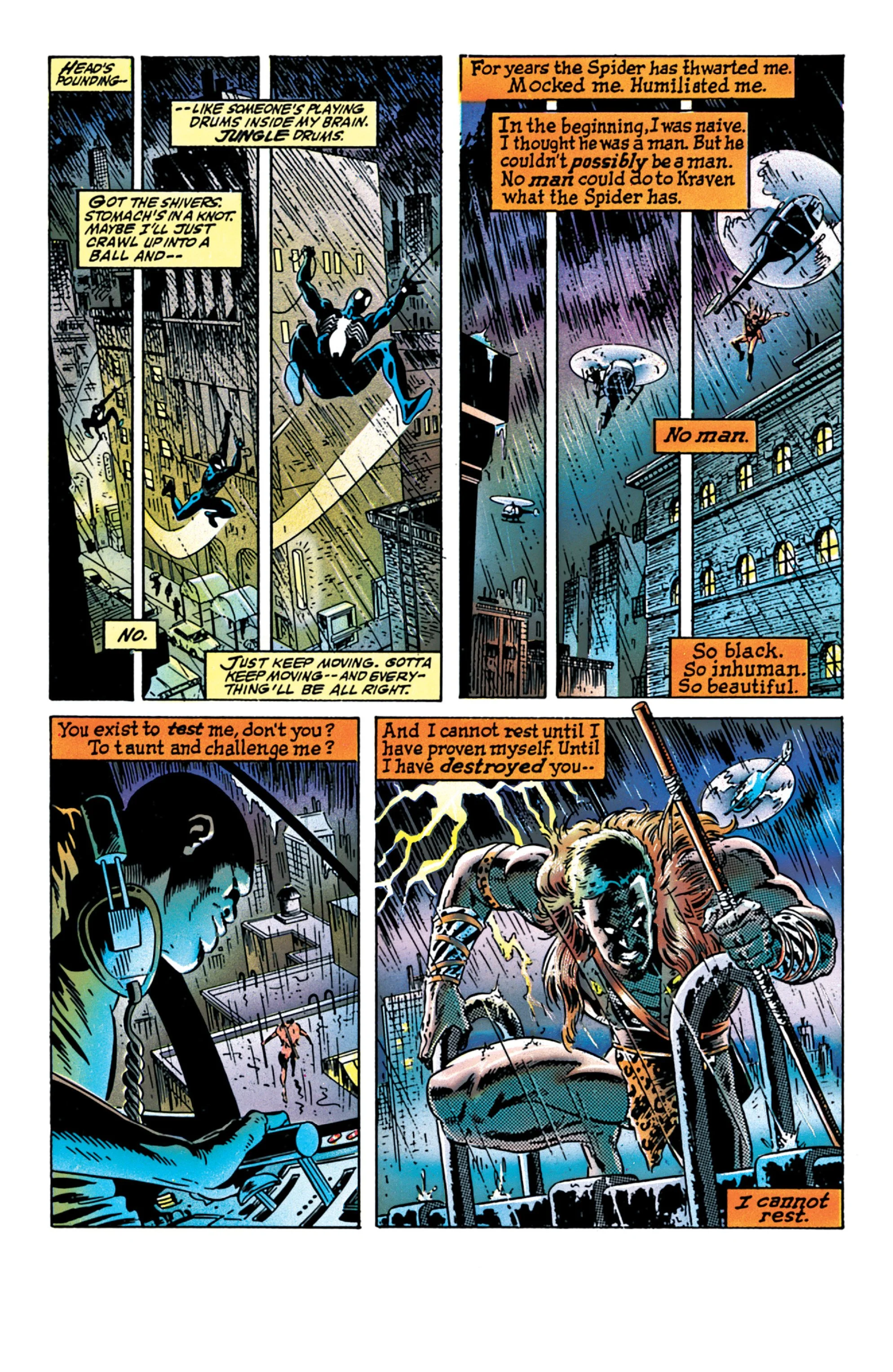
For years the Spider has thwarted me. Mocked me. Humiliated me.
In the beginning, I was naive. I thoguht he was a man. But he couldn't possibly be a man. No man could do to Kraven what the Spider has.
No Man.
So black. So inhuman. So beautiful.
You exist to test me, don't you? To taunt and challenge me?
And I cannot rest until I have proven myself. Until I have destroyed you---
I cannot rest.
In other words, his focus on Spider-Man is a function of his unassailable belief in his own importance. He attributes a supernatural significance to his opponent based entirely on the otherwise incomprehensible fact of Kraven's repeated defeats (No man could do to Kraven what the Spider has). Even the font used for his narration reinforces Kraven's sense of drama; using lower case-lettering years before Ultimate Marvel would make this a standard, the font reveals the capitalization of "Spider" that would otherwise be invisible. Hopped up on a cocktail of herbs and drugs, Kraven launches into the what may be the worst abuse of William Blake's poetry of the last half-century ("Spyder! Spyder! /Burning bright/In the forest of the night").
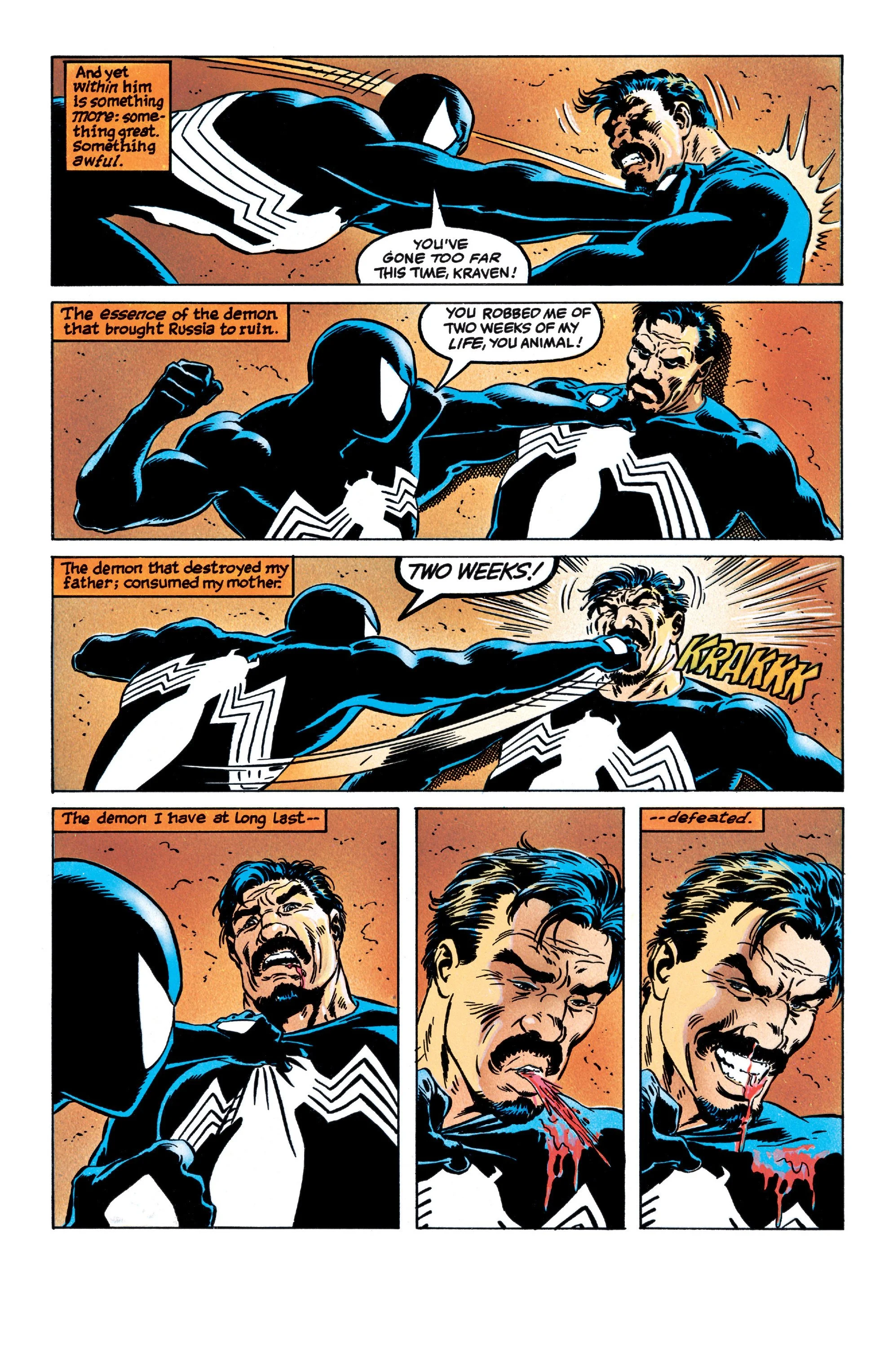
Even with such stylistic excesses, living inside Kraven's consciousness is one of the highlights of the comic. And, despite the momentary overlaps of their hallucinatory visions, this is an experience that is never really available to Peter--only to the readers. The fifth chapter, which features the extended, final struggle between Kraven and Spider-Man followed by Kraven's suicide, is a masterclass in miscommunication. Spider-Man had been ambushed in the first chapter by a man he didn't even know he was fighting; four issues later, he pummels Kraven with his fists, but the Hunter offers no resistance. Peter is in no position to realize that, as far as Kraven is concerned, the fight is over. The two of them are talking and acting at cross-purposes, to an extent of which only Kraven is aware. Spider-Man attacks an enemy wearing his costume, not realizing that his real function is to punctuate and interrupt Kraven's ongoing internal monologue. The issue begins with Kraven's oft-repeated, bitter declaration "They said my mother was insane" (in keeping with the story's emphasis on symmetry, this will also be the issue's last line). His mother, we are told, was a noble women driven out of Russia by the Revolution, worn down by America's vulgarity:
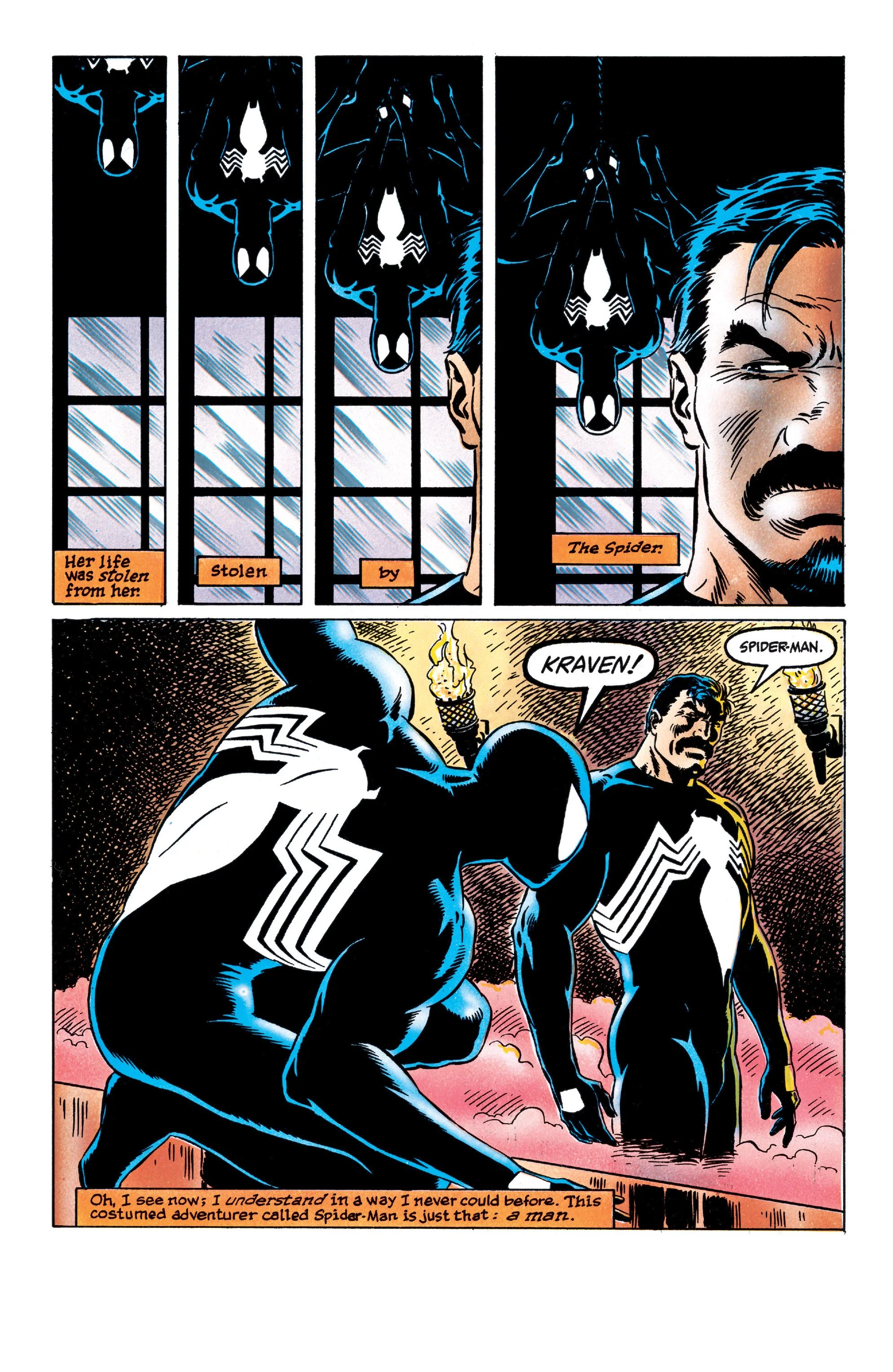
"Her life was stolen from her.
Stolen
by
The Spider.
Oh, I see now: I understand in a way that I never could before. This costumed adventurer called Spider-Man is just that: a man.
And yet within him is something more: something great, something awful.
The essence of the demon that brought Russia to ruin.
The demon that destroyed my father; consumed my mother.
The demon I have at long last---
--defeated."
Again, Spider-Man understands none of this--how could he? He spends the entire issue in confusion, either silent or asking questions, while Kraven tells himself a story that only nominally has anything to do with Peter Parker: "And tonight I finally see that even the man inhabited [by] the Spider--/--is ignorant--/of its devious ways!/ Poor man: possessed by the entity responsible for human suffering...world chaos...and he doesn't even know it!" His capacity to misread Spider-Man seems limitless, attributing a "sadness" to him that moves him to a surprising gesture of affection from which Peter recoils.
The entire exercise has been a catharsis for Kraven using Spider-Man as a puppet. Kraven "kills" Spider-Man, replaces him, defeats an enemy (Vermin) whom Spider-Man allegedly could not beat, arranges a rematch between Spider-Man and Vermin, and then lets Vermin go:
My Spider is gone. Now...there's only a man.
A good man, I think. How strange that I haven't been able to see that till now.
[...] And there's one final thing I see: something. I don't think I was capable of seeing 'till now: every man has his Spider. And perhaps I--
-- I have been yours.
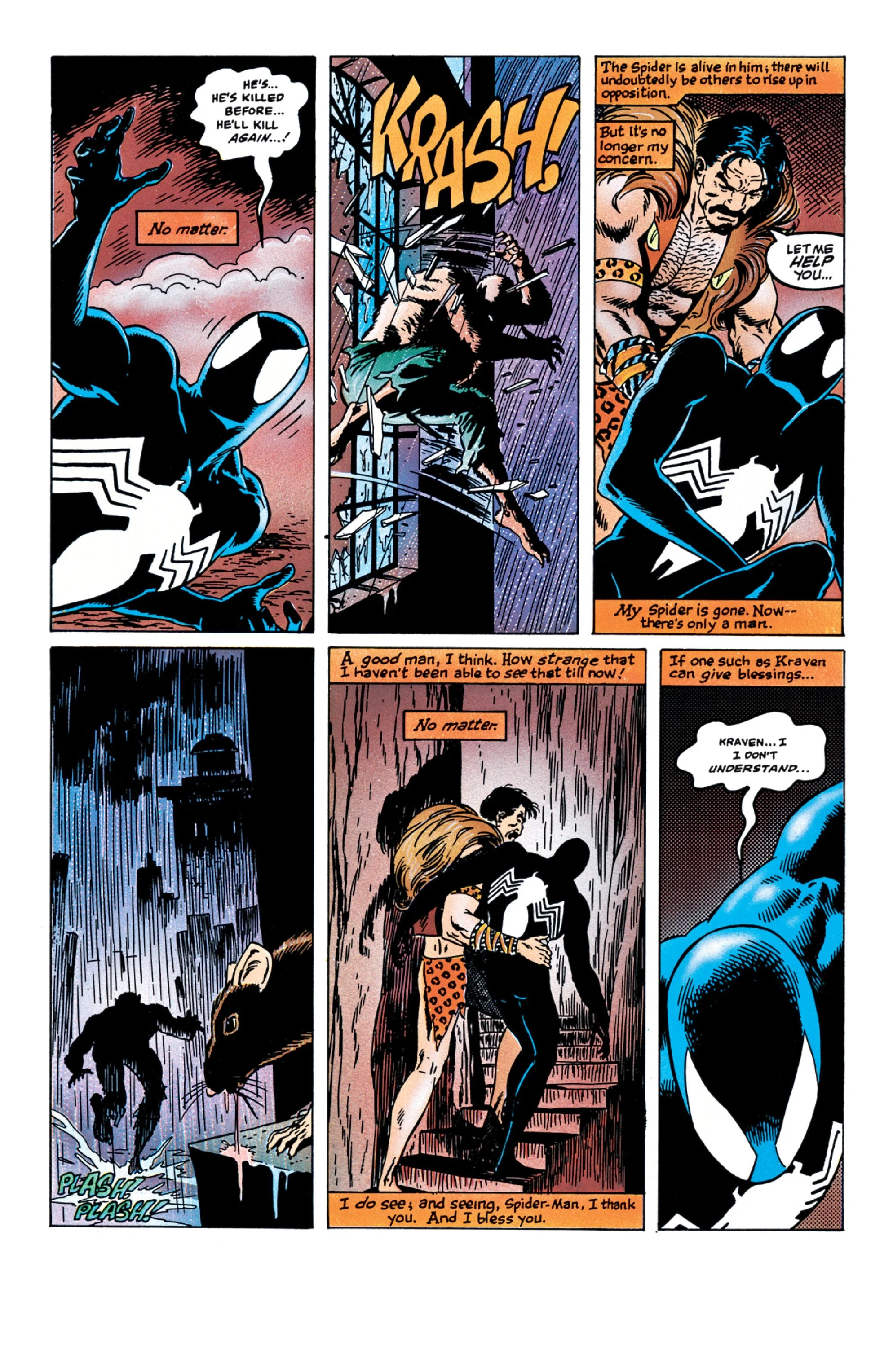
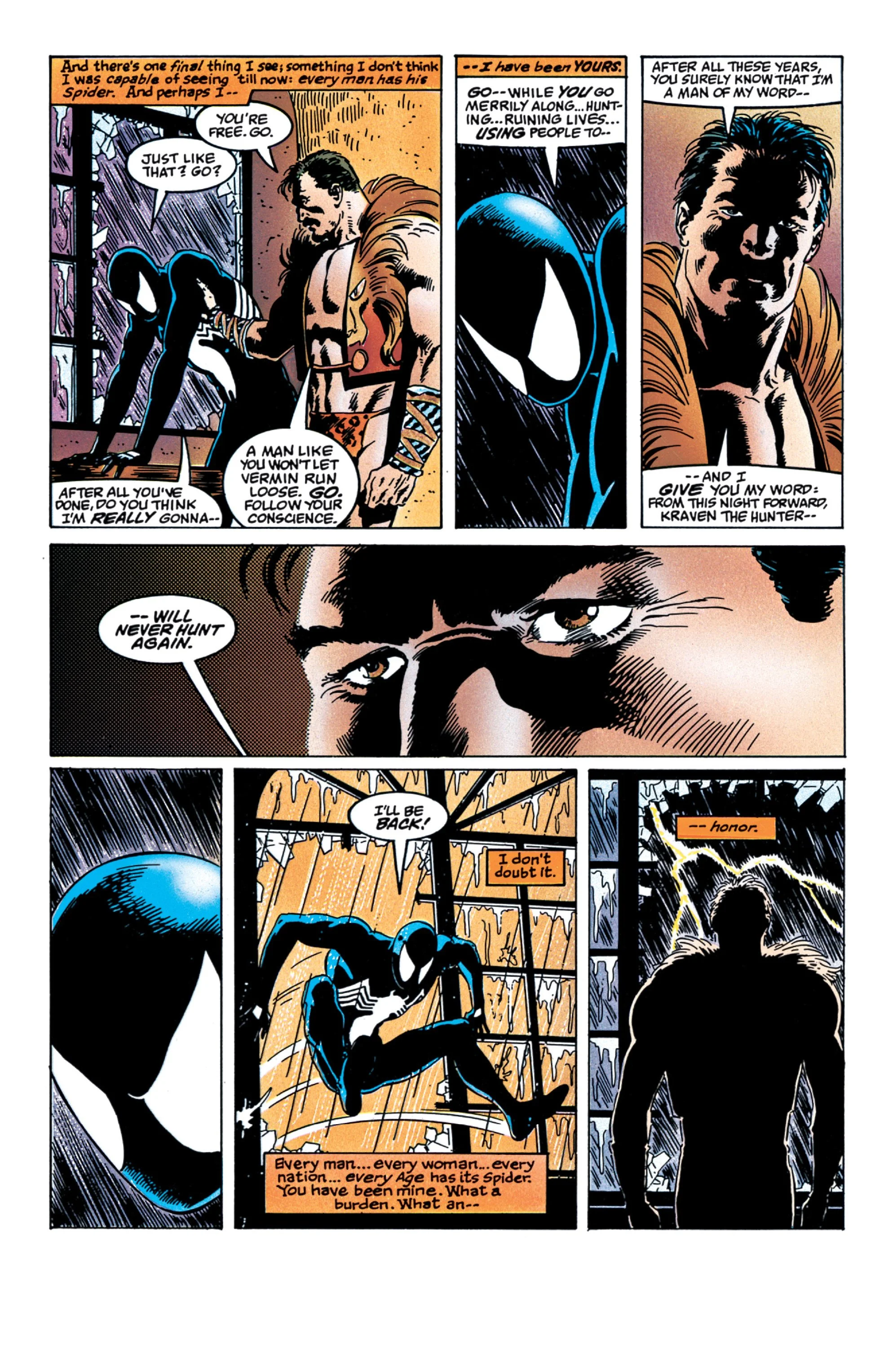
By the end, Kraven's Last Hunt has proven to be less about a mystic bond than about the illusion of connection. Kraven has undoubtedly had a huge (and deleterious) effect on Spider-Man, but in a process that, for Peter Parker, is as random as a natural disaster. Were the "relationship" between the two romantic rather than violent (a possibility indirectly alluded to when Kraven strokes Spider-Man's chin), we would see Kraven for what he is: not a hunter, but a stalker. Spider-Man survives the experience because Kraven lets him, but he recovers because of the real connection he has with Mary Jane. When the two are reunited, Peter's feverish internal monologue stops, or at least pauses: with Mary Jane, Peter can get outside his own head. Kraven, no matter how much he has learned from the process of torturing his imagined nemesis, is still trapped: the only way he can get out of his own head is by putting a bullet through it.
The dueling subjectivities provide the main symmetries alluded to in the original title, and also remind us that Kraven's Last Hunt is both a very 1980s approach to mainstream comics sophistication and a continuation of Marvel's best comics of the 1970s, which used the give readers insight into the characters' inner lives. The beauty of Kraven's Last Hunt lies in more than just its symmetry, though, fearful or otherwise, symmetry is deployed with commendable consistency and inventiveness. Kraven's Last Hunt is best read as a palimpsest of subjectivities: Peter's and Kraven's, but also Mary Jane's and Vermin's, all telling the same story in way so different as to make them different stories. Only a few months late, in Amazing Spider-Man 297, our hero will have to foil Doctor Octopus scheme to use launch a crop duster to destroy the entire population of New York just to defeat Spider-Man. For two months, DeMatteis and Zeck managed to elevate a franchise and engage the reader with complexity.
Notes
[1] "...one of the things that was very clear in that story was that Kraven was suffering from mental illness. ....In Kraven's own head, ]he was thinking], 'Yes, now I have completed my question and I will die with honor. But this was not an a ct of honor. It was an act of insanity.....Tom had gotten a bunch of letters from people saying, 'Oh, you're glorifying suicide!" Normally, I would dismiss that as the usual rantings, except it really disturbed me that people would think the purpose of the story was to glorify suicide." (Dan Johnson, "In Our SIghts Pro2Pro: Kraven's Last Hunt" [Interview with J.M. DeMatteis and Mike Zeck." Back Issue 35, 2009: 9
[2] Nor is there any need to address the fact that Kraven has since been resurrected, an inevitability in corporate superhero comics.
[3] Alaniz puts it best: “Yet, for all its bathetic overreach and its painful puns on William Blake, “Kraven’s Last Hunt” touches on the dark subconscious of the genre, how death structures it, so that the villain’s forthright, extreme causa-sui self-destruction comes to bear a tinge of nobility.”
Next: With Joy to Hear