With Joy to Hear
If Kraven's Last Hunt is something of a mixed bag, with melodrama and emotionality at times overwhelming a well-wrought story, its place in DeMatteis' comics career is therefore a bit surprising, in that the 6-part Spider-Man story began its publication half a year after the conclusion of his 1980s masterpiece, Moonshadow. A broader look at DeMatteis' decades in the comic field show that he is not a creator whose work can be charted on a single line: he has long demonstrated great facility in moving from carefully-crafted, challenging work to raucous humor to quirky superheroes, while also proving to be game for contributing to much more straightforward superhero storytelling as part of a team.
Moonshadow is the first of several DeMatteis-authored comics that refract his personal experience, family lore, and outlook on life through the prism of fantasy and children's literature; these would eventually include Abadazad (2004) and Stardust Kid (2006) (both with art by Mike Ploog), The Adventures of Augusta Wind (2013 & 2016, with art by Vassilis GogtzIlas), Brooklyn Dreams (1995, though with minimal to no fantasy, with art by Glenn Barr). Based on an idea he had been developing for a decade, Moonshadow was first serialized by Marvel's Epic Comics imprint (about which more in another chapter) in 12 issues from 1985 through 1987, with fully-painted art primarily by Jon J. Muth (and an assist from Kent Williams and George Pratt in the last three issues). A coming-of-age story with echoes of William Blake, Kurt Vonnegut, Douglas Adams, Charles Dickens, and Lewis Carroll, Moonshadow was accurately marketed as a "fairy tale for adults."
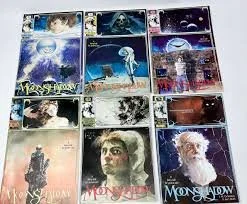
A quick glance at Moonshadow shows why this book really shouldn't work. It is absolutely overstuffed with plot, character, genre tropes, and literary allusions, held together by a narrator who is only too happy to indulge an abrupt change of tone, setting, or theme. There are mysterious, all-powerful, absurdist aliens; a burnt-out Jewish hippy impregnated by one of said aliens, giving birth to the protagonist; an interstellar zoo; an intergalactic war; a family-owned network of corrupt and corrupting social and commercial institutions; religious and philosophical movements ranging from nihilism to mysticism; a porn-obsessed, cigar-smoking Wookie knockoff, sidekick ghosts, a multi-generational family saga of creativity, insanity, and loss, a vaguely magical flute passed along as a family heirloom, a space brothel, an insufferably underdeveloped ethereal love interest, a burlesque of Jewish rites in an alien funeral home, not to mention escapes from prisons, mental hospitals, plague ships, and concentration camps.
Yet work it does, and brilliantly. Four features hold Moonshadow together. First, the narrator, who is an aged version of the main character, and is recollecting his past as he tells the story. This gives a "double-voicedness" to the action, playing off the contrast between his youthful and mature perspectives. As a first-person oral narrative, it also justifies the frequent digressions throughout the series (digressions that work quite well thematically). Second, the series' structure is divided not just into its component issues (here called "books"), but also shorter chapters, which, again, facilitate the movements back and forth in time and space. Third, the painted art is stunning, and functions somewhere in between the standard role of art in a mainstream comic and the illustrative status that art holds in a children's picture book (thereby conditioning the reader to a different pace and a different kind of attention). Finally, the literary quotations that launch each book set the theme and tone, providing unity to what might otherwise seem unconnected.
An elderly narrator recollecting his childhood is not, in itself, a sign of literary or artistic innovation. Nor is it unusual in the Bildungsroman, one of the many genres to which Moonshadow belongs. Even the frequent physical depiction of elderly Moonshadow has ample precedent in Anglo-American comics, which have often featured storyteller figures who stand in front of the reader and draw attention to their narrative role. What is different, however, is the combination of all of these familiar elements: elderly version of hero as narrator, physically present and visually rendered comic book storyteller, hero growing from child to adulthood--all on the comics page. Though the drawings are in two dimensions, comics are a uniquely four-dimensional storytelling medium, as most cleverly demonstrated in Watchmen (which, by coincidence is more or less contemporaneous with Moonshadow): not only does the arrangement of panels on the page allow the reader to jump back and forth through time with little cognitive strain, the very act of flipping through a physical comic book can work as an instance of storytelling because the combination of words and pictures is, at any moment, legible and recognizable in a way that flipping through a prose novel is not (it takes time to reorient oneself on the printed, pictureless page). Jumping around in a film or television episode is now much more technologically feasible than it was in the 1980s, but the experience can still be jarring and difficult (in part because of the additional feature of sound). Moonshadow as a verbal and visual Bildungsroman that regularly depicts its main character at markedly different ages on a single page, makes four-dimensional storytelling comprehensible and unforced.
Next: Words and Pictures