There is a deceptive air of simplicity about Moonshadow that allows it to play fast and loose with the conventions of time. The narrator's somewhat old-fashioned, quasi-Victorian diction does not exactly scream "avant-garde," nor does the straightforward division of each issue into chapters. The chapters, however, are the comic's primary vehicle for narrative time travel. For one, they often (but not always) represent a re-start of the narration from a different moment in time. For another, their titles usually announce their theme, in turn reminding the reader that it is theme rather than action that holds a given issue together. This is not so apparent in the first issue, where the need for background on both worldbuilding (the aliens, the zoo) and character (the hipppy Sunflower, her abduction, Moonshadow's birth, and the beginning of his journey) make the transitions from chapter to chapter rather straightforward. They are also in a simple chronological order.
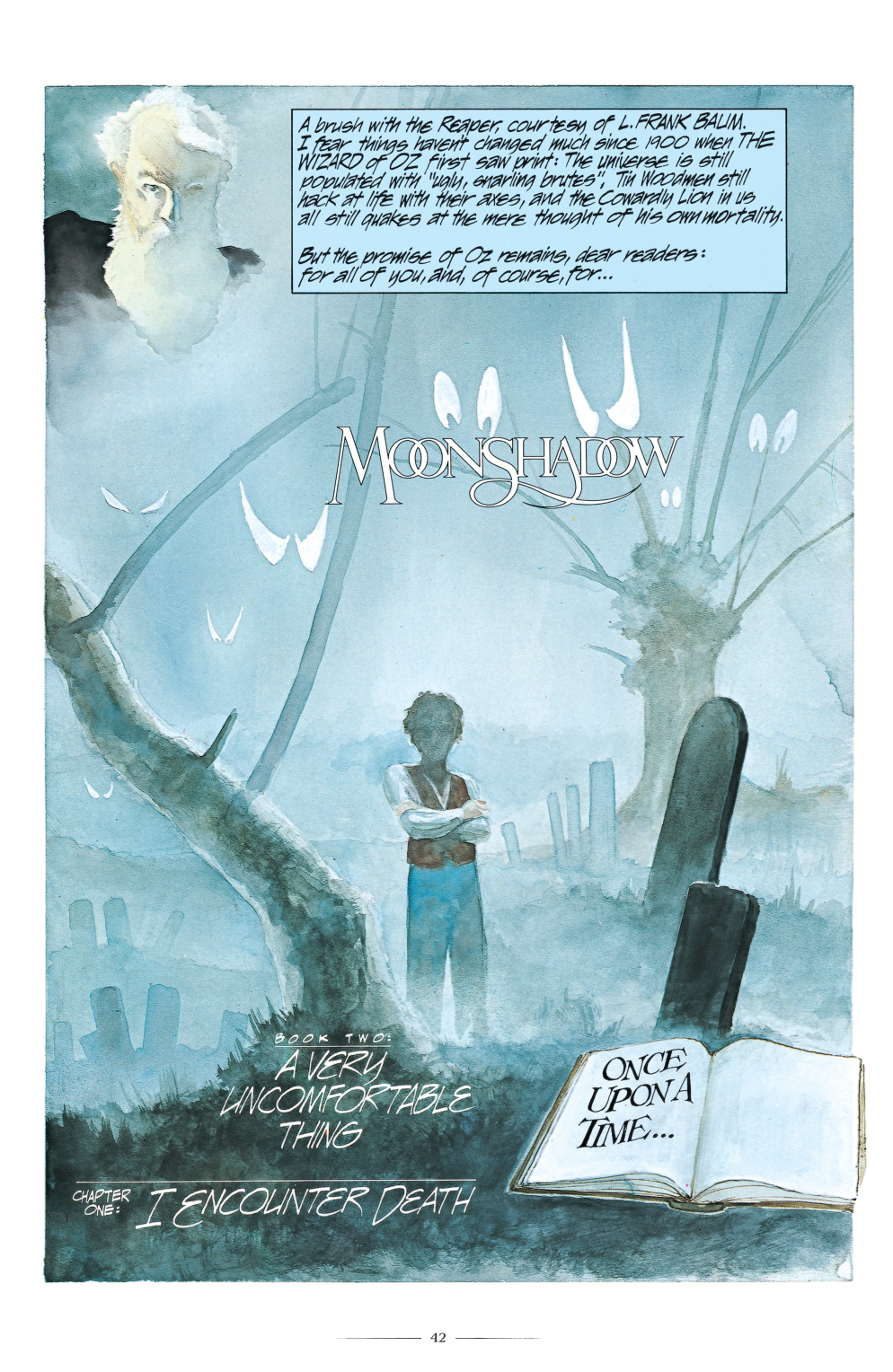
By issue two, however, after the initial one-page literary allusion announcing the issue's overall theme (more on these allusions below), the first three-page chapter is a restatement of the theme specifically in terms of the main characters. "I Encounter Death" starts with nine-year-old Sheila Fay Birnbaum (the future Sunshine) lying in bed, terrified of death and dreaming of the ghost of her crazy Aunt Ettie, who wants her eyes back (when Sheila was born, her father sadly noted that she had "Ettie's eyes"). The story then jumps to four-year-old Moonshadow as his mother bathes him; he, too, is visited by a vision of death, and Sunshine's words of comfort are no less inadequate than her own mother's similar reassurances. Chapter Two ("A Birthday Surprise") rejoins the present-day narrative with Moonhadow, Sunshine, and Ira (the sex-obsessed furry alien) boarding a plague ship to rescue its last inhabitants, only to have Sunshine mortally wounded by the newborn baby monster she has just helped deliver (at the beginning of Chapter Three, "I Encounter Death Again"). In Chapter Four ("I Pray for a Miracle"), Moonshadow can't bring himself to part with his mother's dead body; in Chapter Five ("Arrangements Are Made") and Chapter Six ("Rabbis and Rats"), Sunshine's grotesque funeral ends with Moonshadow's arrest and confinement to a mental hospital. All of this take place in 32 pages: melancholy reminiscence, family history, the detailed exploration of a theme, and what turns out to have been a great deal of plot. This is how virtually all of the "books" of Moonshadow develop: at a pace that is at once leisurely and hurried.
It is also a chapter with very little dialogue, most of it in word balloons, but some reported with quotations marks in narrative boxes. Like many comics from the 1980s, it is much wordier than the average comic from the early 21st century, but this is not the wordiness of an Alan Moore (or, worse, an Alan Moore wannabe). It helps that the words are all "uttered" by the adult Moonshadow, creating the feeling that the reader is listening to someone speak rather than reading endless description. The narration is not attempting to be a moody prose-poem, nor does it simply restate the action depicted in the panels. Instead, Moonshadow successfully embodies what DeMatteis attempted with varying results throughout his 1980s work: a careful synthesis of words and art. We have seen this work fairly well with Zeck in Kraven's Last Hunt, and less elegantly with Perlin in The Defenders. In Muth, DeMatteis has found his ideal collaborator, at least for this project: the lush, painted art demands sustained attention. It manages to hit the sweet spot between illustration and the conventional comics page: some of his layouts have panels with borders, some do not; sometimes, they have action-to-action transitions, and yet they always have attractive, subtle coloring, careful draftsmanship (that nonetheless leaves room for him to move from the realistic to the cartoony ends of the comics spectrum when called for). Part of the pleasure in reading (and, particularly, viewing) Moonshadow is in witnessing the steady physical maturation of the character. He does not simply grow taller, but his facial features become more angular and defined. Even visually, it is a Bildungsroman.
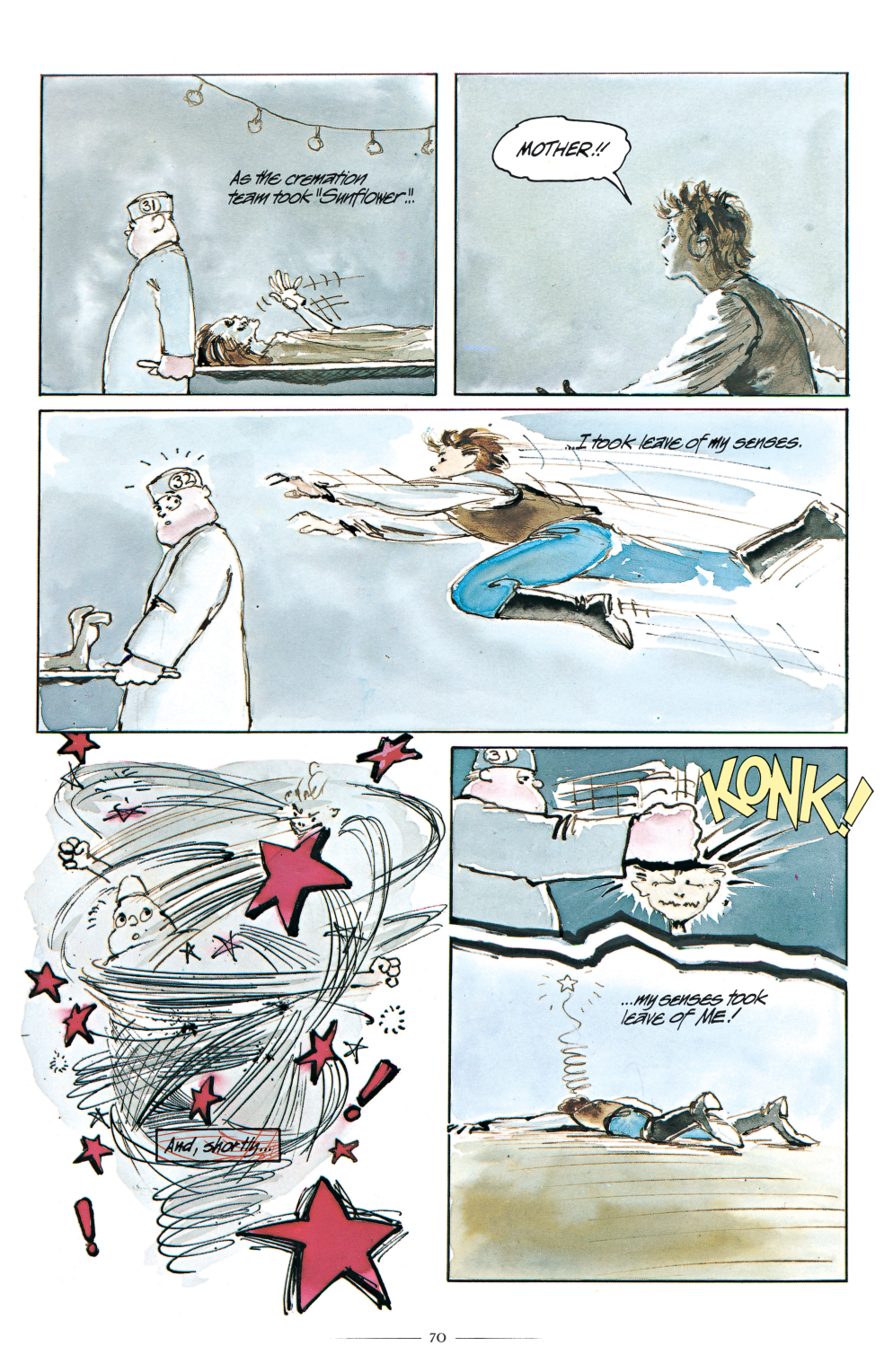
The critic Tom Shapira is not alone in considering Moonshadow more of an "illustrated novel than a comic book,”but this characterization is not exactly fair. There are plenty of comics out there that are largely text boxes with illustrations, particularly comics that are adaptations of fiction. Twenty years after Moonshadow, DeMatteis would in fact, experiment with a hybrid comics mode that looked more like an illustrated book, but this was at the request of his editors at Disney, who were interested in reviving his and MIke Ploog's Crossgen comic Abadazadas something closer to a conventional, non-comics publication. But this is not the case with Moonshadow, whose combination of words and pictures is, if anything, more immediately legible than it was forty years ago. Allison Bechdel's Fun Home, along with nearly all the comics work of Lynda Barry, demonstrate the multiple strategies for balancing word and image.
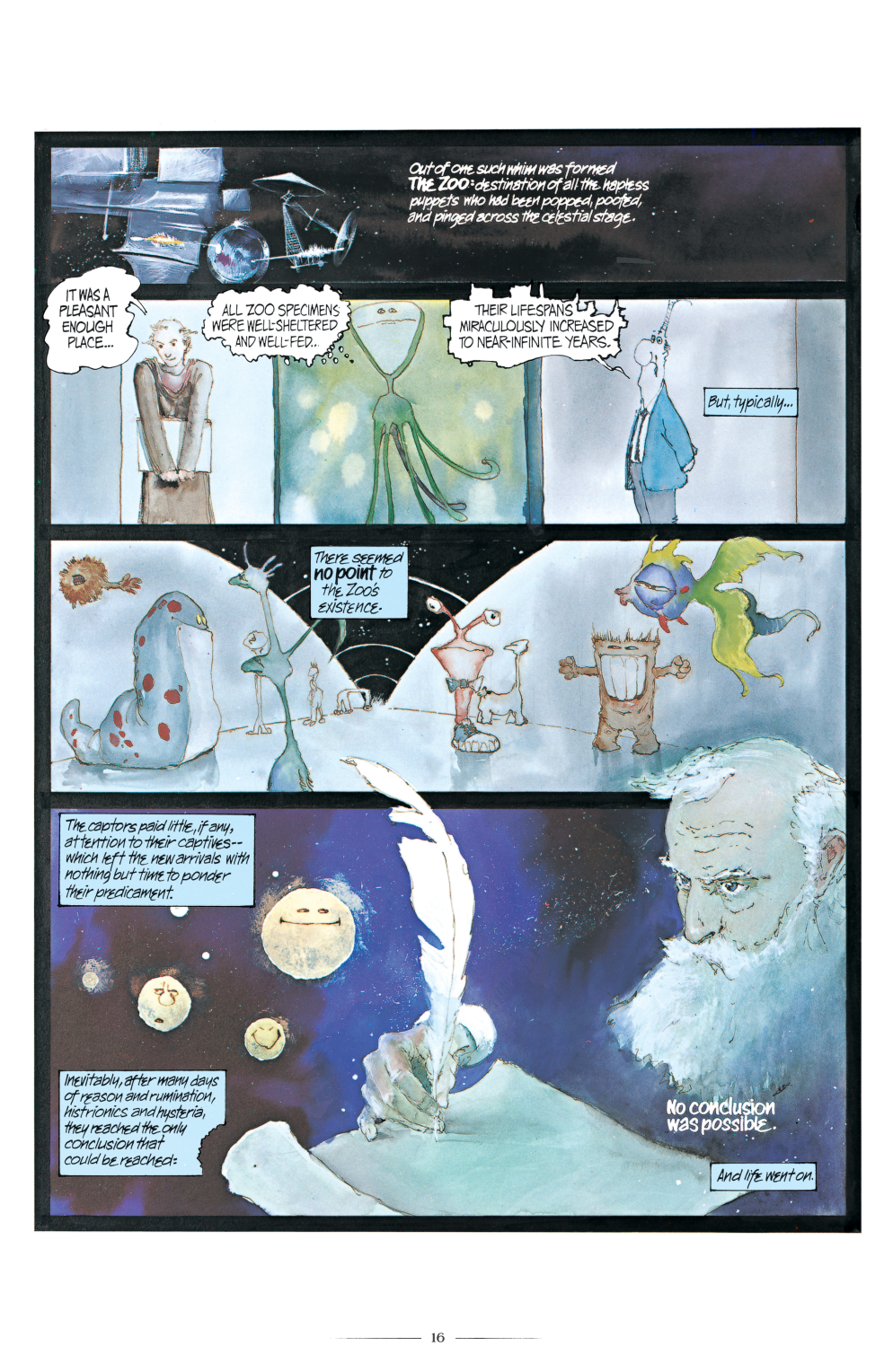
One important difference is that they are writer/artists, so any critique of their choice cannot be reduced to the differing priorities of a prolix writer and a put-upon artist. It is true that, when not working in a primarily humorous mode, DeMatteis's writing is on the wordy side, especially when compared to the next generations of mainstream comics writers, who tend to minimize or even eliminate narrative captions. Yet his captions neither overwhelm the page not over-describe it; nor do they take the place of action and dialogue. DeMatteis and Muth alternate between dialogue-free pages that illustrate Moonshadow's monologue and extended sequences of comics and action that would not be out of place in the most conventional mainstream comic. In the first issue, during the description of the galactic zoo, they even break the frame by having older Moonshadow's monologue briefly continued by a few of the zoo's denizens, before the narrative baton is passed back to its original owner. Moonshadow's voiceover sets the pace and tone for graphic novel, and that pace includes the recognition that the narration can and should be have a rhythm sustained by the intermittent eruption of conventional comics pages.
Finally, there are the literary quotations that introduce eleven of the twelve books (the final one opens in silence, but ends with a repetition of the poem from the first issue). The writers and texts are a veritable who's who of classic literature and children's entertainment: in order, they are William Blake, L. Frank Baum, W.B. Yeats, J.R.R Tolkien, Percy Bysshe Shelley, J.M. Barrie, Robert Louis Stevenson, Fyodor Mikhailovich Dostoyevsky, John Keats, Henry Miller, and Samuel Beckett. Again, critical and reader reactions can (and do) vary, and the narrator's occasional rhapsodizing over a great writer's words can be hard to take. But they are aptly chosen signposts for each book's themes, with Blake's "Piping down the valleys wild" serving the same overall introductory function for Moonshadow as it did for his Songs of Innocence and Experience (and also a perhaps on-the-nose reference to the pipe that Moonshadow plays at various points during the book). Indeed, the title of Blake's collection could easy serve as a subtitle to DeMatteis' and Muth's graphic novel, were that spot not already taken by "A Fairy Tale for Grownups." [1]
Here, too, Moonshadow prefigures an element of Bechdel's Fun Home. Each chapter of Fun Home gets its title from a classic literary work, though the intertextual connections play out differently. Whether it be Proust, Joyce, or Oscar Wilde, Bechdel reflects on each author's texts within the chapter itself. DeMatteis and Muth usually do not engage with a given text over the course of an issue, instead using an extended literary quote as both the beginning of older Moonshadow's monologue and as a kind of visual soundtrack: the first page typically features the older Moonshadow walking, dancing, or painting in a field, followed by a splash page with his reflections on what we have just read, and a nondiegetic depiction of the hero at the age he will be for the rest of the chapter.
Note
[1] "A Fairy Tale for Grownups" made its first appearance on the cover of the second issue of Moonshadow, presumably as a belated content warning after outcry by some retailers and readers over the first issue's reference to Moonshadow's teenage masturbation ("This Dante-like belief in a pure and perfect Beatrice didn't prevent me from shooting semen high and low once puberty came a'knocking.""
Next: Are We All Ants in a Meaningless Cosmos?