As the Blake references make clear, Moonshadow is about childhood and maturation to adulthood (and even to old age). But, just as the narrative skips about through time, so too does it oscillate between innocence and maturity in ever issue. As the life story of its eponymous hero, Moonshadow asks if growing older means growing cynical, and uses this question as a proxy for the larger issues with which DeMatteis frames the entire graphic novel: is life random and absurd, or is there a larger meaning? By this point, anyone who has read the rest of DeMatteis' work (not to mention this chapter) will suspect what his answer will be, but one of the book's strengths is that, even as it inevitably comes down on the side of a (for once) understated New Age spirituality, Moonshadow revels in the absurdity that makes belief in a Grand Plan so difficult.
This theme is present from the very beginning; indeed, it even precedes the first appearance of the protagonist (besides the narrator): Moonshadow begins without Moonshadow. Instead, the comic establishes the world that produces him, introducing the reader to the G'l-Doses, golden "grinning balls of light" whose "actions seem totally without motivation." We see the all-powerful G'l-Doses intervene to stop a genocidal war on the planet Bazoom, leaving its inhabitants in a "true, lasting peace." But as a counter-example, the G'l-Doses also visited the happy, prosperous planet of Kvell, letting loose a plague that wipes out almost the entire population. To top it all off, they are in the habit of picking a seemingly random person, inducing fits of giggles, and whisking them away to an interstellar zoo. While some look at the G'l-Doses benevolent acts as proof of a benevolent God, others come to a different conclusion. In his bestselling book We Are All Ants in a Meaningless Cosmos, Ragstone Phillit argues that the G'l-Doses are motivated entirely by whim, and therefore "to label these beings, to find in their actions proof of any divine intelligence or the basis of any philosophical thought, is absurd." At least, this is what he writes before the G'l-Doses snatch him away to join the zoo.
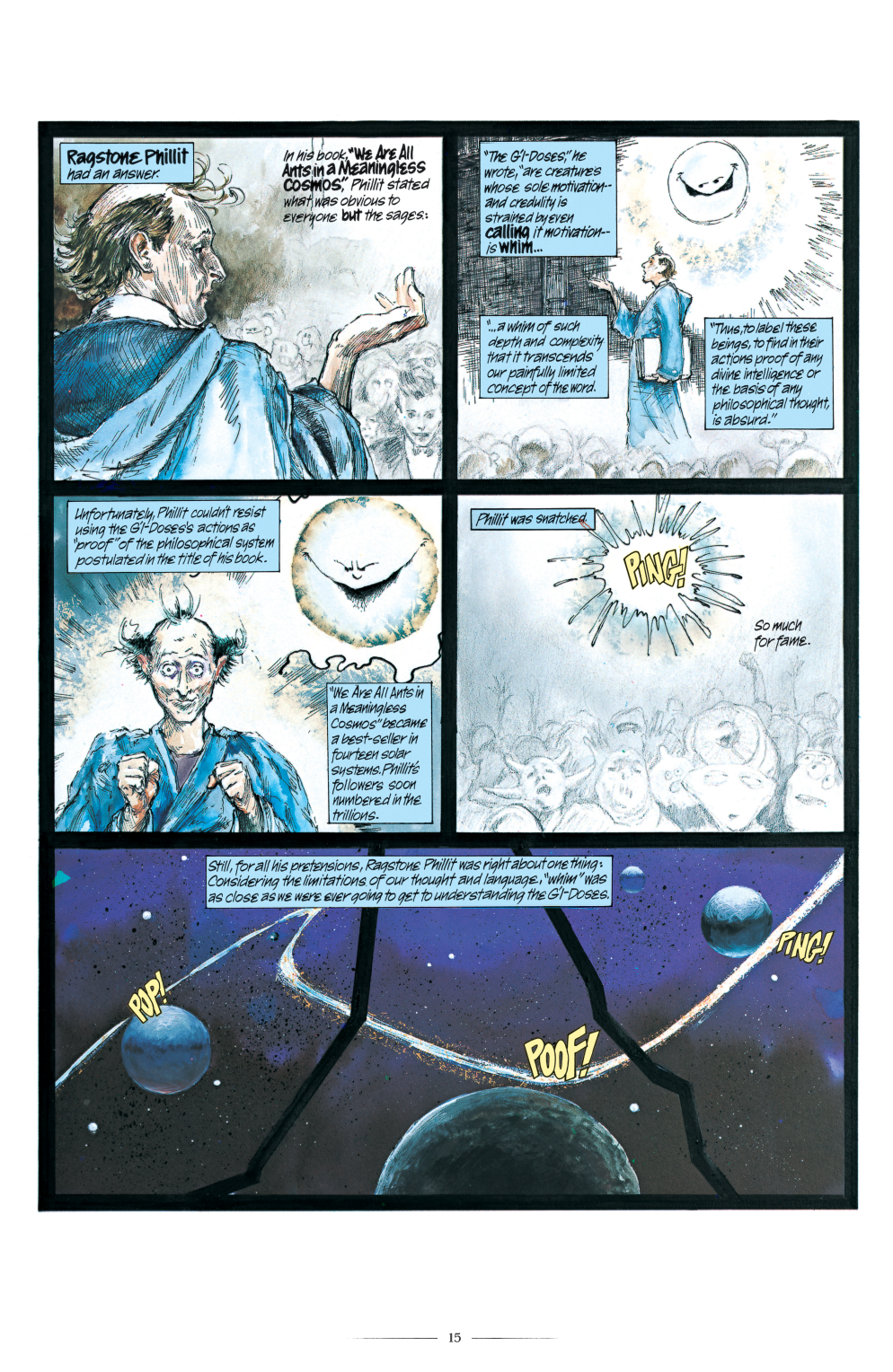
As already mentioned above, DeMatteis is unabashedly stealing from Adams and Vonnegut here, with the G'l-Doses as spherical stand-ins for the latter's plunger-shaped Tralfamadorians and their casual genocide reminiscent of the bureaucratic destruction of the Earth at the very beginning of the Hitchhiker's Guide the Galaxy. In all these cases, however, absurdity and humor are a mask for horror; they may be entertaining, but they are not innocent. Moonshadow is an innocent not only by virtue of his age (born in the interstellar zoo, he is literally a baby at the beginning of the story), but also by contrast with his absurd environment. Nothing about his world makes sense, but because his G'l-Dose father grants his human mother's request that their child have a vast library, he is raised on a diet of adventure novels and nineteenth-century classics. We can never know why the G'l-Doses conceived him, but everything about his upbringing has made him a seeker of meaning:
Homer, Cervantes, Bradbury, and Baum; Shelley, Keats, Byron and Blake; the Brontes, the Brownings, the Three Musketeers Peter Pan and Wendy; Siddhartha and Govinda; Prince Myshkin, King Richard, and Captain Blood!
Considering the influences, is it any wonder my world-view was that of the rose-tinted Romantic?
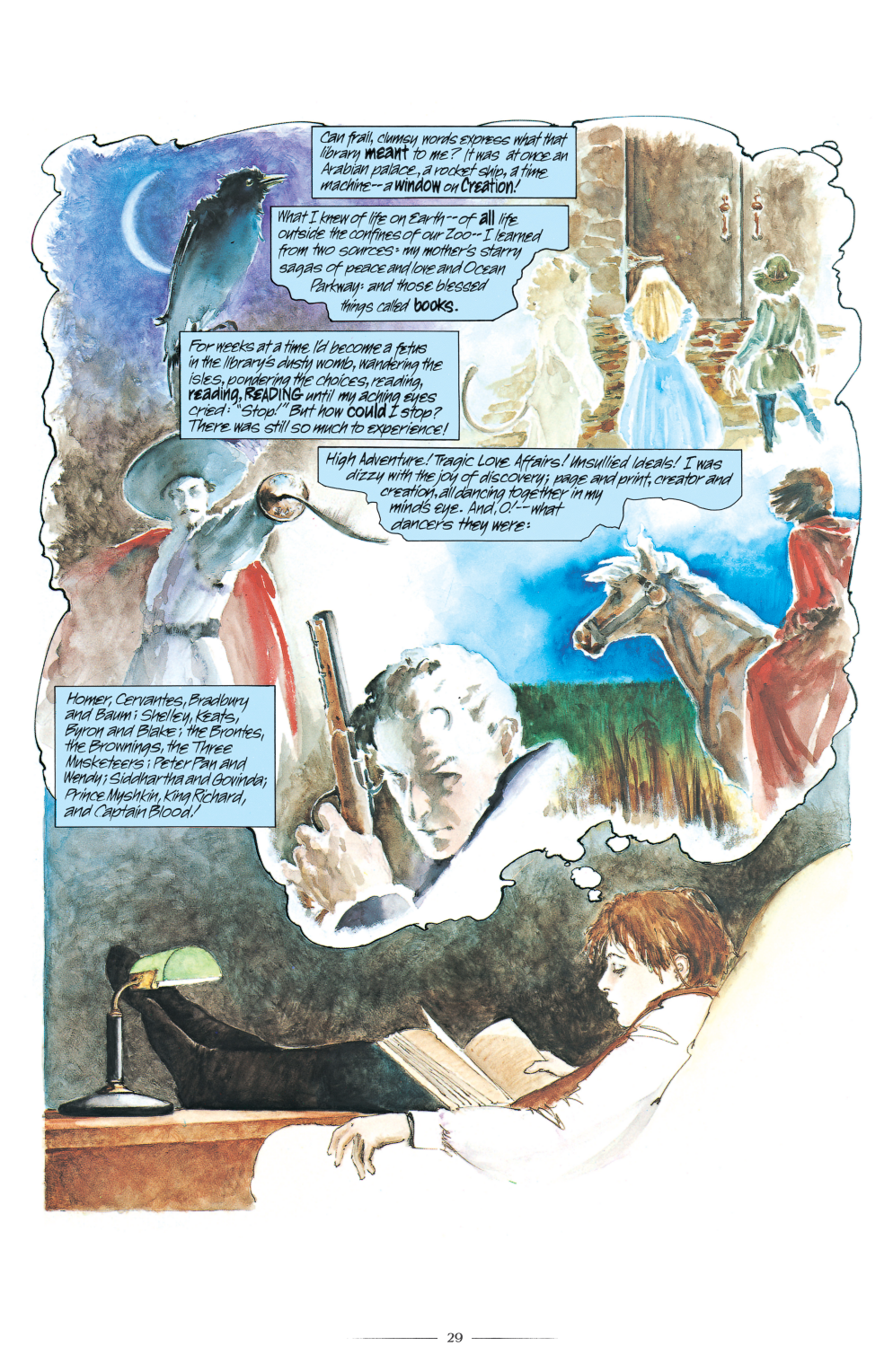
Note that Cervantes is name-checked early here, and for good reason: Moonshadow is not just a reader, but a reader of books about readers. He is comfortable living in a world of quotations; when he asks his father why he is being sent out of the Zoo, their dialogue immediately settles into something out of The Wizard of Oz: "Because" "Because?" "Because" "Because." [1] And, naturally, he sets off on his quest with a quote from Peter Pan: "Second to the Right-- -- and straight on 'till morning." DeMatteis always undercuts the romanticism with bathos: the invocation of the great Romantic writers is followed by the infamous passage about Moonshadow's masturbation, while the Peter Pan quote precedes our hero "puk[ing his] guts out and faint[ing] dead away"
As we can see, the oppositions between innocence and experience, pathos and bathos, romanticism or spirituality and absurdism or cynicism are not just the path on which Moonshadow's life develops. Not only will Moonshadow himself will oscillate between extremes at various points in his development, the book is built on the ongoing interplay between these contrasting modes. If Moonshadow works, it is because DeMatteis and Muth have found a balance.
Note
[1] Moonshadow's father is himself something of a Wizard of Oz figure--mostly offstage, and unpredictable force that can sometimes be convinced to grant a boon.
Next: Westward Ho the Perverts!