Westward Ho the Perverts!
Moonsahdow balances on the unlikely friendship (if that is even the best word for it) between the two characters who are the most frequent traveling companions on the book's various journeys: Moonshadow and Ira. Moonshadow is ethereal, wide-eyed, and rosy-cheeked; Ira, initially another denizen of the G'l-Doses' zoo, has no visible skin at all, his angry eyes the only body parts poking out of a mountain of fur. Looking like the improbable result of a drunken three-way involving Chewbacca, Cousin It, and Oscar the Grouch, the cigar-chomping Ira is pure Id.
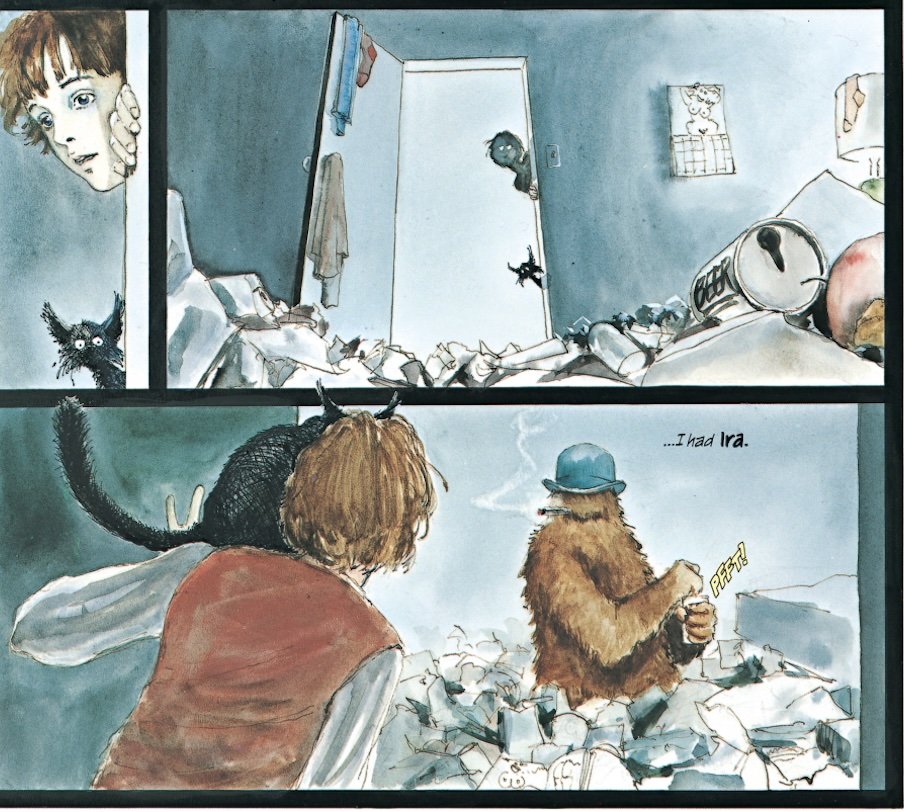
Ira is chosen by Moonshadow almost at random to be his adult male role model, a job that does not interest him in the least. Curiously, however, Moonshadow wins him over with literature. Indeed, Ira is our introduction to the boy's habit of reading:
So, three weeks into our one-sided courtship, I arrived at Ira's dome bearing gifts; filth, really: hard-core pornography from my mother's native planet...
[...]
...three pages into Westward Ho the Perverts [...]it became obvious that Ira had found fresh stimulus for his jaded appetites.
And, so long as the smut supply lasted, I'd found--a father!
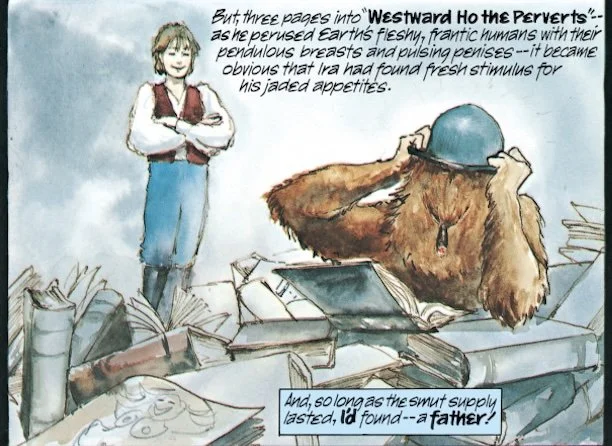
It is not just Ira's own fixations that are erotic; Moonshadow's own language is steeped in Oedipal homoeroticism: the alien is "courted" into become the boy's father. It is as if he has inverted the primal scene, using simulated sex to conceive a father into existence where none was to be found.
This also helps justify the scandalous reference to Moonshadow's teenage masturbation a few pages later, as literature is introduced into the story first as porn, then as art. So far, books have supplied every manner of stimulation available to Moonshadow; rather than leave him to a life of endless, pointless self-pleasuring, the boy's actual father sends him on the quest that makes up the rest of the book.
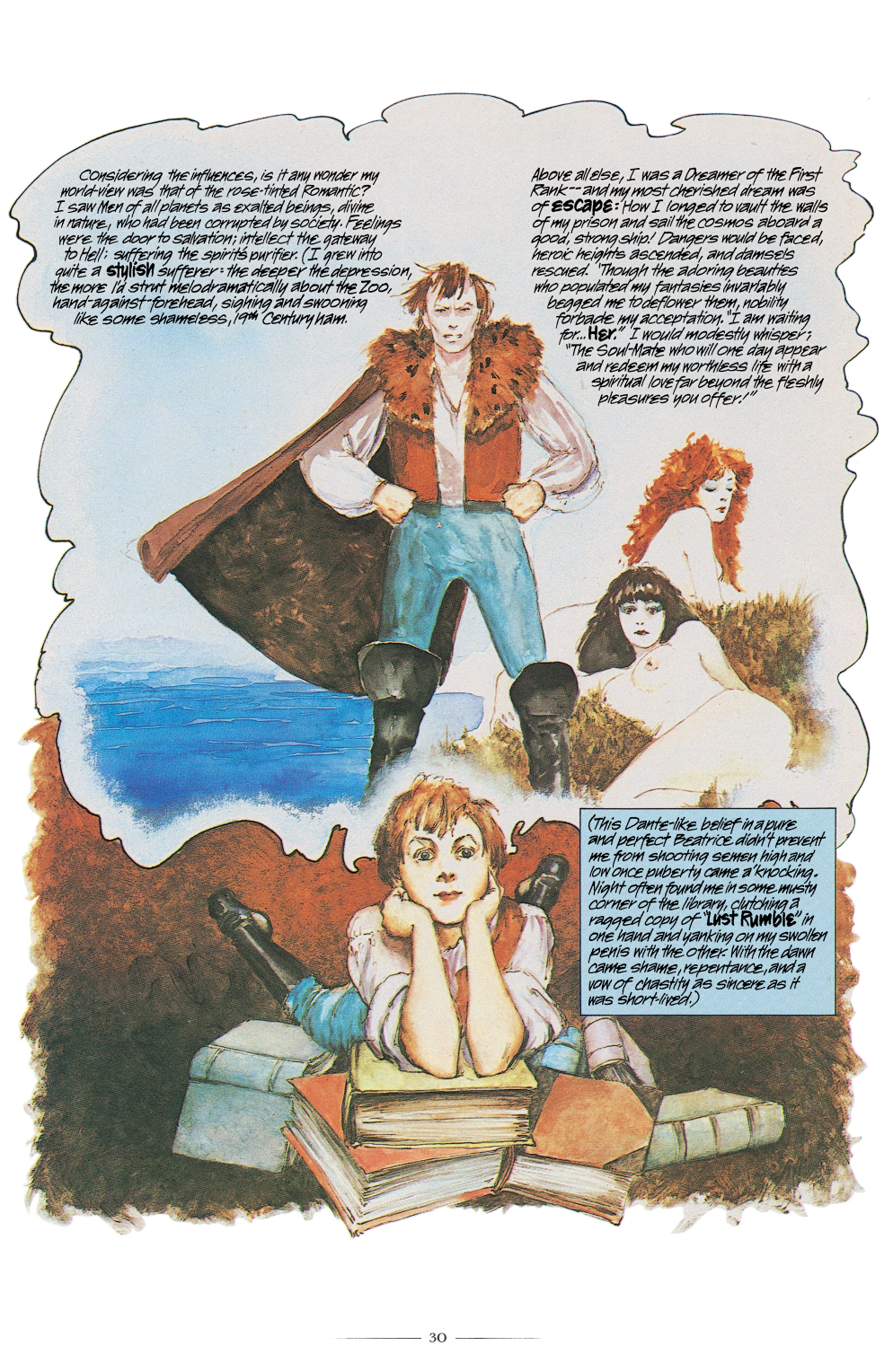
Thus the first book of Moonshadow consists of multiple origin stories: the background for DeMatteis' whimsical science fictional universe; the first part of the life story of Sunflower; the multigenerational Birnbaum heritage of creativity, longing, and madness; the early years of Moonshadow himself; and the origin of Moonshadow as a reader. This last point should not be underestimated; not only have writers spent centuries gently and not so gently lampooning their heroes for their reading habits (the aforementioned Quixote, but also Emma Bovary and Catherine Morland, among many others), but there is also a much more common, and more recent, sentimental version of the reader's origin. After all, writers begin as readers, and dedicated readers can build an identity around both their reading habits and their reading choices. There is something both satisfying and flattering in getting to know the hero as a reader, not to mention the potential for readerly identification: under the pen of a more clumsy writer, the hero who reads can be a transparent Mary Sue.
Moonshadow never quite gives up on modeling himself after others, whether they be literary heroes, long dead relatives, or generally disappointing father figures. This is a novel of education, which means that by necessity, he will have to confront the gap between his idealized role models and reality (whether that be his reality, as opposed to fiction, or the less than edifying characteristics of the people in his life once they are removed from their pedestals). Along the way, he must confront loss (as we have already seen, and will see again), his own sexuality, the madonna/whore complex his reading must have encouraged, the power of the law and the results of the law's defiance, and the horrors of war.
Next: Shimmy, Shimmy, Ko-ko Bop, or, Crime and Punishment