"Shimmy, Shimmy, Ko-ko Bop" is the title of Book 3, Chapter 3, introducing a delightful dissonance of tone at a point when the narrative is about to take yet another grim turn. It is also the name of the catchy, if silly hit released by the R&B group Little Anthony & The Imperials in 1960. The next chapter bears a grimmer, if more familiar title: "Crime and Punishment." Part of the journey to adulthood (or, as the narrator calls it at the end of each issue, the "journey to awakening") is breaking the rules and reckoning with the consequences. Initially, Moonshadow suffers from more consequences than his actions tend to deserve. In Book 2, he is arrested after his violent breakdown during the travesty of his mother's funeral, and spends the first part of Book 3 in the psych ward before Ira, who is desperately in need of cash in order to get their ship out of hock, breaks him out in order to make the boy work off the balance due. After all of Moonshadow's menial labor fails to make a dent in their debt, Ira demands that Moonshadow turn to a life of crime. Moonshadow, remembering a story told by his mother, refuses, prompting Ira to violently beat him until he assents.
The connection between Moonshadow's decisions, his subsequent attempt at "thievery," and his mother's experience highlights one of the features that makes this story of a boy's path to maturity so unusual. Yes, Moonshadow's desire for adventure and his imprinting on Ira are rooted in his longing for an absent father, and, yes, in an almost Disney-level predictability Moonshadow's actual adventures only get started with his mother's death, but the framework he has for guilt and repentance, not to mention virtually every ethical quandry he encounters, is maternal. Yet despite the general affection for borscht-belt Jewish shtick seen throughout DeMatteis's work (Greenberg the Vampire, some of his Marvel Team-Up Stories), Moonshadow is not the tale of a young man who can only individuate himself be escaping a smothering mother. DeMatteis's might lapse into lazily romantic, underrealized female characterization elsewhere in the book (Lady Shady, Bettina), but Sunshine is that rare character in men's stories of their childhood: a mother who is granted a history and subjectivity independent of her son, and every bit as valid as his.
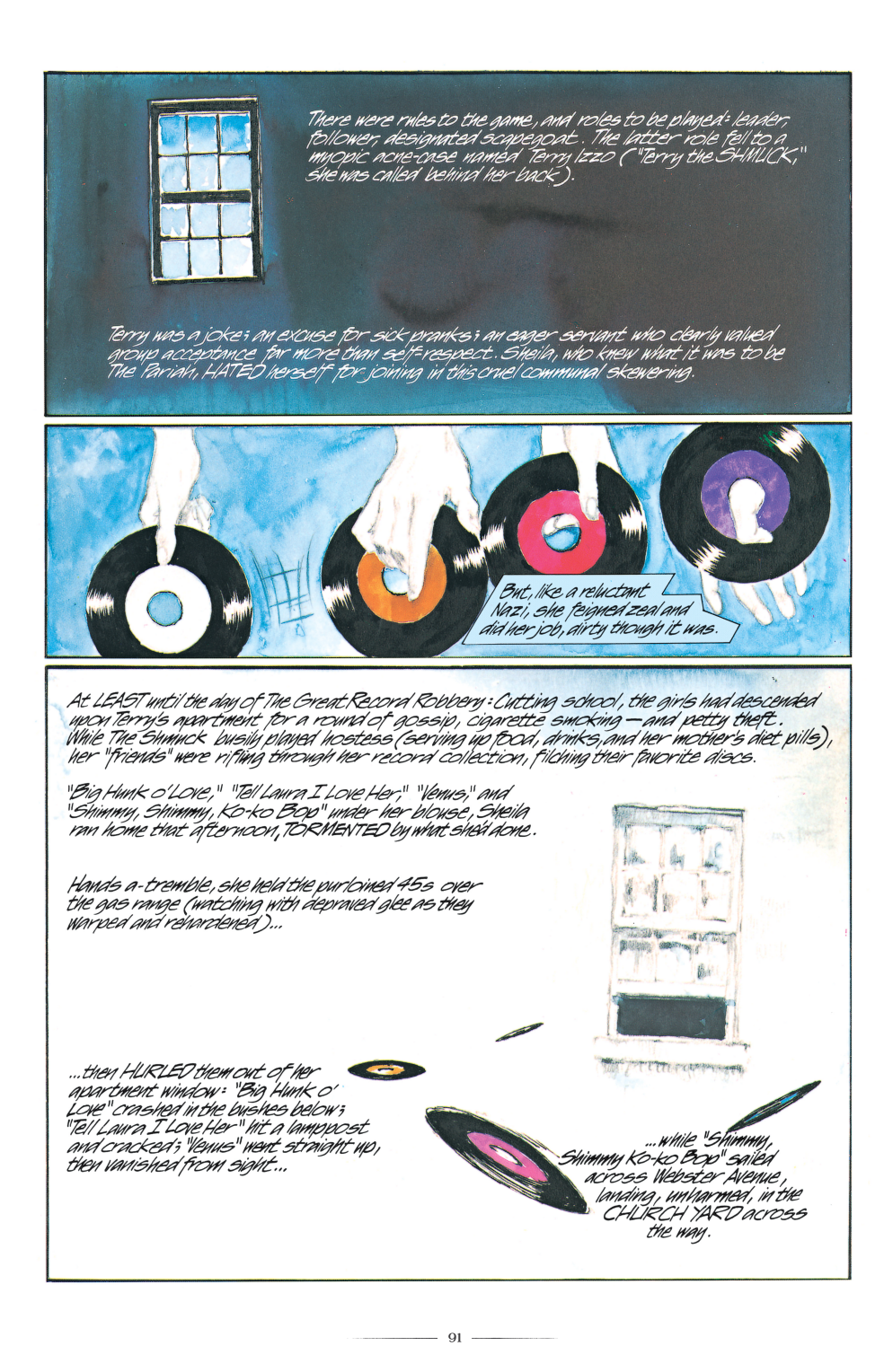
Thus Moonshadow, in contemplating his own impending life of crime on an alien planet, is able to understand guilt and responsibility through recalling an incident in his mother's life that, on its own, might seem prosaic and decidedly "girly": her teenage foray into a domestic version of shoplifting. At 14, Sheila ("not yet 'Sunflower'; not yet Mother; not yet dust!") is navigating adolescence by attempting to create a new identify for herself in order to fit in with her friends: hip, cynical, and sarcastic. This group included Terry, the designated scapegoat, whom the girls decide to rob while guests at her house. Sheila is appalled, but, "like a reluctant Nazi, she feigned zeal and did her job." She stuffs several of Terry's beloved records down her blouse, takes them home, and immediately repents:
Hands a-tremble, she held the purloined 45s over the gas range (watching with depraved glee as they warped and rehardened)...
---then HURLED them out of her apartment window: "Big Hunk o'Love" crashed in the bushes below; "Tell Laura I Love Her" hit a lamppost and cracked; "Venus" went straight up, then vanished from sight...
...while "Shimmy, Shimmy Ko-ko Bop" sailed across Webste Avenue, landing, unharmed, in the CHURCH YARD across the way.
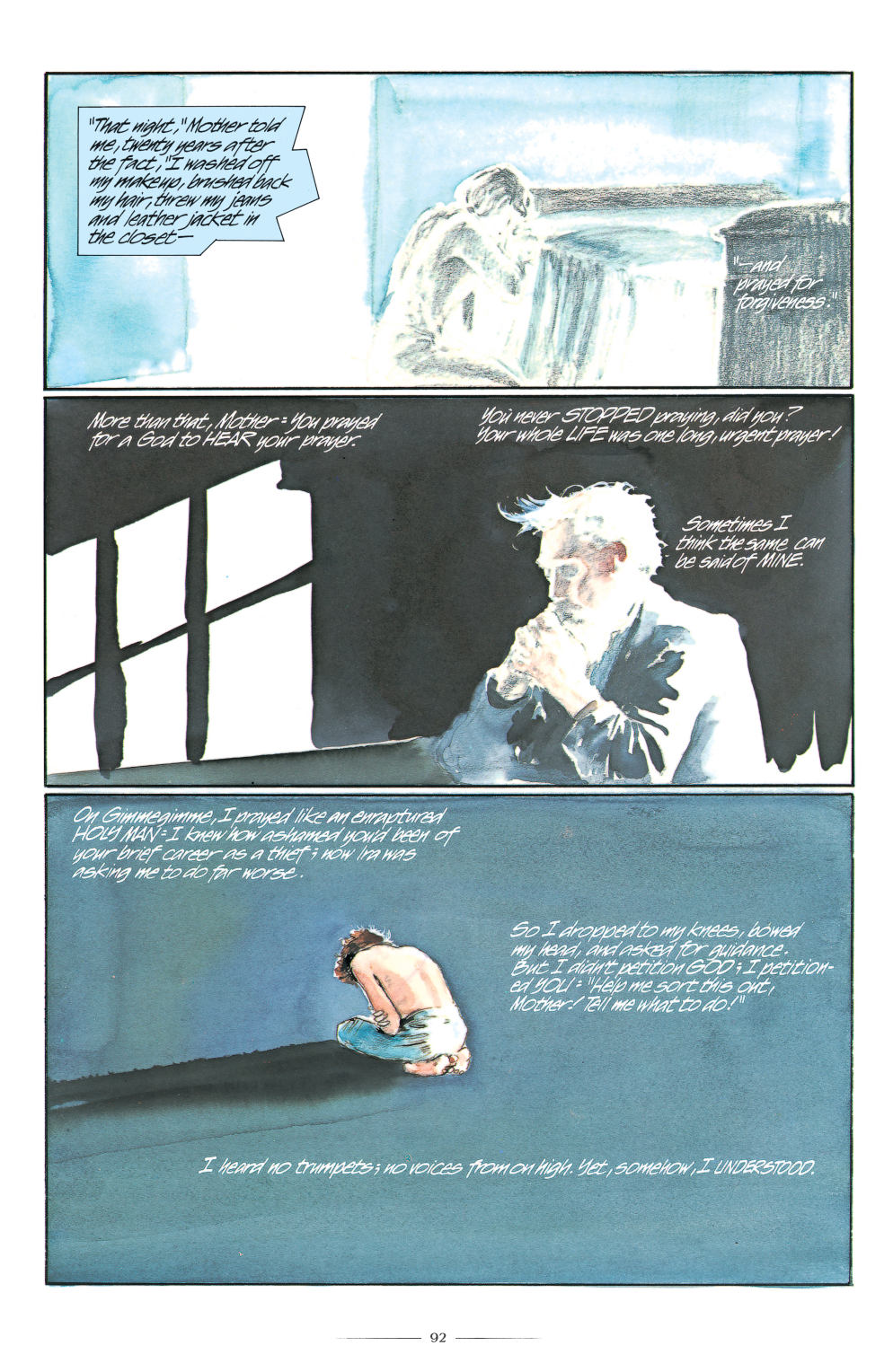
That night, Sheila dropped to her knees and prayed for forgiveness.
More than that, Mother: you prayed for a God to HEAR your prayer.
You never STOPPED praying, did you? Your whole LIFE was one long urgent paryer!
Sometimes I think the same can be said of mine.
As he does throughout Moonshadow, DeMatteis carefully balances pathos and bathos--Sheila's feelings are described with intense seriousness at the same time that the author never lets us forget the essential silliness of the crime. Sheila's actions are an affront against her friend, but the insistence on listing the records by name reminds us that the context itself is not nearly as serious as the guilt that afflicts her. This would not work nearly so well without Muth's expert painting, which here serve primarily as illustrations and counterpoint. As the narrator compares Sheila to a "reluctant Nazi," Booth shows us four colorful 45s, each palmed by a girl's white hand. These same records are shown flying out Sheila's window, looking as much like flying saucers (shades of alien abduction!) as 45s.
Yet her repentance (and the proleptic repentance of Moonshadow, who has yet to commit a crime) is dramatic, real, and painful. A shirtless Moonshadow, on his knees facing a wall, looks like a penitent inmate confined to a bare prison cell. We still haven't begun the chapter entitled "Crime and Punishment," but we are clearly in nearby territory. Before that, however, DeMatteis and Muth give us one last tonal shift, and it is, quite literally, a kick in the gut. Moonshadow delivers a typically earnest speech explaining that stealing "isn't RIGHT" For the first time, Ira demonstrates that his gruff exterior covers a violent interior. In five wordless panels, he grabs Moonshadow, throws him against a wall, punches him in the face, and throws him back to ground, before kicking him in the stomach and blaming him for ruining his life." The result is typical for Moonshadow: he is bludgeoned into compliance and left a sobbing wreck, but his illusions remain intact: "I love you, ira. You're my friend...you're like a FATHER to me...YOU'RE ALL I HAVE LEFT!! Please--don't hate me. I'll be good...I swear! I'll do anything you want me to do! ANYTHING! / Just don't leave me."
Also typical for Moonshadow (or really, for Moonshadow): the boy's faith in his friend/father figure is proven justified. A few chapters later, when Moonshadow lies ill, it is Ira who stays at his side and fends off anyone who tries to hurt him. But this does not change the essential fact of the "father-shaped hole" the elder Moonshadow had identified in his younger self. His mother may be his moral compass, and even, to an extent, his role model, but in his attempts to understand his own place in the world and his relationship to authority, Moonshadow is very much subject to the proverbial Law of the Father.
Next: Boys to Men