Over the next three years, DeMatteis would follow the example of Gerber and Englehart in their team books: introducing character development by focusing on heroes who did not have books of their own. Though Dr. Strange and the Hulk would continue to play a role throughout most of his run on the book, DeMatteis took the opportunity to develop two Defenders stalwarts (Hellcat and Nighthawk), two characters from Marvel's fringes (the Son of Satan and Devil-Slayer), and one whom he created in his third issue: Isaac Christians, the Gargoyle. All of them wrestle with sin and guilt, and all of them manage to find redemption.
"Sin" is a strong word for a superhero comic, but entirely appropriate for all of these characters, with the possible exception of Nighthawk. Not that Kyle Richmond lived a life free of error or remorse; we have already seen what he did to Mindy. But even when he is wallowing in self-pity, Nighthawk never avails himself of Christian theological language as a framework for his guilt. [1] The other characters, however, establish a pattern that DeMatteis will develop for decades, melding a Christian narrative of sin and salvation with a New Age framing of grace and revelation as a variation on satori, the sudden, fleeting experience of a truth that cannot be put into words.
Given DeMatteis's Sixties countercultural orientation, one might look to the novels of Hermann Hesse as a possible source of the writer's preoccupation with sin and salvation, were it not for two important factors: first, DeMatteis' characters do not need to maximalize their sinfulness before seeking redemption, and second, DeMatteis's own words point to Dostoevsky's novels as ur-texts. Most of the direct evidence for his love of Dostoevsky is found in DeMatteis' other comics from the 1980s, from the Russian author's inclusion in Moonshadow's formative reading, the revelation that Spider-Man's foe the Chameleon is actually named "Dmitiry Smerdyakov" (a last name that only exists in The Brothers Karamazov). A self-described "Dostoevsky fanatic," DeMatteis used the title "Crime and Punishment" for a Two-Face story at DC and cited the novel as part of the inspiration for "Fearful Symmetry." DeMatteis' makes no bones about Dostoevsky's centrality to his development as both a reader and writer:
When I read Crime and Punishment and The Brothers Karamazov in high school, they seeped in through my brain, wormed their way down into my nervous system...and ripped me to shreds. No other novelist has ever explored the staggering duality of existence, illuminated the mystical heights and the despicable depths of the human heart, with the brilliance of Dostoyevsky.
Both of the novels DeMatteis name-checks foreground themes that, with a change of context and genre, are legible to the superhero comics reader: a young man's belief that he might be the superman (Crime and Punishment) and an exploration of the nature of crime, sin, and justice (The Brothers Karamazov). For DeMatteis' first arc, however, the Dostoevsky title that comes closest to home is Demons. From Issues 94-100, followed by a thematic coda in 101, the Defenders face off against a hellish threat called the Six-Fingered Hand. Each finger on the hand is a different demon, nearly all of them bearing a name suggestive of a particular sin or power ("Avarrish"; "Hyppokri"). They are a threat that seems tailor-made for the professional exorcists sometime-Defender Daimon Hellstrom, who, as his nom de guerre indicates, is literally the spawn of the devil.
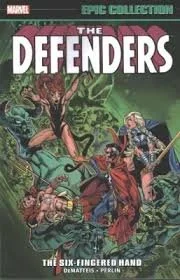
No, this is not the cover to The Brothers Karamazov
Over the course of each of six issues, the Defenders face off against a series of demons that have either possessed or seduced a host, leading to conflicts that are as much about salvation as they are about superheroic violence. Indeed, their very first opponent quickly becomes their ally: Isaac Christians, an old man who made a pact with the Hand to save his dying town (and, along the way, trapping him in a monstrous, mystically empowered Gargoyle body). Isaac's repentance is immediate, and his redemption complete by the time the Six Fingered Hand saga is over. The old woman he injured in his assault on Patsy Walker's home has no memory of the attack, eventually even falling in love with him, and his fellow Defenders quickly learn to rely on his homespun wisdom and almost reflexive inclination towards grace and forgiveness.
By rights, a fight against demons from hell (who turn out to be working for Satan himself) should have been a recipe for simplistic heroism. Where is there room for subtlety when your enemy is the embodiment of absolute evil? For The Defenders, a comic whose previous three years had suffered from an almost oppressive lightness, struggling with the forces of darkness imbued the heroes with a sorely-needed darker overtones. The immediate beneficiary was Patsy Walker, a character whom Englehart had plucked out of Marvel's older teen soap opera comics, first to depict a failing marriage (in Amazing Adventures, starring the Beast), and then to transform her into a determined, self-actualized "I'm-not-a-feminist-but" survivor as the Hellcat (in The Avengers). After she joined the Defenders, she quickly became a one-note, perky adventurer who could not stop making terrible puns about cats.
The death of Patsy's mother opened the door to more emotionally serious storytelling in the last issues of Hannigan's run, but DeMatteis immediately upped the ante: Patsy is possessed by a demon in the very first chapter of his first extended storyline, a trauma exacerbated by her discovery that her soul had been promised to the Six-Fingered Hand by her dying mother. Though rescued by her fellow Defenders, Patsy struggles with the aftermath of her experience and the revelation about her mother. Over the next few issues, she displays a hitherto-unseen dark side at inopportune moments: flirting with Daimon before scratching his face with her claws, or laughing maniacally at the dramatic irony that the manager of the demonically-empowered death metal rock star turned out not only to be the one who is taken off to hell after making a deal with the devil, but is also the rock star's brother.
It's not all darkness, however; even as Patsy seems to be heading back down the road to hell, she and Daimon develop romantic feelings for each other that could point the way towards the light. There is only one small problem: in the last chapter of the Six-Fingered Hand Saga, Satan (falsely) claims to be Patsy's father (which would make Daimon her half-brother). This is not the only roadblock in their relationship: in order to win the battle against Satan, the Defenders were forced to encourage the dominance of Daimon's Darksoul (his demonic heritage), leading him to decide that his place was in Hell rather than on Earth. All of this would eventually be resolved: Daimon would return to Earth and lose his Darksoul, Patsy would discover that she is not the Daughter of Satan, and the two would marry and live, if not happily ever after, happily for a time. [2]
Notes
[1] Curiously, after Nighthawk's death in Defenders 106, theology came after Kyle Richmond with a vengeance. Resurrected by Mephisto, Nighthawk was cursed with a mystic sight that allowed him to see crimes before they happened. Kyle's visions are explored in the alternate reality series Universe X, only to be taken away during a subsequent volume of The Defenders.
[2] In the 1990s, Hellstrom gets back both his Darksoul and his own solo book, leading Patsy to lose her sanity and commit suicide. Eventually, Patsy is resurrected and restarts her life and career as Hellcat, with Daimon only an intermittent obstacle.
Next: Driving Out the Demons