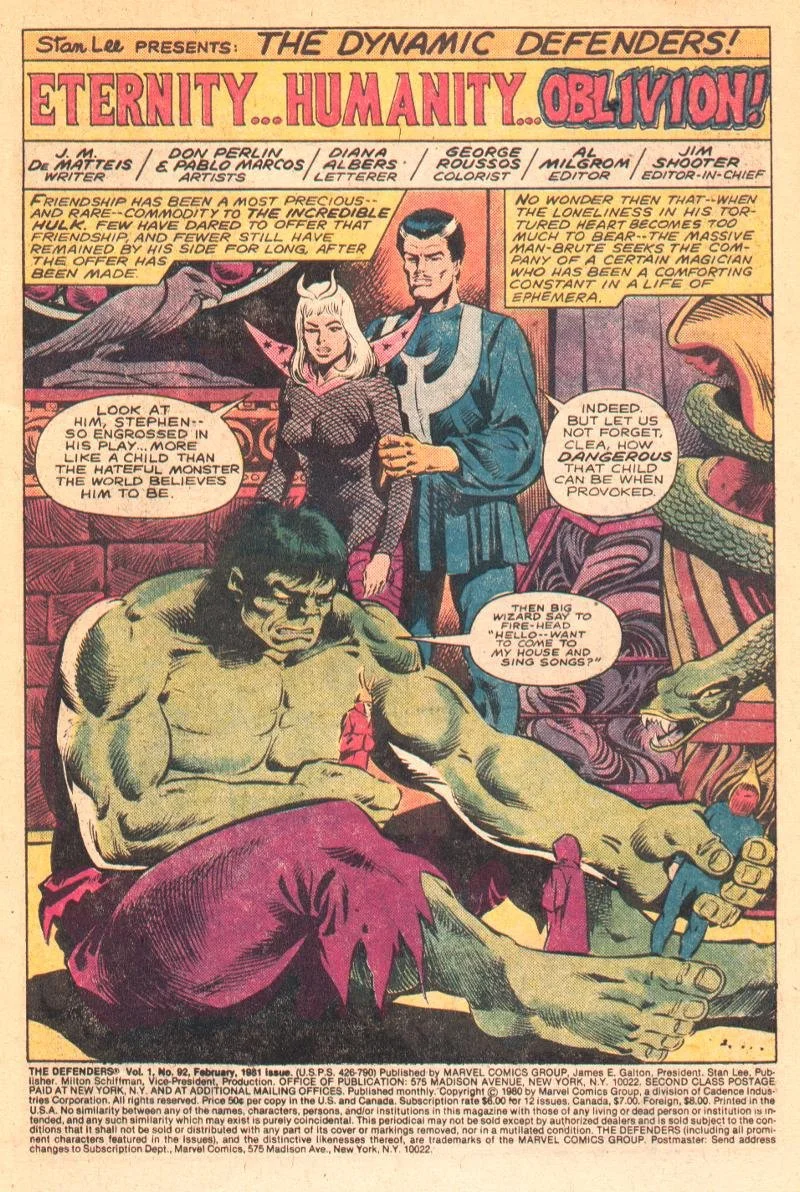
The Defenders was DeMatteis' first significant run on a Marvel comic; he debuted with issue 92 ("Eternity..Humanity...Oblivion!", with art by Don Perlin and Pablo Marcos, February 1981), seven months before he began writing Captain America. The series proved to be the ideal vehicle for DeMatteis' burgeoning skills as a comics writer. First appearing in 1971, The Defenders were initially a triumvirate composed of Dr. Strange, the Incredible Hulk, and Namor the Sub-Mariner. None of them were team players (that was the point), but the stories were popular enough to land them their own title in 1972. After a few appearances by the Silver Surfer, they were joined by The Valkyrie (an amnesiac Norse goddess inhabiting the body of a human madwoman) and Nighthawk (former bored rich boy Kyle Richmond and villainous Batman-clone-turned hero). Well into its ninth year, The Defenders was a comic that had seen better days.
As a "non-team," with no fixed roster, leader, or regular meetings, the Defenders hit their mark early on under the pen of Steve Englehart. Englehart was also writing The Avengers at the same time, a circumstance he exploited to great effect in his multi-part Avengers/Defenders clash, an entertaining crossover that was among the first of its kind at Marvel. After a brief interim by Len Wein, The Defenders fell into the hands of Steve Gerber, whose time on the book included some of his best work for the company.
Gerber saw the team as a collection of freaks and outcasts. At their best, The Defenders was not just metaphorically cerebral; it came close to being literally cerebral as well. Issue 21 (“Enter…the Headmen!”) was both a self-contained, if puzzling, story and the lead-in to the nearly yearlong storyline that capped Gerber’s tenure on the book. [1] The three Headmen of the title are obscure villains who each appeared in the publisher's pre-Marvel age science fiction horror comics: Arthur Nagan, whose experiments with interspecies organ transplants culminated in an ape rebellion and the grafting of his head on a gorilla body; Jerry Morgan, whose research into shrinking technology resulted in the miniaturization of his skull, but not the soft tissues that contained it; and Chondu the Mystic, a forgettable, minor-league guru. The conflict that ensued was entertaining, but it also highlighted Gerber's approach to the book as a series of talking heads engaged in an ongoing talking cure. For Gerber, the Defenders were less of a (non-) team than an encounter group.
With Gerber's departure after issue 41, the book floundered. David Anthony Kraft retained some of the whimsy and introspection in his first year as writer, before giving the book over to random wackiness (a televised call to every hero to join the team) and continuity obsession (revisiting the Valkyrie's Asgardian backstory). When Kraft was succeeded by Ed Hannigan, the writing for the book was on the wall: for the two years preceding DeMatteis' arrival, The Defenders was the Platonic ideal of mediocrity.
One of the most remarkable things about DeMatteis' freshman outing on The Defenders was that it had a follow-up. DeMatteis had done so many fill-in issues that his name on the cover after the end of the Hannigan era was a likely sign that the issue was more palate cleanser than appetizer. There were, however, a few hints, because the story contained something that had been absent from The Defenders for years: attention to interpersonal dynamics and character development.
"Eternity..Humanity...Oblivion!" sets the tone with a splash page that is refreshing for its unequivocal rejection of comic book action: Dr. Strange and his lover/disciple Clea watch as the most physically powerful Defender, the Incredible Hulk, sits on the floor and plays with Strange's statuettes of his archenemy Dormammu and his departed mentor the Ancient One as if they were action figures dragooned into a little girl's tea party: "Then big wizard say to fire-head, 'Hello--want to come to my house and sing songs?'" Playtime is interrupted not by a sudden menace, but by the arrival of another Defender: Nighthawk.
Nighthawk is in the throes of a deep depression as a result of events in a DeMatteis' comic from the previous month that really was a fill-in: "To Judge a Nighthawk!" (Marvel Team-Up 101, January 1981, with art by Jerry Bingham and Mike Esposito). In that story, DeMatteis used two of what would become his favorite tricks to bring instant depth to a shallow character: linking back to an obscure Steve Gerber moment, and expanding on a previously undisclosed or underdeveloped tragic back story. As one of the Defenders who did not star in his own book, Nighthawk (Kyle Richmond) got a great deal of Gerber's attention. In the very complicated Headmen arc, Kyle briefly exists only as a disembodied brain, reliving his life's greatest failures. One of these was a drunk driving accident in college that killed his girlfriend, Mindy. In Marvel Team-Up, DeMatteis reveals that Mindy survived, but as a vengeful, psychically-gifted paraplegic who is obsessed with making Kyle pay for what he has done to her. Gerber designed Mindy to be nothing more than the collateral damage of Kyle's irresponsibility; she was not just "fridged" (sacrificed for the sake of the male hero's character development), but may as well have been born shrink-wrapped in the refrigerated goods section. Her revival at DeMatteis's hands does not do Mindy any favors: even when she eventually becomes a recurring character in The Defenders, her entire existence revolves around Kyle.
But when Kyle appears on Dr. Strange's doorstep, Mindy is simply the absent cause of Kyle's despair. Strange listens to Kyle's story, and his reaction may as well be that of a longtime reader of The Defenders who had had enough of Kyle's whining (showing that such is the case of DeMatteis himself): "Not only is your self-pity distasteful, Kyle--but it has distorted your perceptions beyond belief"
What follows is a clever pastiche of the Silver Age comics of DeMatteis' youth: Strange's involuntary astral journey to meet with Eternity (the humanoid embodiment of all existence) is an obvious Ditko homage, while the story itself is structured like a classic Gardner Fox Justice League of America comic. [2] Since the Defenders must find the three errant pieces of Eternity living out human lives across the globe before their extended separation destroys all of existence, Strange divides the team into three pairs on separate missions: the Hellcat and Son of Satan Daimon Hellstrom are dispatched to an Indian temple, the Valkyrie and the Sub-Mariner journey to a small Greek island, and Nighthawk and the Hulk find themselves in a remote Russian village. Fox divided up the JLA in the interest of plot dynamics, but here, the three different sets of Defenders allow for instant interpersonal drama. Patsy Walker, the Hellcat, is still emotionally wounded by the death of her domineering mother. If nothing else, Daimon's response ("If it helps--know that I, too, have been torn by conflicting feelings towards a parent") shows that among the Son of Satan's many powers is understatement. The Hulk's limited intelligence means that Nighthawk will have to grapple alone with the ethical quandary of not informing a boy's adopted parents that they will never see him again (since the boy is one of the missing pieces of Eternity), while Namor the Sub-Mariner horrifies Valkyrie with his casual lie to a woman missing her husband (another wayward piece of Eternity) that she is now a widow.
The different approaches taken by all three pairs, as well as the disagreements each pair of Defenders has about the best course of action, constitute an implicit mission statement for DeMatteis's run on the book. The emphasis on interpersonal conflict is, of course, one of the key features that distinguished Marvel from DC in the Silver Age; this is what made Steve Englehart's brief run on Justice League of America in the late 1970s such a shock after years of the team's bland bonhomie. It also highlights one of the inherent appeals of a team book, which is watching the characters interact with each other. In the case at hand, the attention to character work also has thematic resonance: these very diverse heroes are tasked with convincing three newly-individuated parts of the monolith Eternity to relinquish their identity for the sake of those they have learned to love. Their sacrifice is consistent with the altruistic morality of most Marvel superheroes at the same time that it represents the exact opposite of what DeMatteis has already started to do with the Defenders: explore the characters as individuals rather than as underdeveloped cogs in a failing team book.
In the decades that follow, DeMatteis will consistently double down on transcendence and the overcoming of the individual ego, but in "Eternity..Humanity...Oblivion!" this same process is one of great sacrifice. Granted, by the end, the three Eternity shards feel the comfort of returning "home," but their decision to do so (after being persuaded by an emotionally vulnerable Nighthawk) requires the abandonment of their own desires for the sake of the greater good. These three characters only existed because of a rejection of the transcendence to which they would eventually reluctantly acquiesce.
All of which shows the issue's opening pages to be particularly clever: watching the enormous Hulk use tiny figurines of Dr. Strange's supporting characters as dolls is an innocent counterpoint to the nearly apocalyptic experiment undertaken by Eternity: playing with actual human lives raises the stakes too high.
Notes
[1] This is despite the fact that, even here, DeMatteis managed to mine some earlier Gerber material. Gerber's wrote only a handful of largely forgotten issues of the series, yet DeMatteis brings back Gerber's version of the Ameridroid, a character whose return was unlikely to have been a response to popular demand.
In Comics Interview 40, DeMatteis remarked that it was a relief to write Moonshadow and "funnel" his perspective "through my brain and translate it into this fantasy universe. ...Before it was like, 'Well how do I funnel my point of view or my life or whatever through Captain America?'...Which is hard to do through Captain America...Or the Defenders. Or whatever.'"
[2] "It was basically the Defenders as the Justice League. Comics Interview 39, 9
Next: Dostoevsky's Defenders