Introduced on the last page of Fantastic Four volume 1, 48 ("The Coming of Galactus," by Lee, Kirby, and Sinnott, March 1966), Galactus was Marvel's first cosmic threat. Not that the heroes had never been confronted by alien invaders, but those aliens tended to be humanoid, and their goal was usually conquest rather than extermination. In the person of Galactus, the Fantastic Four were confronted with a planetary apex predator who looked at entire biospheres as sources of sustenance. From the beginning, we are told that Galactus is not, precisely, evil; he is simply following the dictates of his hunger.
Technically, Galactus was not supposed to menace the Earth after his initial defeat at the hands of the FF, when he swore an oath never to consume our planet. But in his most recent appearance (drawn by Byrne, but written by Marv Wolfman), Reed Richards had been forced to strike a deal with Galactus in order to defeat a more imminent threat. In exchange for defeating the near-omnipotent Sphinx, Galactus was released from his vow, freeing him to come back and eat the Earth whenever he chose.
Thus Byrne was already involved in a Galactus story that was playing the long game. The most logical course of action for the world-eater would be to wait until the Fantastic Four and its generation of superheroes die off, and return to consume an unprepared and unsuspecting planet. Of course, this was never going to happen, because Galactus' entire purpose as Marvel Comics IP is to provide a serious challenge to the company's superheroes. So instead, Byrne played a long game of his own.
Byrne brings Galactus back for three interconnected storylines spanning a year and a half of real time: Fantastic Fourvolume 1 242-244 (May-July 1982), Fantastic Four volume 1 257 (August 1983) and Fantastic Four volume 1 261-262 (December 1983-January 1984). Together, they develop a moral framework in which Galactus can and should continue to exist, raising the ethical issues connected with a creature who devours planets only to brush them away with a bit of cosmic hand-waiving.
The first story is kicked off by the return of Terrax the Tamer, Galactus' most recent herald, who rips Manhattan from the face of the earth and sends it into space in order to force the Fantastic Four to confront his master. Though the team never seems to acknowledge it, Terrax has a reason to hate the Fantastic Four: as Terrax reminds them, he was the one who brought him to Galactus to be transformed and enslaved in the first place. Minor though this incident is in the scheme of things, it is one of many strands in the web of complicity in which the Fantastic Four finds themselves.
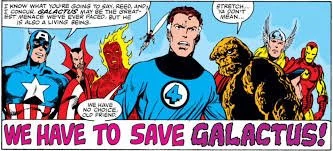
Galactus handily defeats Terrax, but he is on the verge of starvation, and prepares to make a meal of the planet. The combined forces of the Fantastic Four and the Avengers manage to stop him, with a timely assist from Dr. Strange, who confronts Galactus with "the ghosts of all those he has slain." In other words, Galactus is defeated by the victims of his own actions, which, in a different comic, might amount to a form of poetic justice. But Reed and the other heroes, faced with a dying Galactus, channel their heroic impulses into a confounding resolve:
Reed: If you'll think for a moment, you'll realize our problems have only begun!
Captain America: I know what you're going to say, Reed, and I concur. Galactus may be the greatest menace we've ever faced, but he is also a living being.
Ben: Stretch...ya don't mean...
Reed: We have no choice, old friend. WE HAVE TO SAVE GALACTUS! ("Shall Earth Endure?" Fantastic Four 243, June 1982")
Do we, though? Really?
"No choice" amounts to abdicating moral responsibility in the name of abstract morality. It is actually a better description of Galactus's own dilemma: he has no choice but to consume planets, due to his hunger. Reed and Captain America are guided by an unquestioned and simplistic moral code: all life must be preserved, period. One could imagine a complex argument in favor of saving the life of a mass-murderer who will have to re-offend, perhaps based on the principle that the value of life cannot be reduced to a question of numbers. But Reed offers no such justification, convincing the other heroes of the rightness of his cause with just a brief conversation in the course of a single panel.
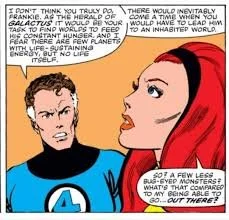
Reed's compassion is a sharp contrast to the attitude expressed by Frankie Raye, Johnny's girlfriend who had recently discovered that she, too, has the powers of a human torch. Frankie immediately recognizes the devourer as something so beyond the everyday as to be practically sublime: she spends most of the first part of the story just repeating the word "Galactus!" to herself while combing through the FF's files to find out more information about him. She volunteers herself as a new herald to the revived but weekend Galactus, but with none of the moral compunction that haunted her most famous predecessor, the Silver Surfer:
Reed: There would inevitably come a time when you would have to lead him to an inhabited world
Frankie: So? A few less bug-eyed monsters? What's that compared to my being able to go...out there?
Frankie Raye’s next job: Ice Barbie
Frankie had already proved to be callous about human life in her brief time with the machine, so her cavalier attitude towards "bug-eyed monsters" is not all that surprising. Nonetheless, she does have at least one thing in common with the moralistic Reed Richards: both of them are making decisions about what is happening right now, in front of them, with little regard for the consequences.
Next: Cosmic Gods Who Eat Your Planet (and the Writers Who Love Them)