Much of DeMatteis' best Marvel work can be viewed as a kind of excavation: what lies beneath the surface of these sketchily-rendered characters? What secrets from their past can be dug up in order to reveal their greater depth? With Fearful Symmetry: Kraven's Last Hunt, DeMatteis and Mike Zeck render this metaphor literal, by burying and exhuming its heroes multiple times, journeying to and from the underworld of the New York City sewer system, all in a plot motivated by a symbolic framework that may or may not only be entirely in the villain's head.
Kraven's Last Hunt has its own history, buried under layers of rejected pitches and rewrites. Two separate story ideas eventually coalesced into this six-part Spider-Man sequence, one centered on the image of a character digging his way out of his own grave, and the other exploring the psychodynamics of a hero/villain relationship. First DeMatteis wanted to do a miniseries about the Avengers character Wonder Man, whose own history with death and rebirth is one of the most notable features of an otherwise underdeveloped character. [1]. Then he had an idea involving the psychodynamics of the Batman/Joker relationship, but the pitch was rejected because of its similarity to another story DC had in the works. He retooled it to involve a different Batman villain, only to have it rejected again. Eventually, he reworked it for Spider-Man, with plans for creating an entirely new antagonist. But then DeMatteis stumbled on the entry for Kraven the Hunter in the Marvel Universe Handbook, and he was hooked:
...they mentioned that Kraven was Russian. For me, a total Dostoyevsky fanatic, the idea that Kraven was Russian and had the same tortured, Russian soul that the great Dostoyevsky characters had, unlocked this door in my head and suddenly I had a new understanding of this character.
DeMatteis' explanation encapsulates both the strengths and the weaknesses of the storyline that would eventually become Kraven's Last Hunt. His familiarity and engagement with the Russian literary canon inspired him to give Kraven a particular type of emotional depth, even as that inspiration was rooted in a rather facile notion of both Dostoyevsky and the "Russian soul." It works, but with an asterisk.
Other factors also played a role in the success of Kraven's Last Hunt: when he was developing the idea, DeMatteis was in the throes of both divorce and depression, a bit of extratextual information that makes his depiction of newlyweds Peter and Mary Jane all the more poignant. And, though he denies any suggestion that Kraven's Last Hunt is a response to the "darkness" of mainstream comics in the wake of Watchmen, in an interview years later DeMatteis does make the connection between his artistic collaboration with Mike Zeck and the Moore and Gibbon's powerful sense of silence and pacing in their visual storytelling. As we've already seen, DeMatteis had already been using silent panels for dramatic and emotional effect in The Defenders, but Don Perlin's pencils were arguably not the best fit for this particular visual device. In Zeck, DeMatteis found an artistic partner capable of both a broader range of facial expressions and a more dynamic approach to action and panel transitions. Finally, his silent panels and voice-over narration had a visual vehicle that served them well.
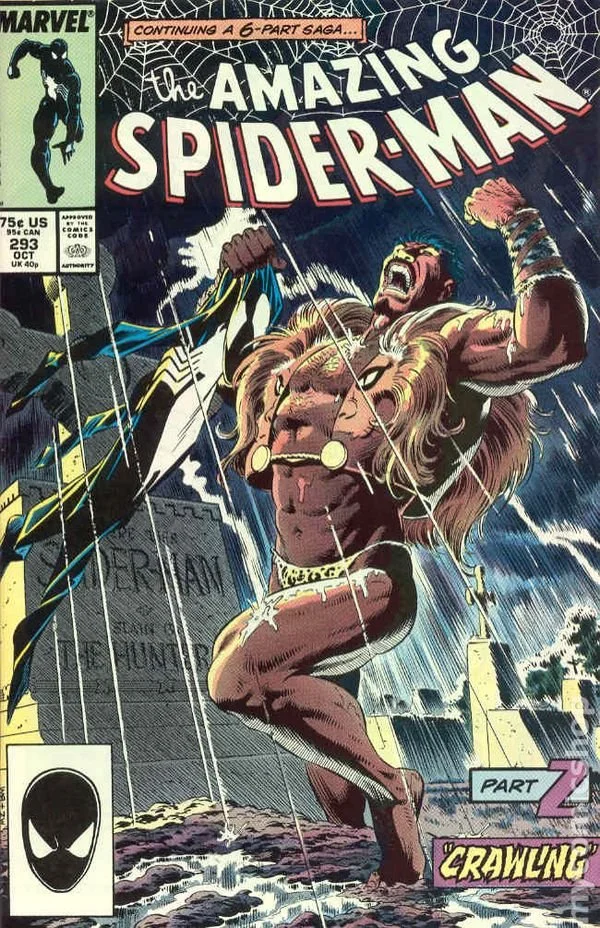
Previously, on What Not to Wear…
Kraven's Last Hunt did more than simply elevate a D-list villain (Zeck said that as soon as he saw the plot, he knew this would be the definitive Kraven story), but the antagonist's previously marginal status gave the story a particular resonance that a Batman/Joker comic could not have had. DeMatteis and Zeck crafted a comic that was built on relationships, connections, and intersubjectivity.
First, a quick recap for those who may not know or remember the story that well: Fresh from his honeymoon, Peter Parker receives bad news about the death of an acquaintance (after worse news about the death of a friend), and is plagued by visions he shares with his old enemy, Kraven the Hunter. Kraven stalks Spider-Man, drugs him, shoots him in the face, and buries him in a grave at a cemetery. Meanwhile, the monstrous cannibal Vermin is loose in New York, stalking victims whenever he leaves is lair in the sewers. Kraven and Vermin seem to be sharing hallucinatory nightmares. Distraught that she can't find her husband, Mary Jane searches for him on the streets of New York. When she is attacked, she is saved by a man in a Spider-Man costume who is uncharacteristically brutal and uncommunicative: either Peter has gone insane, or he has been replaced. An increasingly unhinged Kraven captures Vermin. Peter turns out not to be dead, but is having visions of spiders and dead people as he claws his way out of the grave, horrified to learn that he has been underground for two weeks. After reuniting with Mary Jane, he confronts Kraven (both are dressed in the black Spider-Man costume). Kraven sets Vermin against Spider-Man, but then lets both of them go. Alone in his mansion, Kraven puts a rifle in his mouth and kill himself. In the final issue, Spider-Man confronts Vermin in a vicious battle, eventually turning him over the police. Peter and Mary Jane are reunited yet again, and Kraven is buried by his henchmen.
This six-parter, serialized over two months in three different Spider-Man titles, was the first to explore Mary Jane's and Peter's emotional connection now that they were married, with Spider-Man's costume (and particularly his mask) continually threatening to disrupt their relationship. Not only is the black costume threatening, and not only does it literally prevent Mary Jane and Peter from seeing eye to eye, but it also, inadvertently, causes a terrifying betrayal: Mary Jane cannot assume that the man behind the mask is her husband. [2]
The second, and central, relationship the story explores is the one between Spider-Man and Kraven. In a comic originally entitled "Fearful Symmetry," their connection is profoundly asymmetrical, at least in the beginning. Kraven is cultivating an almost mystical bond with Spider-Man, but it is based on an understanding of their mutual roles that exists entirely in his own head. For Kraven, Peter is not Spider-Man, but "the Spider," his natural enemy who represents every obstacle and setback in his unnaturally long life.
The third set of relationships involves Vermin, a young man turned into a human rat hybird by the Nazi villain Baron Zemo in DeMatteis and Zeck's Captain America run. A cannibalistic denizen of the sewers, Vermin would prove an excellent fit to a story of burials, deaths, and resurrections. Even more important, as an unwitting pawn in Kraven's hunt of the "Spider," he repeatedly attacks Spider-Man and evinces a visceral repulsion that, along with his experience at Kraven's hands, pushes the hero into dangerously violent territory. Vermin's involvement raises the stakes, threatening Peter's sense of his own humanity.
And it is his humanity that is at issue throughout all six parts of Kraven's Last Hunt. From his early days, Spider-Man's cast of characters was something of a bestiary: his villains included a Vulture, a (Doctor) Octopus, a Rhino, a Lizard, a Chameleon, and a Scorpion, with the eventual addition of the Black Cat. It is in this context that a hunter like Kraven starts to make sense, with DeMatteis taking things a step further: in Kraven's mind, when he hunts Spider-Man, he is engaging with a primal creature (the "Spider"). Anticipating J. Michael Straczynski's controversial 2001 retcon, Kraven sees Spider-Man as a totem.
Notes
[1] After dying at the end of his very first appearance ("The Coming of...the Wonder Man!" The Avengers 9, by Stan Lee, Don Heck, and Dick Ayres, October 1964), his brain patterns provided the basis for the personality of the Synthezoid vision. He would appear as either a ghost, a comatose body, or a zombie several times in the 1970s, before finally being revived in 1976. The experience leaves him haunted by a fear of death for years.
[2] The black unitard looks like the original costume that became Venom, but it has the advantage of not actually being a homicidal alien symbiont.
Next: Death and the Spider