Transcending the Negative Zone
"Yesterday Never Dies!" confronts Eric Simon Payne (the Devil-Slayer) with the consequences of his own actions while doubling down on the familiar tropes of the superhero genre (monologuing villains, demons from hell, the damsel in distress). The final chapter of the triptych ("....Hunger..."), by contrast, starts as the equivalent of a theatrical production on a bare stage: Eric cradles Sunshine's dead body while sitting on a floating rock in the Negative Zone.
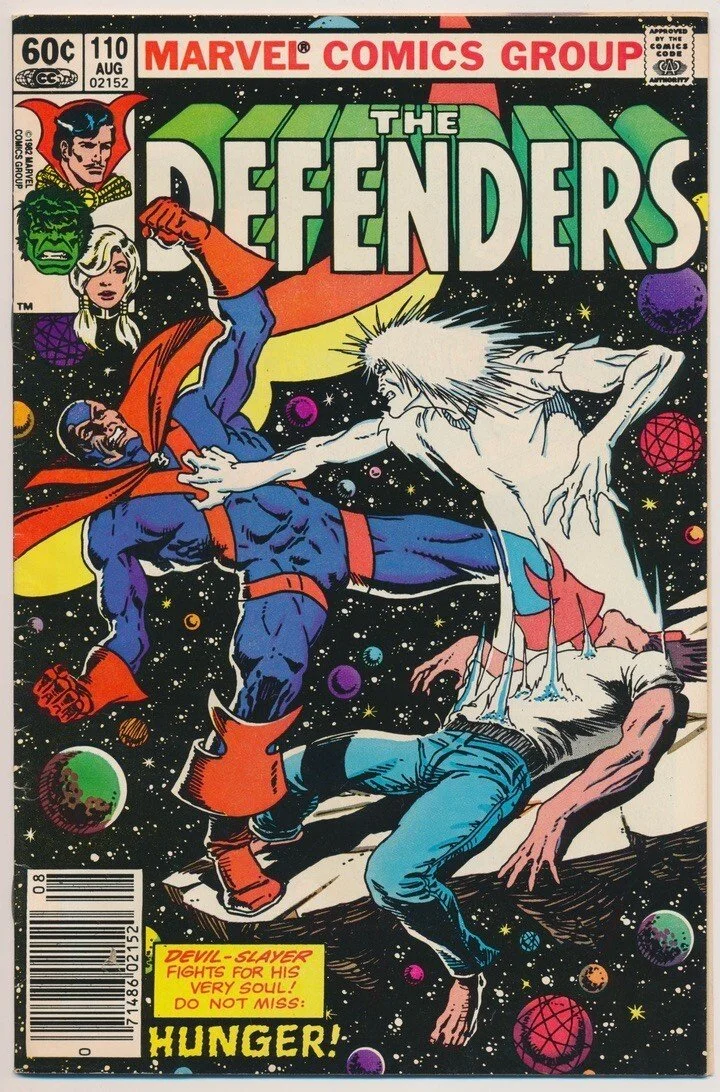
Don’t you hate it when this happens?
Since its introduction in Fantastic Four 51 ("The Man...This Monster!" by Stan Lee, Jack KIrby and Joe Sinnott), the Negative Zone has frequently served as a moral crucible for the individual characters who find themselves trapped in it. A realm of anti-matter, it inevitably leaves its visitors plummeting towards an event-horizon that will destroy them. In "This Man...This Monster!" a mad scientist who has disguised himself as The Thing has a change of heart, rescues his hated rival Reed Richards, and resigns himself to his impending destruction in the immediate aftermath of his moral redemption. Years later, an alternate version of Reed (from Counter-Earth, on the other side of the sun) initially consigns the "real" Reed to the Negative Zone, only to, like the false Ben Grimm, sacrifice himself and take his place in the anti-matter realm. The Zone is instrumental in the emotional growth of Rick Jones when he and Mar-Vell (the company's first Captain Marvel) alternate time there. Rick Moody would later mine the Negative Zone for its symbolic resonance in his 1994 novel Ice Storm, but it is the film adaptation that captures the Zone's significance best:
To find yourself in the negative zone, as the Fantastic Four often do, means all every day assumptions are inverted. Even the Invisible Girl herself becomes visible and so she loses the last semblance of her power. It seems to me that everyone exists partially on a negative zone level, some people more than others. In your life, it's kind of like you dip in and out of it, a place where things don't quite work out the way they should. But for some people, the negative zone tempts them. And they end up going in, going in all the way.
Having finally accepted some measure of responsibility for the deaths he has caused, Eric suddenly realizes why his cloak as transported him to the Negative Zone: "I am here-- to die." For everyone else who has been trapped in the explosive belt of the Zone, death appears to be inevitable--there is no escape route available (aside from the one the writers open up to their heroes at the last second). But the Devil Slayer's experience of the Zone is different: his Shadow Cloak can transport him out of the Zone at any moment. And, indeed, it does, several times, right before the asteroid he stand upon explodes.
Once again, deMatteis uses the Marvel toolbox for allegorical purposes: Eric's lifelong problem is his propensity for avoiding consequences (the Negative Zone) at the last second (using the Shadow Cloak). "Hunger" frames Eric's supernatural powers and human weakness in terms of an endless capacity for choice and evasion: "There are so many worlds to walk, so many wonder to behold, and --in all the limitless cosmos--only I have access to these myriad realms." This freedom is its own kind of trap, because it saves him from every unbearable confrontation at the last second: his morality (he leaves the Negative Zone right before an explosion four times), his dependency on alcohol (the ghost of Sunshine spurs him to leave a bar), his self-loathing (smashing a mirror in a filthy alley), his deflection of blame (retreating from the house of the mobster for whom he worked as a hitman, after being reminded that his sins are his own), his envy (the vain fury he feels when he visits a wounded veteran friend who managed to create a real life for himself), and his ex-wife Cory's terrifying call to prayer and faith). It makes sense that this last installment is told by Eric in the first person, because his dilemma is that he can never escape himself.
Or rather, he cannot escape himself if he refuses to look outside himself. This is where Cory comes in, both as a disappointing, familiar plot device (the "good woman" whose love is her only value in the narrative) and as a restatement of deMatteis's Dostoyevskian theme. Yes, Cory was mistaken to put her faith in the false messiah David, but this turned out to be an important step on her path to true salvation: faith in Christ. Despite the fact that he strikes her, despite all the misery she has put up with during and after their marriage, she jumps into his Shadow Cloak as he once again teleports to the Negative Zone, ready to die along with him. Unwilling to let her, he leaves the Zone for the final time, and beg Cory to help him believe.
"...Hunger..." has turned into a remix of Crime and Punishment," borrowing from the point in the book that so many readers find the least satisfying: Raskolnikov's acceptance of Christianity. Echoing the novel's epilogues, the last page even jumps ahead four months to an epilogue of its own, with Doctor Strange reading a letter from Cory describing their life now that he has turned himself in to the authorities and gone to prison. As in Crime and Punishment, we do not see Eric's conversion first-hand, a distance that helps make it palatable. And after being confronted by Eric's tortured consciousness for the entire issue, this distance is a bit of relief. The issue ends with Stephen Strange shedding a single tear, emblematic of deMatteis's strengths and weaknesses as a chronicler of spiritual growth: he hits all the right notes, but cannot resist the cliches of melodrama.
Next: Hunting the Spider