Let the Sunshine in
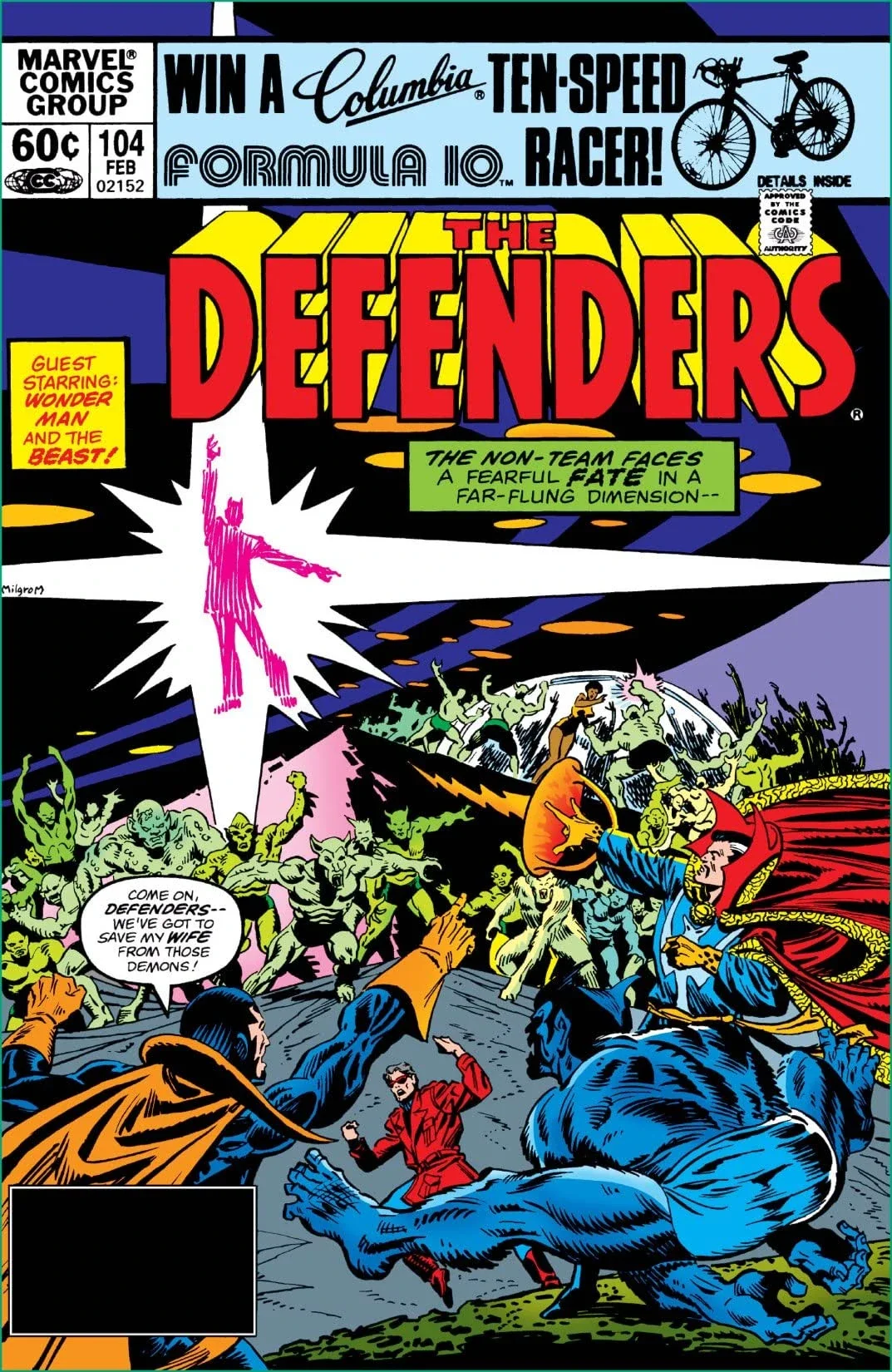
What follows is DeMatteis' Devil-Slayer Triptych: the aforementioned "Renewal!", "Yesterday Never Dies!" (Defenders 104, by DeMatteis, Perlin, and Sinnot), and "...Hunger..." (Defenders 110, by DeMatteis, Perlin, and Esposito). While his teammates are finding their bliss in Africa in the first story, Eric encounters a drug-addled ex-hippie who calls himself "Sunshine."[1] Because Sunshine is able to pierce the veil of illusion that hides his costume from ordinary humans, Eric mistakes Sunshine for a demon, before realizing that Sunshine's perceptions have been permanently altered by years of drug abuse.
Eric's first encounter with Sunshine consists of repeated threats of violence on his part, followed by recognition of kinship and a resolution to help himself before he can help the addict whose squalid life so disgusts him. Given his circumstances, Sunshine's name looks like a cruel joke, and yet he and Eric do manage to shed light on each other. They are both doubles and opposites: each of their lives was changed irrevocably by Vietnam (Eric's participation in the war and Sunshine's rejection of it as a blossoming flower child), and each has the capacity (limited and flawed though it may be) to see beneath the surface of the everyday.
yeah, that sounds totally sane
Eric and Sunshine share another distinguishing feature: each of them has outlived his context, resulting not just in their misunderstandings about each other, but in an ongoing generic awkwardness. Sunshine (like the would-be-messiah David before him) is a hippy in a world that has moved on, and Eric is constantly on the lookout for supernatural demons, even when none are to be found. To be fair, Eric does live in a Marvel superhero comic where demons are real, but his experiences have permanently damaged his capacity to recognize the mundane. When he stumbles into Sunshine's life, he does not see the far from fantastic misery that characterizes a conventional addiction plot. For his part, Sunshine has long since abandoned the ordinary perception of a default realist environment in favor of the hallucinatory charms of powerful narcotics.
In the middle installment, Eric follows through on his promise to help Sunshine, albeit with tragic results. "Yesterday Never Dies!" brings back Cory, this time as a hostage held by Ian Fate, a reporter-turned-sorceror whose wife and child Eric killed during his mob hitman days. Cory, Sunshine and Eric now form a triad linked by attempts at salvation, victimization, and self-sacrifice. Eric plans to bring Sunshine in for treatment before being derailed by the threat to Cory; Cory is stabbed to death while protecting Eric from a demon; the Cory who dies turns out to be Sunshine masked by one of Fate's spells, and Eric himself is dissuaded from taking revenge on Fate by a teammate's reminder that this entire situation is Eric's own fault.
Self-sacrifice and the recovery from crippling guilt are classic Dostoevskian themes, but DeMatteis adds a context that departs from Dostoevsky's Christian traditions. Christianity assumes an equal capacity for sacrifice among all believers, while also according all sincere sacrifice an equal value. "Yesterday Never Dies!" points to the pagan antecedents of sacrifice that are the centerpiece of Giorgio Agamben's theories of biopolitics: not all lives are valuable enough to be worth of sacrifice. In his seminal study of the same name, Agamben analyzes the Roman concept of the "Homo sacer," a social outcast who can be killed by anyone without impunity, but cannot be the subject of a religious sacrifice. Payne's own backstory is the drama of a man who has lost sight of the value of human life, first in Vietnam, then in his work as a hitman. Sunshine can no longer see the value of his own life, and it is to Payne's credit that he has endeavored to see this filthy addict as human. Here Payne must use the opposite of his "demon sight": he must look beyond superficial appearance to the humanity that lies beneath.
Corey is sacrificed twice over the course of "Yesterday Never Dies!" yet, on each occasion, her death is an illusion. The first time Fate has her suspended in mid-air over a pentagram, with six magical knives pointing at her body. A cross between a stereotypical Satanic offering and a Tarot card, this scenario, aimed as it as at Payne, is not about Corey at all ("just a projection made convincing by the images of Ikonn"). Fate does not need her death; he only needs its effect on Payne. Corey's second "death" is different: now she has chosen to put herself in harm's way, shielding Eric with her body and dying from a knife wound. Now the subject of the sacrifice has agency and purpose. The only hitch is that "Corey" is actually Sunshine, disguised by yet another illusion.
Fate, in his quest for vengeance, proves himself to be an imperfect victim. Yes, his wife and child did not deserve to die at Payne's hands, but Fate abducts and disguises Sunshine because he cannot accord the addict's life the same value as Cory's:
I couldn't take an innocent woman's life! I sent Cory back home..../ But I still had to hurt you--you see that, don't you? That's why I transported that pathetic junkie here...surrounded him in illusion and silence! / He wasn't innocent! He was worthless!/ But I could see that you cared about him!
When Wonder Man reminds Payne that everything that has happened with Fate is all his fault, he is not simply reinforcing the themes of guilt and redemption that are evident in each installment of DeMatteis' Devil Slayer triptych. He is also highlighting the problems of agency and misprision that manifest themselves throughout these stories. Payne's guilt is undeniable, and his quest to exterminate demons is an obvious externalization of his own failed attempts at exorcising the devils that have been haunting him since Vietnam. But even as his mental powers give him the capacity to see demons in disguise, these powers consistently fail him, because he lacks the capacity for clear moral judgment. Instead, he projects his guilt and shame onto others, reducing them to players in his own psychodrama.
Note
[1] In his few, brief appearances as a minor character in The Defenders, he is always referred to as "Sunshine" (in quotation marks). I have left the quotation marks out, because I find them distracting, not to mention unnecessary ("Devil-Slayer" is fine without quotation mark, but "Sunshine" isn't?).
Next: Transcending the Negative Zone