The defeat of Satan and the Six-Fingered-Hand (in the 100th anniversary issue, no less) was thus a victory that the Defenders could not reasonably celebrate. In a move that was uncharacteristic for Marvel at the time, DeMatteis chose to let his characters sit with their feelings of loss and despair for the better part of an entire issue ("Renewal," Defenders 101, by DeMatteis, Perlin, and Joe Sinnot). Or perhaps "better" is not the word here; with the exception of one powerful plotline, DeMatteis displays his worst, most mawkish instincts. Not only is Patsy comforted by a bald-headed little girl in a cancer ward who is wise beyond her years, but Dr. Strange and Clea regain their appreciation of life when the Silver Surfer takes them to "Africa"("It's no longer the heart of darkness Jospeh Conrad wrote about some sixty-five years ago, but it still [sic] a continent that evokes a deep, primal awe""). Among the "simple people" in the village that welcomes them, the two mystics are renewed.
The saving grace of an issue that tries so hard while falling so flat is yet another character whom DeMatteis had recently adopted as his own: Eric Simon Payne, the Devil-Slayer. Created by David Anthony Kraft and Rich Buckler in 1975 as Demon Hunter for Atlas Comics, the chracter initially had better luck killing off comic books than denizens of hell. He appeared only once before the company shut its doors. With a few minor changes, they revived him as Devil-Slayer in Marvel Spotlight 33 (April 1977), the last issue of a series that had run for six years. Undaunted, Kraft brought him into The Defenders for a compelling three-issue sequence called "Xenogenesis: Day of the Demons." From the beginning, Kraft set Payne up as a flawed, tragic figure: a traumatized Vietnam veteran and soldier of fortune who gained a mystically-empowered cloak and psychic abilities when he joined a demonic cult.
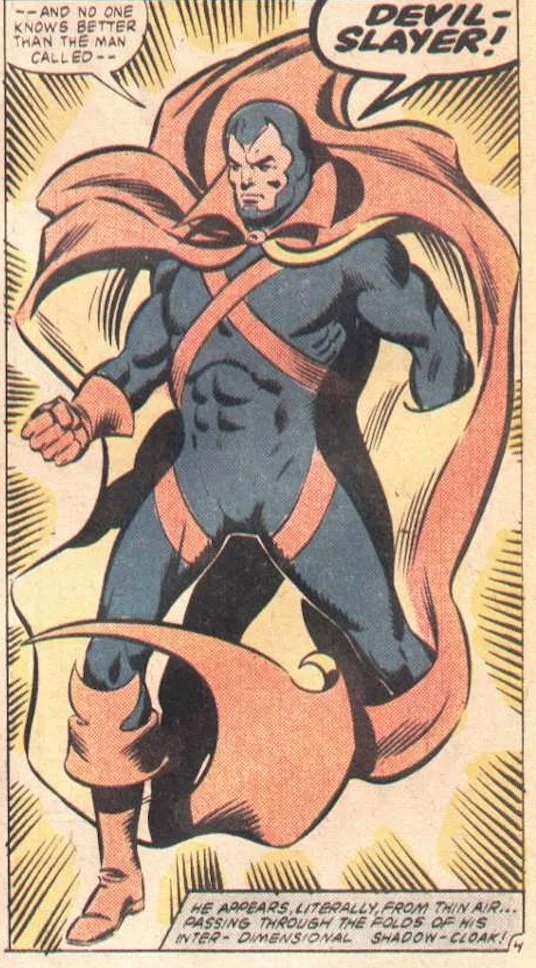
In other words, Devil-Slayer was the sort of character that DeMatteis found irresistible: flawed, tortured, with a tragic backstory steeped in magic and horror. Like Daimon Hellstrom, he was a sensible choice for a storyline involving demons and devils. His very name is as much a clever bit of irony as it is a mission statement, as the only devils Eric Simon Payne cannot slay are his own.
Thus what looks like just another supernaturally-themed guest appearance (after Dracula and Ghost Rider, but before Man-Thing) is actually Devil-Slayer's introduction as a semi-regular Defender. As with Nighthawk just a few months earlier, DeMatteis introduces Devil-Slayer in Defenders 98 ("Slouching toward Bethlehem," by DeMatteis, Perlin, and Sinnott) by focusing on a meaningful relationship from his troubled past: his (estranged) wife, Cory, who writes to Eric that she has discovered true happiness on an Israeli kibbutz run by David Kessler, a self-proclaimed messiah.
Devil-Slayer's introduction to the team takes place in an issue that displays DeMatteis' growing mastery of his craft: "Slouching toward Bethlehem" simultaneously advances the overall plot (confronting the fifth of the hand's six demons), develops the themes that would prove central to DeMatteis' run on the book, and deploys most of the comic's recent character transformations to move the plot along. In order to investigate this mysterious messiah, Dr. Strange yet again cast an "unstable" teleportation spell, this time to bring the team to Israel (later we learn that forcing Strange to repeatedly use this spell is part of the Hand's plot to weaken the barriers between Earth and Hell). No one thinks about the time difference, however, and Kyle Richmond, whose ability to move his body now only functions at nighttime, quickly relapses into paralysis once he suddenly finds himself in daylight. Rather than complain (much), Kyle volunteers to be a guinea pig for David Kessler's alleged healing powers.
In one of the most tightly-controlled sequences in all DeMatteis' Defenders run, the next six pages show Kyle's successful healing by David (involving a full-body baptism-style immersion followed by thunder and lightning) while a reunited Eric and Cory continue their ongoing argument about faith as Cory tells her estranged husband about the angelic visitation that granted David his powers. At the sight of Kyle standing on his own two feet, all the Defenders feel the need to reassess their opinion of David's claims, all except the Son of Satan. DeMatteis' is creating a brief tale of faith, disillusionment, and persistence that now unfolds in a series of visually striking revelations: first David strips the illusions masking the true appearance of Daimon Hellstrom and Gargoyle, then David summons the "angels" who have empowered him, only to have Dr. Strange reveal them to be demons. David himself is completely taken over by "Hyppokri--demon of the hand!" before refusing to let himself be used any longer and ending his own life by throwing himself onto Eric's outstretched sword.
As Devil-Slayer, Eric's power is to see the demons who disguise themselves as humans, but his first appearance in the Six Fingered Hand Saga continually calls into question the extent to which appearances can be trusted. Those who appear to be angels are actually demons, while those who look demonic (such as Isaac and Daimon) are on the side of the (metaphorical) angels. Cory's faith allows her to persist in believing in the good that has been corrupted by evil ("Hyppokri"), while Eric is still, for the moment stuck in his black-and-white outlook.
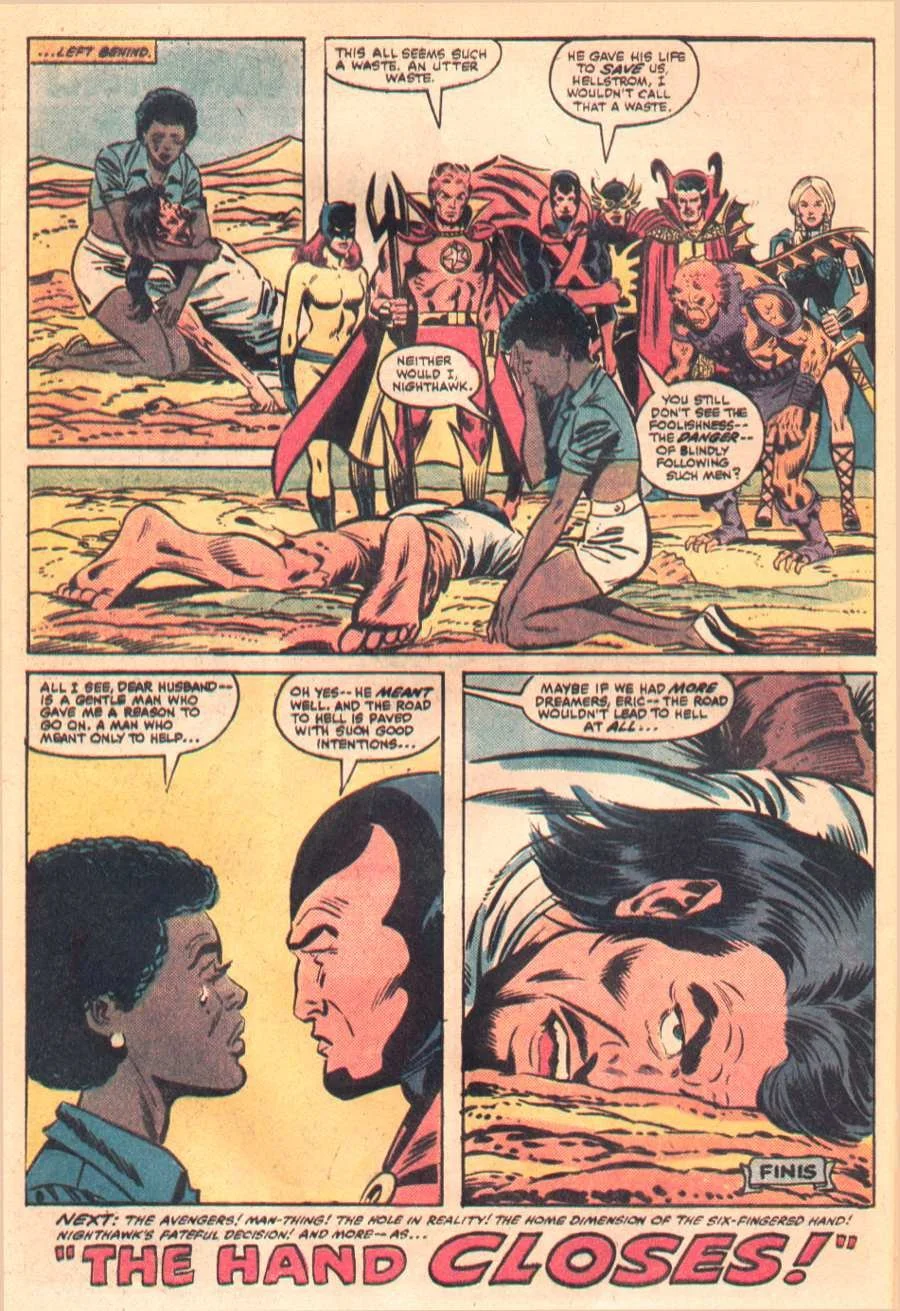
Though DeMatteis did not create Devil-Slayer, he zeroed in on elements of the character's back story to use him as a vehicle for stories of disillusionment, enlightenment and redemption, both of which are featured in "Slouching towards Bethlehem:" post-Vietnam America (David was a hippy before finding "God') and his relationship with Cory. Cory was a cipher in Kraft's and Buckler's hands (to be fair, they had little opportunity to do anything with her), while DeMatteis folds her into the redemption narrative so effortlessly that one might think that had always been her role. Cory's function as the vehicle of Eric's eventual salvation is, of course, a familiar stereotype, but she does not accomplish this miracle on her own. Rather, as someone who believes in God and Eric, she is poised to pick up the pieces when he is finally ready to rebuild his life.
Next: Let the Sunshine in