The Dark Phoenix trilogy (X-Men 135-137) is one of those landmark stories that, thanks as much to its influence as to changes in storytelling styles, can read like a collection of clichés. In the four decades since, heroes have gone "dark" again and again, especially female heroes, and the tropes involved have moved from comics to animation to television and film. The Phoenix saga has been revisited on multiple occasions in the various volumes of What If?, retold in Marvel's Ultimate Comics line, adapted for the 1990s animated series (with a happier ending), served as the basis of two different X-Men movies (X-Men: The Last Stand and X-Men: Dark Phoenix), and used as the obvious model for Willow's corruption on Buffy, the Vampire Slayer. Sue Richards went briefly dark to become "Malice" when John Byrne was writing and drawing Fantastic Four, while Wanda Maximoff's descent into madness and occasional evil was a years-long set of Avengers plotlines that inspired WandaVision and Doctor Strange and the Multiverse of Madness. Starting in the 1980s, comics creators realized that Lee and Kirby's aversion to giving female characters physical powers meant that their potential was actually far greater than that of their male counterparts (Jean, Sue, and Wanda being the salient examples). The contrast between their 60s and modern power sets lent itself to drama, but the frequency with which specifically female characters found themselves overwhelmed by near godlike-power looks suspicious. These women's journeys complete a full circle from helplessness to strength back to helplessness again.
The Dark Phoenix storyline thoroughly committed to the metaphor of the divided self, to the extent that it was never clear whether or not the Phoenix was actually a separate entity. Both the captions and Jean's own dialogue suggested that the Phoenix was a primal force (and therefore existed before the space shuttle incident), while Claremont's tendency to have characters refer to themselves in the third person for dramatic effect did not help matters ("Dark Phoenix knows nothing of love!" X-Men 136). Not long before her suicide, Jean explains to Colossus:
Two beings--Jean and Phoenix--separate--unique--bound together. A symbiote, Peter; neither can exist without the other.
Phoenix provides my life force, while I provide a living focus for its infinite power.
[..]
The Phoenix is a cosmic power. It can neither be contained nor controlled---especially by a human vessel. Return it to the cosmos which is its home.
Kill me! ( X-Men 137)
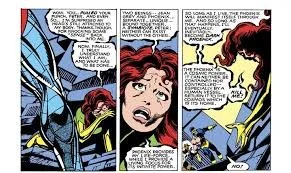
Jean Grey’s secondary mutation: drama queen
Within the fictional framework of the X-Men, Jean's explanation can be taken at face value. Indeed, it serves as the basis for a massive retcon years later, allowing Jean to come back to life, unburdened by responsibility for the Phoenix's actions. [1] But it also literalizes the metaphor of divided self to the point of dissociation. Hence Jean's ability to watch the Phoenix's actions at a distance: it is her, but it is also not her.
In any case, the retcon about the Phoenix Force is not relevant here, if we want to read the comic as it could have been read when it was first published (September 1980); Jean would remain dead for over five years before she was brought back in Fantastic Four 286 (January 1986). Moreover, to the extent that one cares about authorial intent, once Jim Shooter forced Claremont and Byrne to redo the last pages of X-Men 137 to kill Jean rather than simply de-power her, both of them wanted her death to stick. [2] Without the "Phoenix Force," Jean's dichotomy is much more interesting.
When Scott confronts Jean at the end of X-Men 136, he addresses her as Phoenix, before telling her, "You're also still Jean Grey, no matter how hard you try, you can't exorcise that part of yourself. It's too fundamental." This is when she replies to him in the third person: "Dark Phoenix knows nothing of love." Scott disagrees; everything that led her to become Phoenix was motivated by love: "Jean, you are love!" Her response is revealing: "I...hunger, Scott---for a joy, a rapture, beyond all comprehension. That need is a part of me, too. / It consumes me." The Phoenix is a creature of passion, but the thing she and Jean share (as one entity, speaking in the first person) is appetite. As so often is the case in superhero comics, the metaphor is literalized: in the previous issue, Jean/Phoenix, in a thought-ballooned monologue whose tone is completely consistent with Jean's speech patterns before and after becoming Dark Phoenix, has to admit that "like it or not--and I don't--I still have limits./ I'm ravenous. Before I go on, I need sustenance./ This star should do nicely." She consumes that star, killing the five billion people in its orbit. Jean Grey, who has spent her entire adult life in love with Scott Summers, the past master of self-denial, is undone by needs that she cannot suppress.
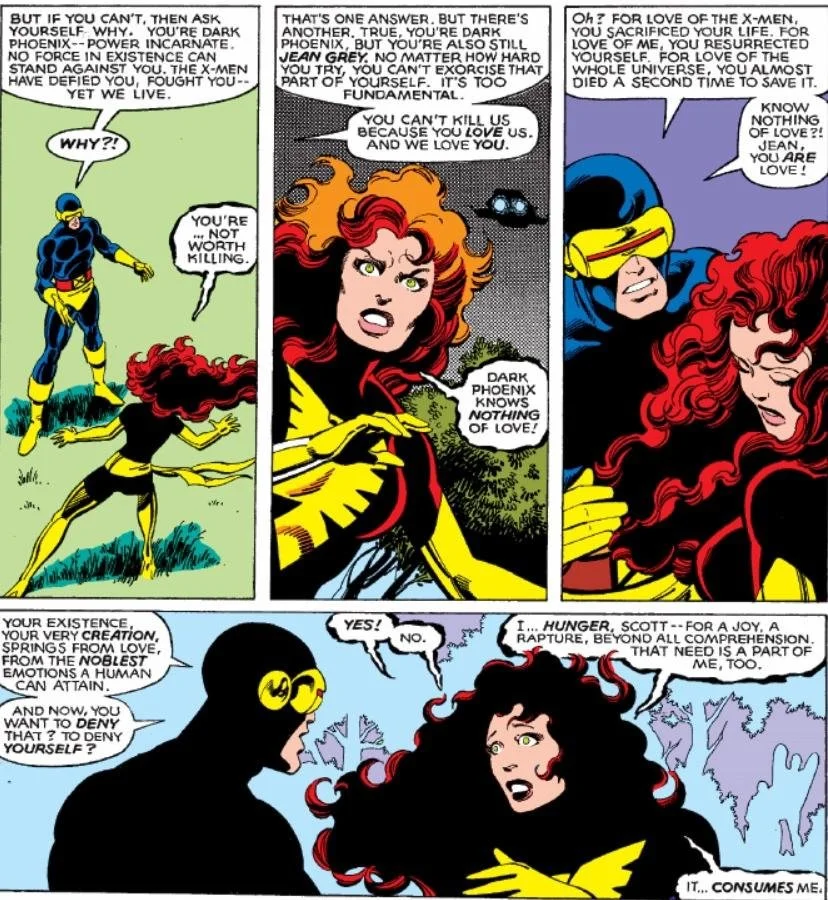
Yeah, Scott’s not going to fill that hunger
Defeating Dark Phoenix, even temporarily, requires curbing her power, her needs, and her passion, all at once. The middle part of the trilogy shows three different men attacking the "problem" from different angles. Hanк McCoy (the Beast) has thrown together a "mnemonic scrambler" that will interfere with Jean's psychic. powers: "she shouldn't be able to think a coherent thought, much less read minds or throw telekinetic bolts," he tells Scott. It as it this moment that Claremont engages in what seems to be a typically superfluous elaboration of a character's power set. As he takes off his visor and puts on his glasses, he thinks:
I can't open my eyes, even the tiniest fraction, until I've put on my special ruby quartz glasses, or my optic blasts could punch a truck-sized hold in the wall.
I've had to be this careful since before I joined the X-Men. I'll have to stay this careful till the day I die.
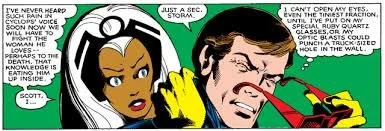
Ok, Scott, we get it, but is this really the time for your whining?
The adherence to the premise that "every comic is someone's first comic" here is almost endearing; X-Men 136 is not just the middle installment of a trilogy, but the eighth issue of a nine-issue trilogy of trilogies, not to mention the culmination of years of subplots. But this exposition is, in fact, going somewhere. Scott continues:
Ororo wants to help me, to comfort me. But I can't given in. Not yet. If I give full rein to my feelings, i'll....shatter.
For Jean's sake, as much as everyone else's I have to stay strong... in control.
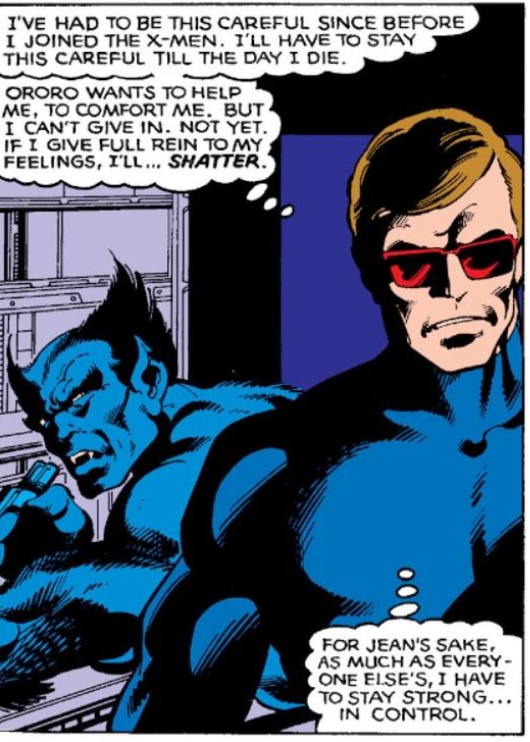
Dude, I don't know how to tell you, but that’s not Ororo
In other words, Scott is facing Jean's dilemma on a much smaller scale, but it is one he has grappled with for his entire adult life. Beast's attempt to defeat Dark Phoenix with technology only works temporarily, letting Jean's human side emerge and beg Wolverine to kill her, but this, in turn, only plays on Logan's emotions and prevents him from taking action. When Jean burns out the mnemonic scrambler, Cyclops takes his turn. For once, though, instead of serving as the voice of repression, he approaches Phoenix on her own turf: passion and love. Once again, the connection between Phoenix and her attacker/interlocutor is cut short, but not by Phoenix; Xavier strikes her down with a mind blast. As the final issue of the trilogy will show, bypassing Phoenix and breaking through to Jean is always a temporary measure: they are linked by passion, and appeals to Jean emotions are a gateway right back to Phoenix. Xavier is the only one who can fight her on her own terms, and not just because of the nature of their abilities. He tells Phoenix that she represents "Power without restraint--knowledge without wisdom--age without maturity--passion without love." Implicitly, Xavier embodies all that she lacks. Yet this, too, will be a temporary solution: the Phoenix will always come back.
And this is part of why the end of the Dark Phoenix trilogy works so well, despite being imposed on the creative team at the last minute by an uncompromising editor-in-chief. The men in Jean's life, even with the best of intentions, cannot help her without depriving her of agency. In that regard, the original ending, with Empress Lilandra performing a "psychic lobotomy" to remove Jean's power is, while not as egregiously gendered, even worse. The only way for Jean to remain true to one version of herself is to kill both.
But even as the Dark Phoenix Saga paves the way for Claremont's many other divided and tortured female characters, Jean's suicide forecloses what would become the most productive avenue for Claremont's exploration of his characters's conflicted psyches: she does not survive the experience long enough to even begin processing her trauma.
Or at least, not yet. After her revival in the mid-1980s, Jean's internal divisions become externalized. Rather than having too many selves in one body, there will be too many iterations of Jean Grey for her to maintain a stable identity. Her dilemma is shared by Claremont himself, who was obliged to make sense out of Jean's resurrection after already populating the X-Men's world with a lookalike (Madelyne Pryor) and Jean's daughter from an alternate future (Rachel Summers, who eventually takes the name Rachel Grey). Claremont generally prefers his characters to contain multitudes, rather than to have multitudes consisting of variations on the same character. We will see how he manages, but only after examining the divided selves he explores in the interim.
Notes
[1]. Fantastic Four 286, written and penciled by John Byrne, and based on an idea by Kurt Busiek, reveals that Jean was never actually the Phoenix. On the verge of death while piloting the space shuttle, she is visited by the "Phoenix Force," which makes a deal with her: Jean will serve as the template allowing Phoenix to exist on our plane, and the Phoenix will save her life. Jean's body is slowly healing in a cocoon at the bottom of Jamaica Bay, while the Phoenix takes her place, believe itself to actually be Jean Grey.
[12] Byrne even showed up at Chicago ComiCon in 1980 wearing a custom-made t-shirt saying "SHE'S DEAD AND SHE'S GOING TO STAY DEAD" (https://www.fandom.com/articles/jean-grey-changed-death-comics)
Next: Where Is My Mind? Rogue, Carol Danvers, and the Boundaries of Selfhood