After the Dark Phoenix storyline, The X-Men continued to tell powerful stories for the brief remainder of Byrne's tenure on the book, with the Days of Future Past two-part dystopian future storyline (141-142) and Kitty Pride's solo fight with a N'Garai demon (143) as particular high points. Over the next three years, Claremont worked with a variety of artists: Cockrum returned with issue 145, penciling sixteen out of twenty consecutive issues from 1981-1982, Brent Anderson drew two stand-alone stories and an annual (144, 160, and Annual 5), Bob McLeod did a two-parter (151-152), and Bill Sienkewicz drew two stories featuring Dracula (159 and Annual 6). Paul Smith was the regular penciler for roughly a year (165-170, 172-175), with a break for guest pencils by Walt Simonson (171). It was only in 1983 that Claremont would get a regular, long-term partner for Uncanny X-Men: John Romita, Jr., who, after an early stint on an annual (4), began a four-year run with issue 175 and ending with 211 (with other pencilers, notably Barry Windsor Smith doing the occasional issue along the way). [11] The first half of the 1980s saw the Uncanny X-Men lurch wildly from genre to genre, with long storylines briefly interrupted for unrelated adventures. The X-Men went into space, fought vampires, found themselves in alternate, mystical realities, and welcomed new members (though not always with open arms). To say that the one constant was change would not just be a cliché, but would also suggest a consistency of planning that was impossible at the time.
The real throughline for the the first half of the post-Byrne decade was Claremont's complicated, divided, traumatized women. Storm underwent a surprising character arc involving violence, love, and punk fashion. Colossus's sister Illyana was raised by demons in another dimension before returning home, having aged several years over the course of a few seconds. [1] The various iterations of Jean Grey are too complicated even to begin to describe yet. But the most intriguing exploration of duality, trauma, survival, and selfhood involved two characters very close to Claremont's heart. One of them was his (co-) creation, Rogue, and the other was a character he repeatedly rescued from weak writing and poor editorial policy, Carol Danvers (the current Captain Marvel). These women did not merely share a common trauma; in an event that will forever link them, each both causes and embodies trauma for the other.
Created by Roy Thomas and Gene Colan, Danvers was introduced in 1968 as part of the supporting cast for Marvel's first Captain Marvel, Mar-Vell (yes, there are far too many "Marvels" in this sentence, but hardcore comics fans will understand why this is unavoidable). [2] Originally the Security Chief at a military base, she overcomes her distrust to befriend Mar-Vell (an officer of the alien Kree). Exposure to an exploding Kree weapon gives her powers like his, and in 1977, she gets her own series as the heroine Ms. Marvel (created by Gerry Conway and John Buscema).[3] Ms. Marvel's initial adventures were, as we like to say nowadays, problematic: Carol had left the military to edit Womanmagazine for Spider-Man's nemesis J. Jonah Jameson, unaware that she had a second personality, a superpowered woman who wears a revealing version of Captain Marvel's costume, has no idea about Carol's existence, and has a precognitive "seventh sense" related to women's intuition.
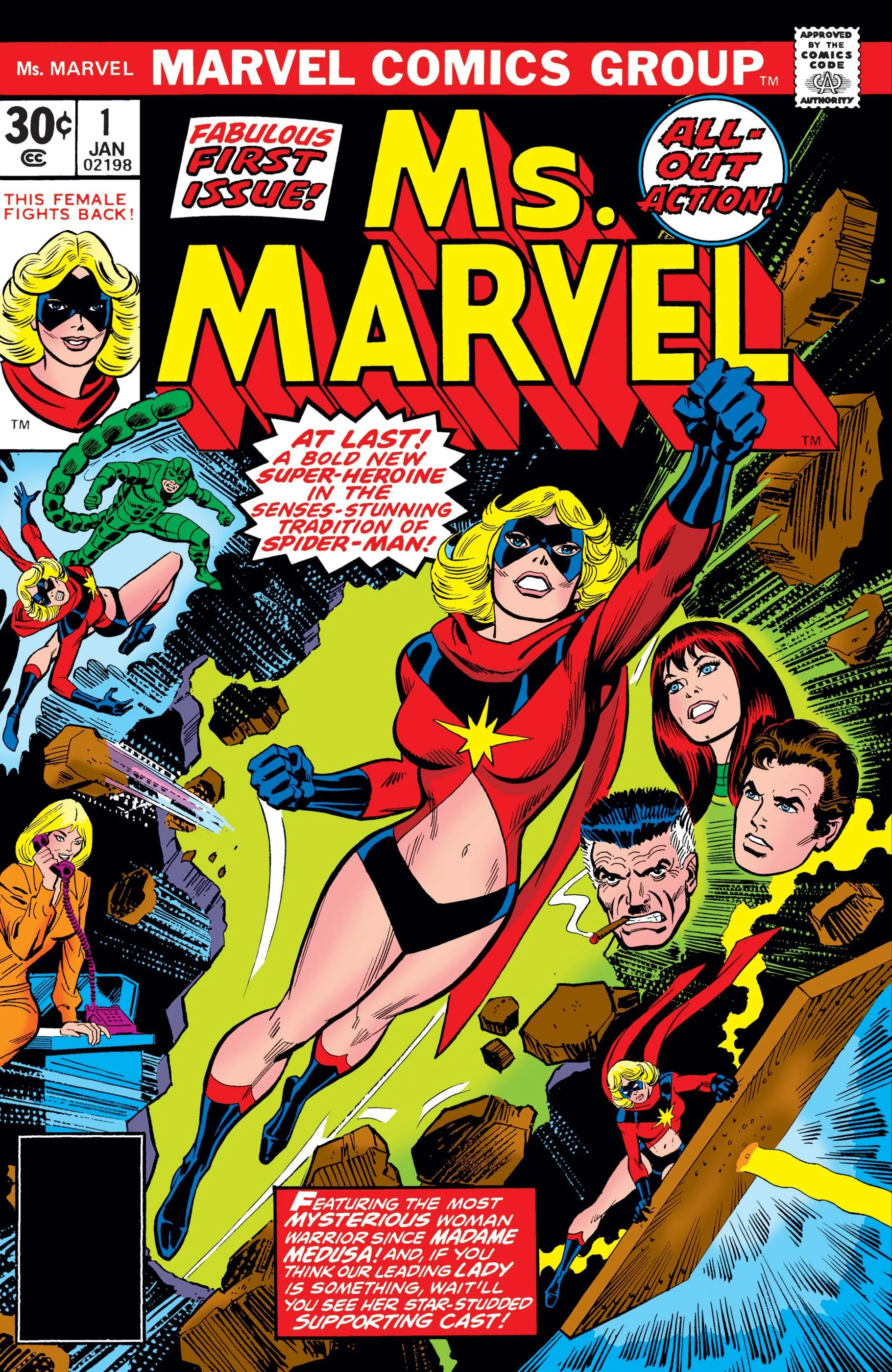
“This female fights back!” Nothing says “empowerment” like taking a man’s costume and exposing the legs and midriff to make a female version.
Claremont took over the title with issue 5, joining penciler Jim Mooney, who was already on the book. By this point (1977), Claremont had already shown his facility for writing "strong female characters"; this phrase is generally inadequate due to its emphasis on strength over complexity, but not out of place when applied to Claremont's women, who exemplify both qualities. Claremont quickly dispensed with Carol's dissociative identity disorder, downplaying the aspects of the book that were based on stereotypical feminine weakness. He gave her a more developed backstory, including both a reasonable adult history of past romantic relationships and a long record of professional accomplishments. But with the benefit of hindsight, Ms. Marvel's introduction as the alternate personality of an unknowing Carol Danvers inadvertently established a pattern for all the iterations of the character to follow: Carol's sense of selfhood is repeatedly under threat.
With Claremont, though, Carol Danvers was in safe hands. Unfortunately for her, she was also a semi-regular character in the Avengers, where her strident "women's lib" received the occasional pushback.
And then things got really bad.
Notes
[1] Both Storm and Illyana have fascinating character arcs during this period, but they are not covered here out of concerns for space.
[2] A very quick summary of a very long story: created by C.C. Beck, the original Captain Marvel was published by Fawcett Comics. National (DC) sued Fawcett for copyright infringement over his similarities to Superman. The end result was Fawcett's closure and DC's acquisition of Captain Marvel and his supporting cast. Meanwhile, Marvel decided that if anyone should publish the adventures of a character named "Captain Marvel," it should be them. This is why the DC adventures of the original Captain Marvel are usually given the title "Shazam."
[3] This origin is later retconned to make Carol less dependent on Mar-Vell, but that is not relevant to the present discussion.
Next: Revisiting the Rape of Ms. Marvel