In Avengers 197, Ms. Marvel has a long talk with Wanda Maximoff about the Scarlet Witch's desire to have children. Scandalously, Carol reveals that she's not sure she ever wants to have any, whereupon she collapses in a sudden swoon. The issue ends with the revelation that she is three months pregnant--dramatic irony and sexist karma in a single package.
It turns out this is no ordinary pregnancy. The fetus is developing at an inhuman rate, and three issues later she is ready to give birth. The Avengers' big anniversary issue (200) is devoted entirely to Ms. Marvel's pregnancy, labor, and aftermath. Credited to a whopping four writers (James Shooter, George Perez, Bob Latyon, and David Micheline), "The Child Is Father to...?" has gone down in Marvel history as one of the most notoriously misogynist comics of the second half of the twentieth century (and one to which none of the four writers involved are so eager to proclaim paternity). The title of Carol A. Strickland's influential essay on the subject says it all: "The Rape of Ms. Marvel."
Carol gives birth quickly and painlessly in the beginning of Avengers 200, and despite the mysterious circumstances of her child's conception, not to mention his rapid growth to adulthood, all her teammates treat her condition as if it were a happy, welcome event (the Beast even shows up with a pile of sports equipment for her son). It is bad enough that the men cannot even begin to comprehend her feelings; even the two (childless) women on the team display a shocking lack of empathy:
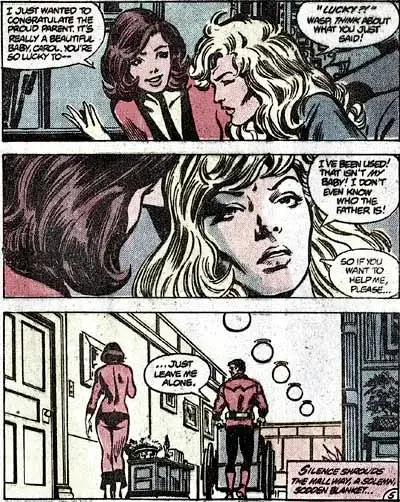
The Wasp: "I just want to congratulate the proud parent. It's really a beautiful baby, Carol. You're so lucky to--
Carol: "Lucky?!" Wasp, think about what you just said!/ I've been used! This isn't my baby! I don't even know who the father is! / So if you want to help me, please.../ ...just leave me alone."
By all rights, this comic should be a feminist horror film, a cross between The Handmaid's Tale and Get Out!, but most of the issue paints Carol as the problem. The baby, now a grown man named Marcus, has been constructing a mysterious machine, and when Carol confronts him, he knocks her out ("Forgive me, mother. / Forgive me...my love.") After he is defeated, he finally reveals his origin. He is the son of the time-traveling lord of Limbo, Immortus. Immortus had gotten lonely, so he rescued the last survivor of a shipwreck, and courted her, supervillain style: "Once back in Limbo, through a combination of gratitude and the subtle manipulations of my father's ingenious machines," the woman fell in love with him. After giving birth to Marcus, the woman (who never even gets a name) disappears, and so does Immortus. A now-grown Marcus decides he needs to be born again on Earth, outside of Limbo, so that he can avoid the time distortion effect that took his mother. With all the consideration of a farmer selecting a cow for insemination, he "determined that Ms. Marvel, the powerful combination of Kree and human strengths, would be the perfect vessel." Like his father, he sets about "winning" the woman he kidnaps, wooing her for weeks "admittedly, with a subtle boost from Immortus' machines." Strangely, no one listening to his story seems to notice that he is describing brainwashing.
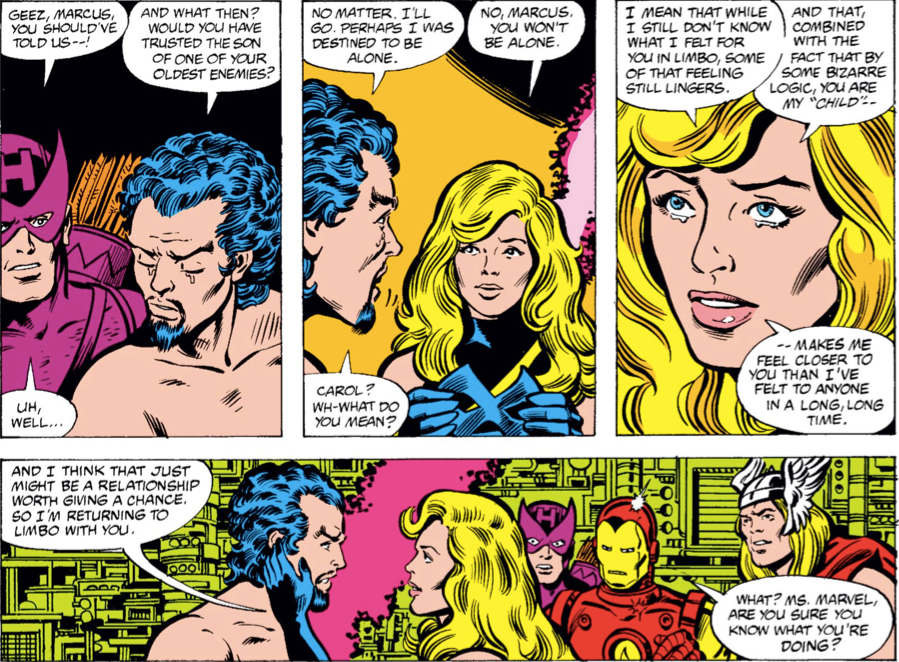
Marcus explains all of this to Carol and the Avengers, concluding, in his perfect proto-Incel fashion, "I'll go. Perhaps I was destined to be alone." But, inexplicably, Carol announces she is going with him:
I mean that while I still don't know what I felt for you in Limbo, some of that feeling still lingers.
And that, combined with the fact that by some bizarre logic, you are my "child"---
--makes me feel closer to you than I've felt to anyone in a long, long time.
And I think that just might be a relationship worth giving a chance. So I'm returning to Limbo with you.
This story so clearly misfires in its misogyny that most of its characters find themselves delivering thinly-veiled meta-commentary on how to receive it. Iron Man at least as the decency to ask if she's sure; Carol replies that she isn't, "but I've been denying my feelings for quite a while. Maybe it's time I started following them."
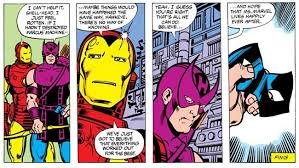
The last word is given to Carol's male teammates. Iron Man concludes that "we've just got to believe that everything worked out for the best." Hawkeye agrees: "Yeah, I guess you're right. That's all we can do. Believe.../...and hope that Ms. Marvel lives happily every after."
Avengers, or Abetters?
Iron Man and Hawkeye are half-heartedly trying to convince the readers that all's well that ends well, but the perfunctory manner in which Ms. Marvel is shunted off-stage to join her rapist is hard to miss. As a character, Ms. Marvel began as an attempt to capitalize on the interest in female superheroes, use the Marvel name, and, to quote Stan Lee, show "tits and ass." Claremont saved her from this fate early on, but with the book's cancellation, the Avengers writers never knew what to do with her. When characters stop appearing in comics for an extended period of time, fans and pros say that they are stuck in "limbo." This issue of the Avengers actually sends Carol off to a literal "Limbo," in the hopes that she can be comfortably forgotten.
Fortunately for fans (and for Marvel and Disney, which would go on to make a great deal of money on her cinematic counterpart), Carol did not stay in Limbo very long. Once again, Claremont came to her rescue, even if this formulation does frame Carol Danvers as a damsel in distress. Her salvation by Claremont gives her the tools to function as a viable character (eventually written by women), but her path to success is paved by further trauma.
Next: Going Rogue