Exactly a year after Avengers 200 sent Carol off to Limbo, Avengers Annual 10 (written by Claremont, with Michael Golden on pencils) brought her back in a story aptly titled "By Friends---Betrayed!" Claremont's response to the original story, which left no room for Carol's subjectivity (or even her basic feelings), was to lean into that basic denial of selfhood. When Spider-Woman rescues a mysterious blonde woman thrown off the Golden Gate Bridge, it takes some time to identify her as Carol Danvers, and even longer as Ms. Marvel. Her mind has been completely erased; it is only with the help of Charles Xavier does she get most of her memories back. Xavier, as Claremont's surrogate, literally rebuilds her character. During a fight with Rogue, the two were in physical contact for too long. Normally, Rogue's absorption of powers and memories lasts a limited time, but now the transfer is permanent.
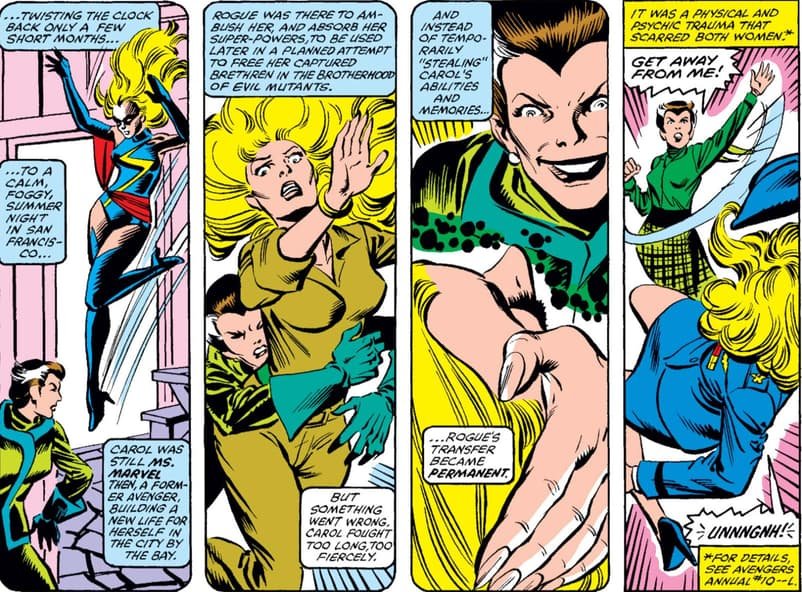
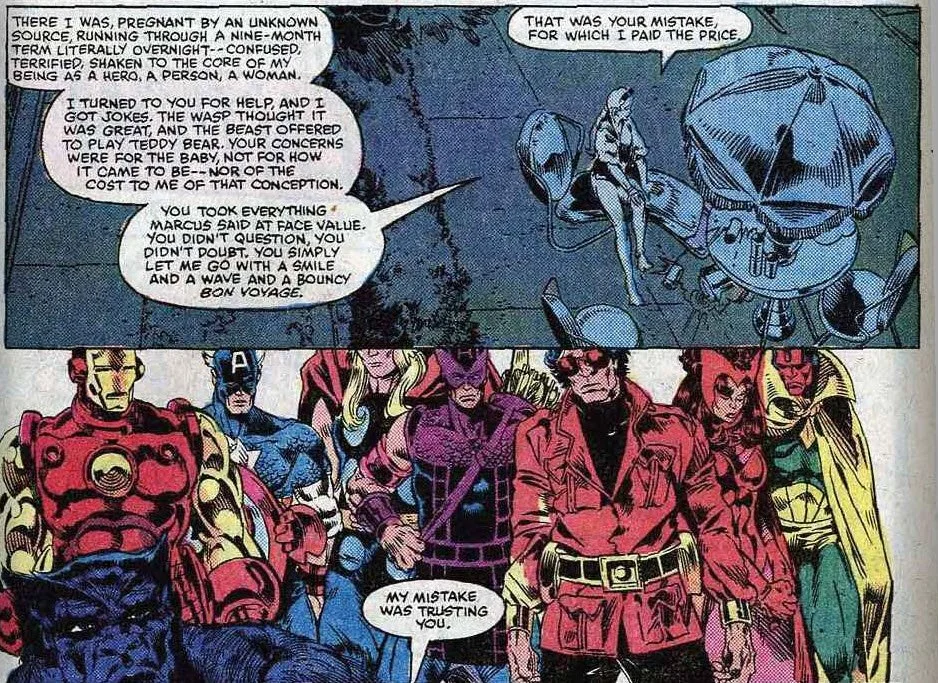
It would only be in Rogue's next appearance that we learn that the experience was traumatizing for her; Avengers Annual 10, quite understandably, focuses on Carol. In a book full of fight scenes (primarily with the Brotherhood of Evil Mutants), it is in Carol's confrontation with the Avengers in the last six pages that the real drama unfolds. Carol's weapon of choice is words (although she does actually slap Thor in the face at one point); the Avengers also speak, of course, but their words are, as in Avengers 200, cringeworthy misfires. Hawkeye the archer is particularly off the mark: "What happened to Marcus? After you left with him, we didn't expect to see you two lovebirds again." Carol explains what should have been obvious: Marcus (now dead) brainwashed her:
There I was, pregnant by an unknown source, running through a nine-month term literally overnight--confused, terrified, shaken to the core of my being as a hero, a person, a woman.
I turned to you for help, and I got jokes The Wasp thought it was great, and the Beast offered to play teddy bear. Your concerns were for the baby, not for how it came to be--nor of the cost to me of that conception.
You took everything Marcus said at face value. You didn't question, you didn't doubt, you simply let me go with a smile and a wave and a bouncy bon voyage.
At this point, her personality only recently reconstructed and her powers gone, all that is left of Carol Danvers is her trauma. Claremont immediately starts the long process of reconstructing her, bringing Carol into the X-Men's supporting cast for a year's time. She confronts the still-villainous Rogue again in The Uncanny X-Men 158 ("The Life that Late I Led...", by Claremont and Cockrum), and, on a mission to remove all record of the X-Men from government databases, erases her own double identity's personal files as well ("the women they represent...are strangers"), determined to "begin my life anew." Which she does, but, once again, through unspeakable suffering: when the X-men are captured by the alien Brood, her strange genetic make-up encourages them to experiment on her ("Though she is experiencing supposedly unendurable pain, she remains aware of all that transpires" (Uncanny X-Men 163, "Rescue Mission," by Claremont and Cockrum). After her rescue, she undergoes a transformation that gives her powers that are "the functional equivalent of a star" (Uncanny X-Men 164, "Binary Star," by Claremont and Cockrum).
At this point, Carol's days with the X-Men are numbered. Once back on Earth, with her ill-defined cosmic power set, the newly-Christened "Binary" could be just as difficult to fit into a team dynamic as Phoenix was, but with less reason for inclusion (Carol is not a mutant). Claremont has one last chance to explore Carol's trauma and recovery before handing her off to others; in Issue 171, "Rogue," with guest pencils by Walt Simonson, Carol visits her parents, frustrated that, while she has most of her memories, "there are no emotions to go along with them." She returns to the X-Mansion, only to find that the teams has inducted Rogue as their newest member. Naturally, a fight ensues, ending in an eerie parallel with Avengers Annual 10: Carol tells the team that she feels hurt and betrayed, and leaves.[1]
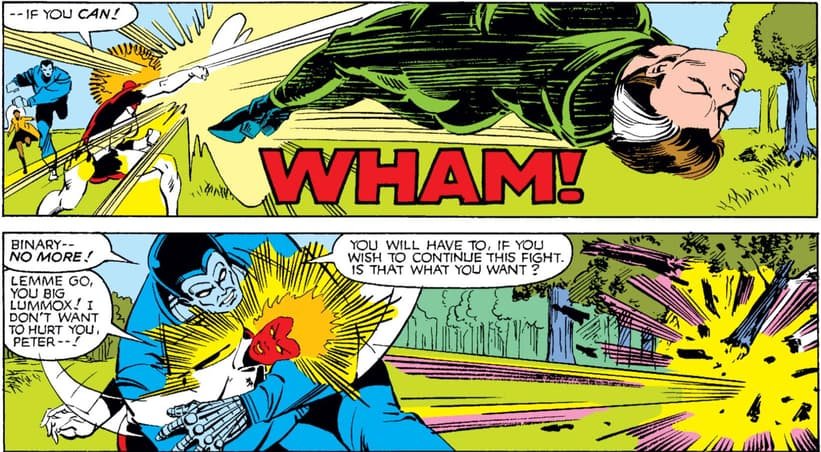
"Rogue" packs in more trauma per panel than any other X-Men story to date, featuring characters who are all trying and failing to recover. In the previous issue, Storm had just won leadership of the outcast mutants known as the Morlocks after stabbing the previous leader, Callisto, in a duel; now Callisto can barely stand. Scott Summer's new lover, Madelyne Prior, is having nightmares about the plane rash she survived, while Charles Xavier is unable to beat the phantom pain that prevents him from using his new, cloned body to its potential. Storm is so out of sorts that she can't water her plants without killing them, and ends the issue contemplating leaving the X-Men.[2]. But the main victim of trauma this issue, as well as its primary source, is the character who gives the story its title: Rogue.
Still suffering the aftereffects of her extended exposure to Ms. Marvel, she now has even less control over her powers than before (a problem exacerbated by Mastermind's unseen manipulation). Already obliged to cover her entire body lest she accidentally steal someone's memory or powers through casual contact, now she cannot distinguish between Carol's memories and her own. Most of the X-Men are unmoved by her plight, but Xavier insists that it is their responsibility to help any mutant who needs training. By the issue's end, Storm is considering quitting the team rather than tolerate Rogue's presence.
Rogue is quite likely Claremont's most successful rehabilitation of an antagonist; unlike Magneto, once she takes the X-Men's side, she never leaves. Claremont's real achievement, however, is making Rogue sympathetic, to the point of turning her into one of the most prominent X-Men characters throughout the entire transmedia franchise. She is a compelling combination of strength (nearly all of Ms. Marvel's powers, plus her own) and vulnerability (the aftermath of her absorption of Carol's personality along with the loneliness of her existence). She is a modern update of Cyclops, but one whose inner life amounts to more than just repression.
Notes
[1] Carol's ongoing recovery would become an important part of the next four decades (!) of storylines. After she loses her Binary powers and is reduced to her former Ms Marvel levels, Kurt Busiek has her rejoin the Avengers and quickly develop an alcohol problem. Once she gets her alcoholism under control, another unfortunate storyline forces her to confront an alternate version of Marcus, whom she forgives. Brian Reed's Ms. Marvel series sees her make her peace with Rogue, while most of the stories written about Carol as Captain Marvel emphasize her strength rather than her damage, even as she loses her memories (again), develops a brain tumor, and reevaluates everything she knows about her family.
[2] She is also only a few months away from an adventure in Japan that inspires her to adopt a leather-heavy punk look and ditch her knee-length hair for a mohawk.
Next: The Three Faces of Rogue