As a crossover spread across five different X-books (Uncanny X-Men, X-Factor, Excalibur, New Mutants, and the X-Terminators miniseries) penned by two writers (Claremont and Louise Simonson), not to mention the many tangential tie-ins to other comics, Inferno has to resolve several barely-connected plotlines in order to wrap up the event. In New Mutants, Illyana is redeemed from her evil "Darkchylde" form and replaced by the child-version of herself who was kidnapped in Limbo in Uncanny X-Men 160, the X-Terminators rescue some kidnapped babies, and, in Uncanny X-Men and X-Factor , the two teams are finally reunited, all misunderstandings sorted out. Naturally, the climax is a battle between the original Jean Grey and her angry clone, Madelyne. Madelyne dies, but not before her psyche is absorbed by Jean. Jean inherits all of Madelyne's memories and some of the Phoenix's, making her the one true Jean who can combine a continuity of consciousness from all her incarnations in a form that has neither the power nor the culpability of either the Phoenix or the Goblin Queen. For a time, Jean's body is the host to all three personalities, before a Celestial deus ex machina takes care of the problem for her.
The Jean Grey who remains now has only one problem. Without the Phoenix, without the trauma of her repeated duplications and iterations, she is on the verge of becoming what she was when Lee and Kirby introduced her: boring. As developed by Claremont, Cockrum, and Byrne, Jean was compelling because of a particular combination of power, appetite, and trauma. What was she in their absence? After pushing aside so many extraneous variations, particularly Madelyne and the Phoenix (Force), the one true Jean is in danger of becoming superfluous. Not only is she no longer the only telepath or telekinetic, but, over the years, the two other female X-Men with her power set become rivals for Scott's affection: first Psylocke (briefly, and because of her own complicated doppleganger storyline), then, Emma Frost, who, years after Claremont leaves the book, engages in a psychic affair with Psylocke and becomes his romantic partner after Jean's next death.
All of which brings us back to the metaphor of the Phoenix and its connection to trauma and recovery. As Claremont explored the nature of the Phoenix throughout his run, he added a third element to the death and rebirth that one expects from the legend of the Phoenix: a suspended, liminal stage between the two, located in what came to be called the White Hot Room. The White Hot Room is where a dying Jean goes when she first meets the Phoenix Force (in the Classic X-Men 8 back-up feature that brings Jean's story in line with the Phoenix Force retcon), and where her spirit goes after the Phoenix's suicide in X-Men 137 (as detailed in the backup feature to Classic X-Men 43). The White Hot Room is a kind of cosmic waiting room; in other words, it is a variation on the idea of Limbo.
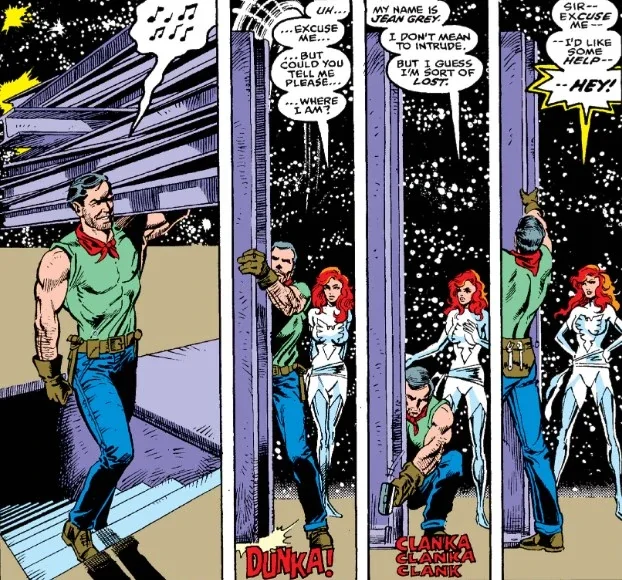
The White Hot Room. Has there every been a better metaphor for Limbo than the inability to get a contractor’s attention?
Limbo and limbo-like states recur with an astonishing frequency in the stories of Claremont's traumatized women. Carol Danvers and Rogue are the outliers: Rogue was never removed from the playing field for any significant period of time, while Carol's consignment to Limbo by a committee of obtuse male writers was what caused Claremont to bring her into the X-Men fold. Illyanna Rasputin's entire life story is impossible to disentangle from a Limbo dimension that is distinct from the one in which Carol had been trapped. This timeless, demonic realm robbed Illyanna of her innocence and her childhood, setting her on a path of corruption that would only be resolved by her eventual death and rebirth as her former child self. [22] Madelyne Pryor's hold on an independent existence was always tenuous before Mr. Sinister stripped it away from her, leading her to consort with demons from the same Limbo that had trapped Illyanna. Years later, when a resurrected Illyana voluntarily cedes control over Limbo to a resurrected Madelyne, it is in tacit recognition of the clone's affinity for this timeless, liminal realm: the only place where Madelyne belongs is a repository for entities who have no other place. Rachel is briefly spirited away to Mojo's world by Spyral, removed from the ongoing story, stripped of her identity, and obliging her to claw her way back to the real world. And then we have Jean Grey, occasional visitor to the White Hot Room, years-long occupant of a cocoon keeping her in stasis, and frequent corpse awaiting a resurrection.
Of course, Claremont's women are not the only comics characters subject to consignment to some form of Limbo or another; if they are exceptional for Marvel, their fate would be par for the course for DC. After DC's Crisis on Infinite Earths, the Earth-2 Superman and Lois Lane, the Earth-Prime Superboy, and the Earth-3 Alexander Luthor were stranded in an extradimensional realm for decades (leading, eventually, to the events of Infinte Crisis), while Grant Morrison has repeatedly visited unpopular characters trapped in "Comics Limbo" throughout their DC career (Animal Man, Final Crisis). But ever since Crisis on Infinite Earths, cosmic threats, reboots, and revisions have been DC's prime storytelling engine: DC comics exist to imprison and free their characters from backwater dimensions. Limbo for DC is primarily about DC, a symptom of the continuity revisions that recur like a bad weather phenomenon. The propensity of Marvel's women to fall into Limbo can be a continuity fix (as it has been for Jean Grey, repeatedly), but it is also about the characters themselves.
Claremont's X-Women face a double dilemma: surviving the experience of being an X-Man and navigating the complexities of their role in a team book rather than a solo title. This goes back to the early disagreements between Claremont and Byrne about Phoenix's power levels: how does a near-omnipotent character function on a team? Claremont successfully carried out his agenda of female empowerment for individual characters, but at the risk of rendering all their team mates (male and female) superfluous. The various iterations of Jean Grey (including Rachel), as well as Binary, are almost literally stellar, their powers either related to stars (star gates, Binary's "white hole" powers, Phoenix's consumption of a sun) or compared to them (Jean/Phoenix is constantly likened to a star). On a more prosaic level, many of them also become the "stars" of the X-Men books. Rather than flying too close to the sun, they are the suns around which the other X-Men orbit, and their storylines burnt hot and fast. Their lives, their powers, and their stories are overclocked, pushing the X-Men to cosmic-level stories that suit the comic well, but are only one type of plot that the X-Men do well. So, again and again, they are taken out of play.
Next: Storm Loses Her Soul, But Gains a Mohawk