For a team book, cosmic powered heroes can spur intense storylines, but in the longterm, they can also be a dead end. In Claremont's X-Men, the cosmic characters were almost always female; ironically, giving these women unbeatable powers would also necessitate their removal (that is, the removal of either the women, the powers, or both), thereby undermining the original feminist intent. Claremont was famous for his "strong" women, a term that covered both strength and complexity. Throughout his entire seventeen-year run, he managed to develop one particular X-Woman in a manner that evaded the traps awaiting the various Jeans. But rather than avoid the tropes that hampered his cosmic powered women, in this case, he embraced one of them completely, in order to move beyond it: in his portrayal of Storm, he developed a character whose strength proved independent of her mutant power set.
Storm was a charter member of Wein and Cockrum's X-Men, and certainly one of the most visually striking. But for the first five years or so, Claremont did relatively little to develop her character. True, he gave her a backstory filled with the requisite childhood trauma (being buried under rubble as a girl caused her claustrophobia), a less-than-saintly past for a so-called "goddess" (after her parents died, she was a pickpocket and thief on the streets of Cairo), but her emotional range was limited. With the death of Phoenix, Claremont finally moved Ororo to center stage. True, this began in the ill-advised "Rogue Storm" sequence, when Ororo appeared to be repeating the Dark Phoenix plotline less than a year after its tragic resolution, but behind this attention-grabbing stunt was a clever reevaluation of Ororo's character. Her restrained affect was now not a flaw of her writers, but a byproduct of her powers: she had to keep her emotions under control lest she inadvertently change the weather. Storm was, in fact, full of emotions just beneath the surface, but they were never just an internal matter: Ororo was a walking, talking Pathetic Fallacy.
Over the next two years of real time, Ororo slowly but surely begins to lose control. Where being team leader drew Cyclops further into his shell, when Storm takes over the role, she finds herself pushed in the opposite direction. Her connection to the natural world has weakened; in "Chutes and Ladders" (Uncanny X-Men 160, by Claremont, Brent Anderson and Bob Wiaceck), she needs to focus just to summon a small rain shower. Presumably, being bitten and seduced by Dracula in the previous issue ("Night Screams," Uncanny X-Men 159, by Claremont and Sienkiewicz) did not help matters. Her dilemma is further exacerbated by the X-Men's fight with the Brood (Uncanny X-Men 162-167), when, unbeknownst to them, everyone on the team has been infected with Brood eggs that, when they hatch, will transform them into the alien creatures, body and soul. Other than Wolverine, whose healing factor burns out the embryo, Ororo is among the first to notice something amiss within her own body ("I am lost---bereft of my self--and--at war with myself, without knowing why." ("Rescue Mission, Uncanny X-Men 163, by Claremont, Cockrum, and Wiaceck). In the next issue ("Binary Star!", Uncanny X-Men 164, by Claremont, Cockrum, and Wiaceck) she loses control of her powers and accidentally kills several vessels full of the Brood. Unaware of the Brood embryo, Ororo chalks up her failure to a combination of her general malaise and the alienation caused by being wrenched away from the Earth (something that never seemed to bother her in her previous outer space adventures):
But my soul is stricken. My spirit is wasting away, and the longer I am separated from my home, the more I will lose.
How will I ever regain those missing pieces of myself, Scott? And when there's nothing left of me?! Can a body live with its soul?
Only when she finally sense the Brood embryo does she truly understand her plight. Fleeing the ship, she nearly dies destroying the embryo, rescued by one of the space-faring Acanti (the enslaved race that the Brood use as their ships). For the brief period when she and the Acanti are bonded as one, she is at peace.
When she returns to Earth, the planet itself seems to reject her: she cannot control the weather and, for the first time in her adult life, actually feels cold ("Professor Xavier Is a Jerk!" Uncanny X-Men 168, by Claremont, Smith, and Wiacek). From this point on, her transformation is rapid and dramatic, although, thanks to Claremont's narrative feint in setting up Madelyne Pryor as a possibly reborn Phoenix, Ororo's embrace of her violent side seems to be part of a larger overall storyline of manipulation and corruption (including Rogue's personal crisis and Karma's encounter with malevolent voices in New Mutants). But the seeds had been planted months before.
Now, when the only way to save Kitty's life is a duel to the death with Callisto, the leader of the subterranean mutant outcasts who call themselves the Morlocks, Ororo does not hesitate to stab her opponent through the heart (Kurt" "I never expected that of you." Ororo: "Neither did Callisto. That was her mistake.") ("dancin' in the dark," Uncanny X-Men 170, by Claremont, Smith and Wiaceck). In the next issue ("Rogue"), Ororo dons Callisto's leather jacket, proclaims her leadership of the Morlocks, and taunts her wounded opponent ("We have crossed paths once, little mutant. / Don't push your luck.") Again, Kurt is the one to register the reader's likely shock at Ororo's behavior. When Storm declares that "nothing can change" the fact that she and Callisto are destined to be enemies, Nightcrawler thinks, "Perhaps. But the Ororo I remember would have at least tried."
Back at the mansion, after Xavier's announcement that he is giving sanctuary to Rogue, Storm contemplates her life as she waters the plants in her attic. Her gentle rain shower turns into a thunderstorm:
Weather around me always relelcts my emotional state.
My anxiety, my confusion--my--fear--manifested themselves as violence.
And my poor plants suffered for it.
When Xaver's psychic projection summons her, she throws a knife at it: "It is because of you that I became an X-Man, old man---/--and that decision is destroying me!"
The turning point in Storm's evolution takes place in Japan, where the X-Men have come for Wolverine's (abortive) wedding. Storm falls in with Yukiko, a young woman who considers herself a ronin and has a history with Wolverine. Yukiko's love of danger proves intoxicating to Ororo. She finds herself looking forward to a street brawl, and when she wins, Ororo tells Yukiko: "Whatever it means--this madness of yours that has infected me---/I welcome it!" ("To Have and Have Not," Uncanny X-Men 173, by Claremonth, Smith and Wiacek). When next we see Ororo, she has ditched her costume for formfitting black leather (complete with a studded choker), and cut off her luxuriant hair in favor of a mohawk. Her new, punk-inflected look is tougher and implies violence, yet careful readers will not that Storm has actually regained a measure of her serenity now that she has accepted her wilder nature. She is now more comfortable summoning violent weather, and untroubled by the implications of this development ("Phoenix!" Uncanny X-Men 175, by Claremont, Smith, Romita Jr. and Wiacek).
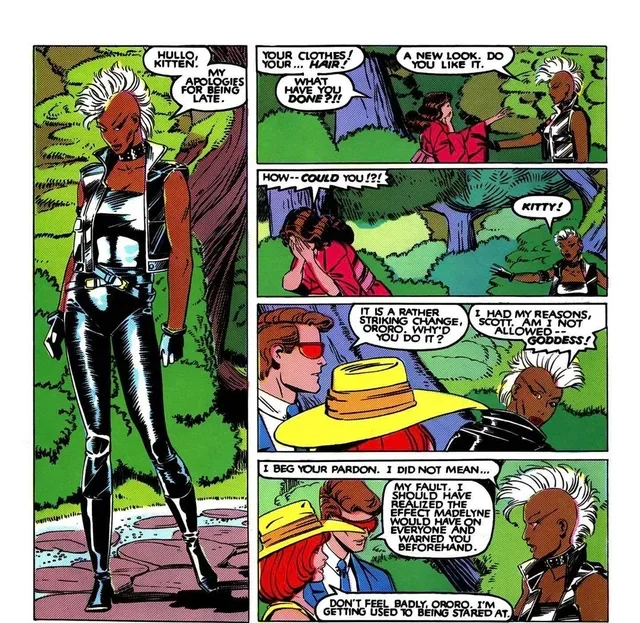
A few decades later, Kitty is going to be really embarrassed by her reaction
This does not mean she has completely made her peace with her new outlook. Kitty Pryde's rejection hurts, and leaves her wondering if the girl's doubts about Ororo's mental health might be justified ("Sanction," Uncanny X-Men 177, by Claremont, Romita Jr and Romita Sr.") She confesses as much to Xavier in "Whose Life Is It, Anyway?" (Uncanny X-Men by Claremont, Romita Jr, Dan Green, and Wiacek): "Sometimes I think, I fear--I--hope/--I must be insane." Xavier's psi-probe reveals "no mental illness," though is own reaction to her (that he never noticed what an attractive woman she was) feels a bit creepy, even if it's supposed to reinforce how different Storm has become. Only when she finally confronts Kitty does she manage to find a context for her transformation from "goddess" to human: "Perhaps I am infected with a kind of madness--but for the first time in my adult life, I can laugh. And cry. / I can feel--to the fullest extent of my being--/without having to deny that emotion."
Storm's growth, while paralleling Jean's descent into Dark Phoenix, is actually the opposite of Claremont's familiar story of seduction by power and passion. Ororo joined the X-Men as a powerful, but restrained "goddess" who was never given much emotional range, and now she is discovering her humanity. The key element in Ororo's growth as a character looks like a variation on a dreary trope: a superheroine loses her powers. This was, after all, what Claremont and Byrne initially intended for Phoenix, and also what Claremont did to Carol Danvers as part of his project to reclaim her from the damage done in The Avengers. Is the point really going to be that Ororo has to choose between having a full emotional life or having mutant powers?
Next: The Power of the Powerless