The Power of the Powerless
When Storm loses her powers in Uncanny X-Men 185 ("Public Enemy"), everyone involved recognizes it as a tragedy. Forge, the newly-introduced mutant genius who invented the power neutralizer, puts it plainly: "You stripped her of her powers! You've destroyed her!!" But the next issue, "Lifedeath" (Claremont, Barry Windsor-Smith, and Terry Austin) forces both Storm and reader to reassess the damage. "Lifedeath" is widely recognized as an X-Men classic, with no small credit to the gorgeous art of Windsor-Smith (who, by that point, was a rare contributor to superhero comics). "Lifedeath" is an example of one of Claremont's greatest strengths as a writer: his ability to use his collaborator's particular visual strengths to the story's advantage. Claremont is far less wordy in this issue, with fewer captions and word balloons. Instead, he trusts the artist to convey his characters' emotions, resulting in a comic that, while filled with clever conversation, is much quieter than the average issue of Uncanny X-Men.
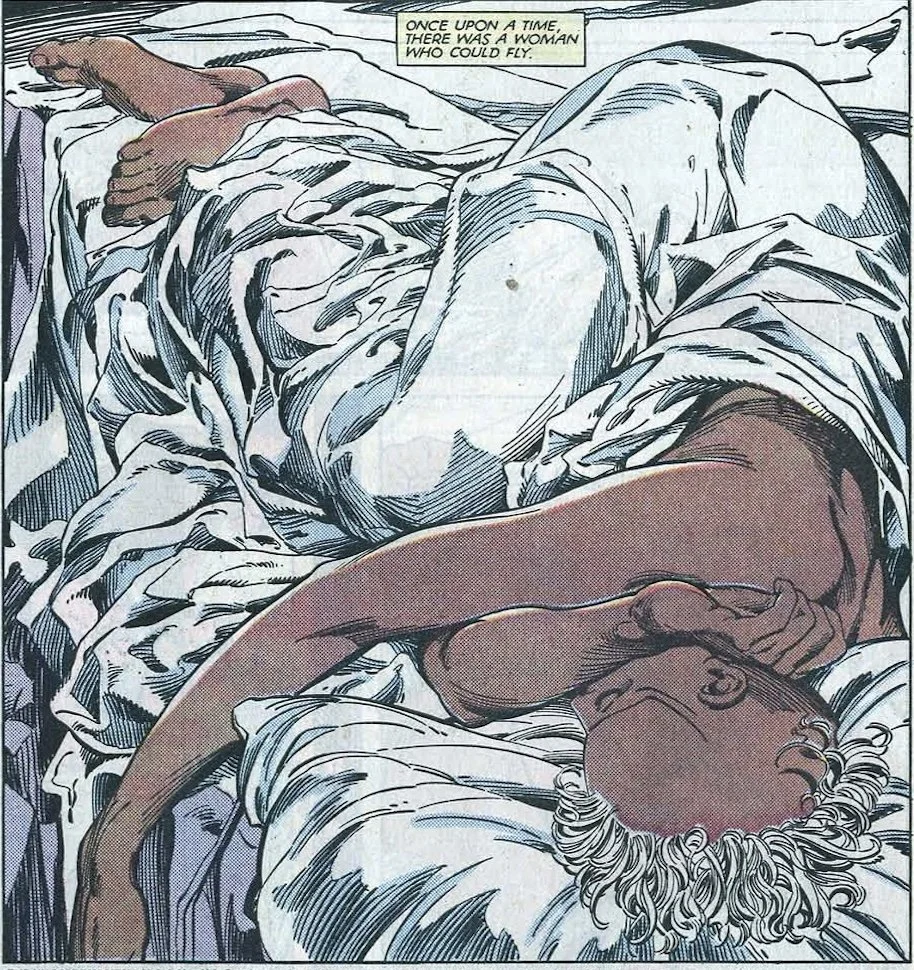
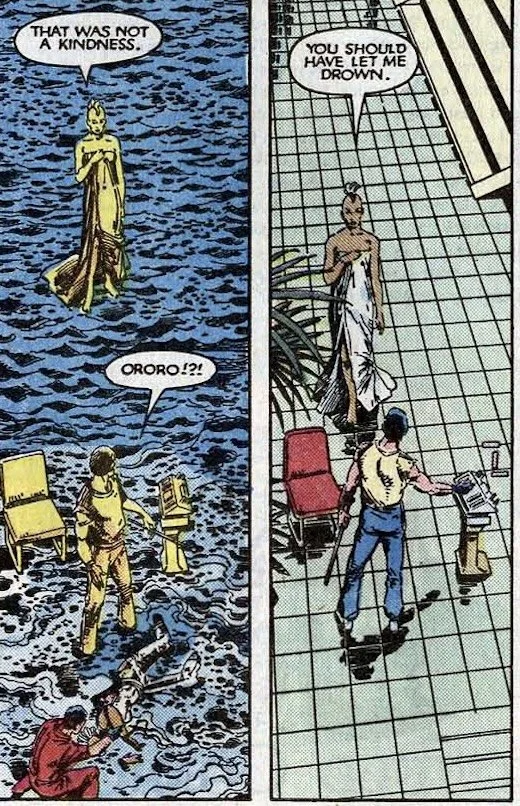
The comic begins with a depressed Ororo unwilling to get out of bed, despite Forge's best efforts. The events of the previous issue are recapped through one of Forge's holograms, which recontruct the scene of Forge wading into the water to bring Storm's powerless, unconscious body to shore. Awake, Storm walks through the hologram, as if walking on water, and engages in a brief dialogue with Forge that, against this backdrop, is beautiful in its simplicity:
Storm: That was not a kindness.
Forge: Ororo!?!
[The hologram fades; Ororo is standing on the plain tiled floor]
Storm: You should have let me drown.
Much of the rest of the issue consists of their conversation. As they look out onto the city, Storm casually demonstrates her proficiency as a pickpocket ("a human skill---something earned---the neutralizer did not affect it." She quietly laments that she can no longer feel the clouds, or fly. Forge's response: "And now you've got to walk, like everybody else. The goddess has become just plain folks." The self-pity passes, and Storm does not spend the issue raging against her fate; instead, she indulges the feelings she starts to have for Forge, opening up to him.
Even before I lost my powers---
--I have been living on the raw edge of my emotions--feeling...reacting...to everything as intensely as can bee...
The first lesson I learned--and a very harsh one it was, too--
--was that my elemental abilities were bound up with my emotions. The greater my feelings, the more extreme the atmospheric response.
To protect myself and those around me, I cultivate an absolute serenity of mind and body, so much that I lost virtually all awareness of myself as a woman.
A few months ago, I cast away these restraints. I could no longer endure my self-enforced spiritual celibacy....
---so I rebelled.
I cut my hear, changed my cloths--like you, I denied as completely as I could my old world self and belifes.
Now--what irony--the problem not longer exists. I need not fear my feelings, for the only person affected--the only one at risk--
--will be me.
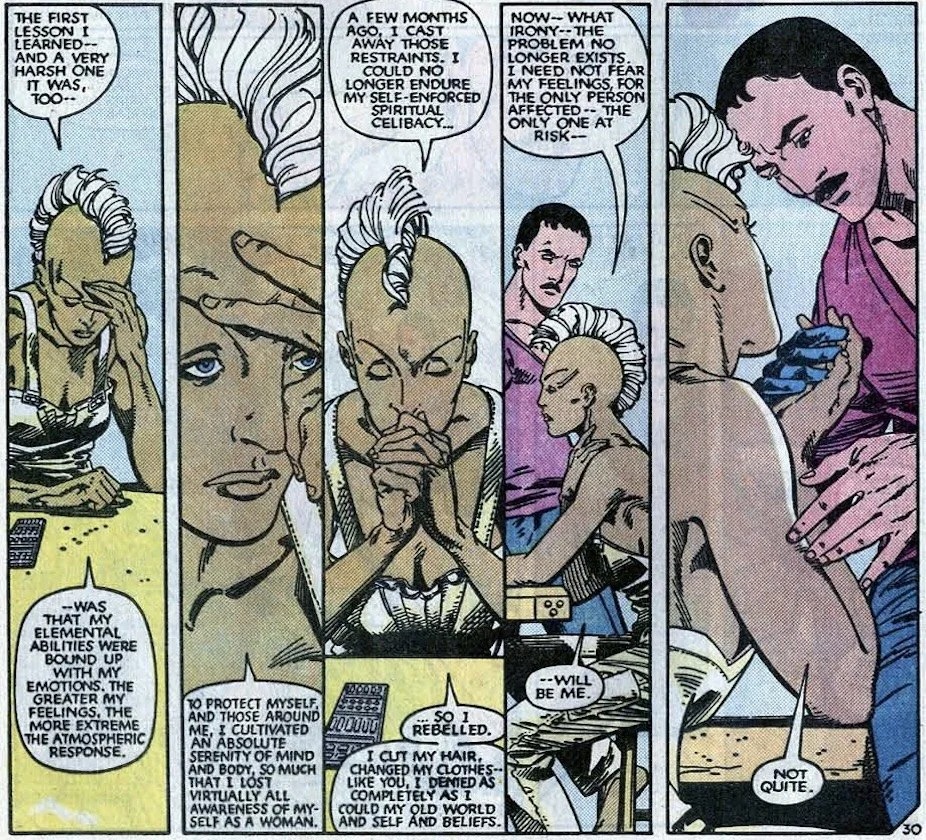
Ororo's monologue not only sums up the last two years of her character growth; it also implicitly explains the dilemma previously faced by her writer. How can an unemotional goddess truly be interesting? The depowering works in this case for a number of reasons. First and foremost, it was not entirely necessary: Storm was already well on the road to self-knowledge without her encounter with Forge's neutralizer. Second, it turns the Dark Phoenix paradigm on its head: Ororo will ultimately be defined neither by her power nor by its lack. For the next forty issues, she will both lead the X-Men and function as one of the book's lead characters despite the absence of her superhuman abilities.
As she moves from Goddess to punk to human, and eventually back to weather-controlling superhero (Forge helps her regain her powers in Uncanny X-Men 226, "Go Tell the Spartans," by Claremont, Marc Silvestri, and Green), Ororo does something that none of the other X-Women discussed in this chapter managed to do: she experience trauma and recovers from it in a relatively short period of time. It is also telling that, by the time this plotline develops, Ororo has gotten her claustrophobia under control--it is still present, but she is no longer helpless against the effects of a formative, childhood trauma. She demonstrates the same strength with the trauma she faces as an adult. Where both Rogue, Carol Danvers, and all the various iterations of Jean Grey/Phoenix must constantly struggle to achieve and maintain a coherent sense of self, Storm confronts the emotional dilemma posed by her powers, works through it, and comes out the other side a fully functional, adult super hero who has access to both her powers and her emotions. Ororo, it seems, can survive any experience.
Next: Inside Out