The main result of Rachel's last year in Uncanny X-Men is also the most important: her new identity as the Phoenix. For Rachel, it is both a step back and step forward. While still on the pages of Uncanny, she cannot escape her past, even if most of it is in the future. In the mutant concentration camp, she is tortured and brainwashed in order to be turned into a weapon for finding runaway mutants. As a "Hound," she is all instinct, and unwittingly commits multiple crimes against her own people. This experience leaves its mark on both body and psyche. Back in the 1980s, when Rachel undergoes extreme stress, the tattoos that identify Hounds reappear on her face. Even when Rachel does make a step towards self-definition, it is not only derivative (taking on her mother's identity as the Phoenix), but it also only supplements rather than replaces what is already there: as the Phoenix, she has the customary red and yellow firebird imagery, but also the Hound tattoos.
Rachel's bonding with the Phoenix force allows Claremont to revisit beloved tropes, but with a twist. If Jean, who was a healthy young adult with an understanding of life and love, could not control this power, how could a teenager as damaged as Rachel possibly hope to do so? She neither consumes a star not destroys a spaceship full of people, but her baseline nonetheless seems much less stable than Jean's. Unlike her mother, Rachel does not suffer from a divided self: whatever she does (before encountering Sypral), she is always Rachel. She does not alternate between the green (good) costume and the red (evil) one; rather, she is always a collage of red, orange and yellow tones, always somewhere beyond the more innocent version of Jean-as-Phoenix, but never quite as malevolent as Dark Phoenix.
A son or daughter embracing a parent's heroic legacy is, if not exactly Superhero 101, then intermediate-level superhero activity. There is often a regressive element to taking up the mantle of the mother or father, but that regression does not always fully register: so many of these first-generation heroes are themselves shaped by childhood trauma, filling the whole left by a departed father or mother figure (Batman's parents, Uncle Ben, etc). Rachel's case is different, however. Her psychological damage is far more extensive, and she suffers from the ambivalent loss of a world that she herself felt was too horrible to be allowed to come into being. Many elder siblings feel displaced by a new baby, but in her case, that displacement is real: the birth of little Nathan rules out the birth of Rachel herself.
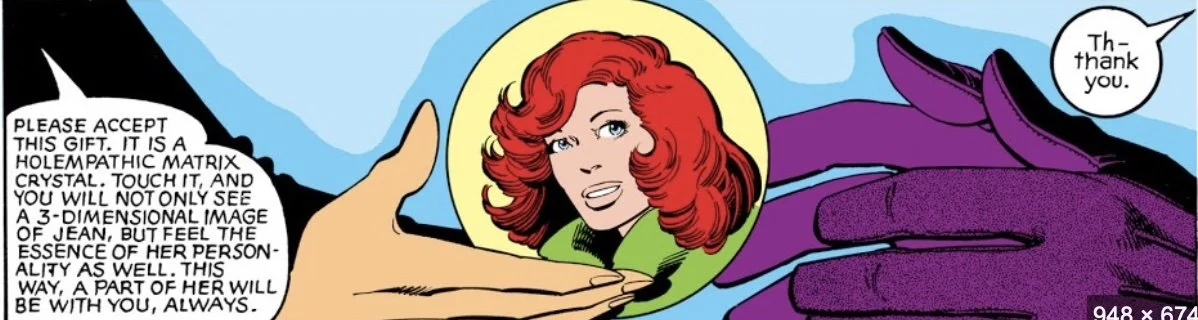
Edged out by a baby, unable to communicate with a father who will never actually become her father, seeing her mother replaced by an uncanny lookalike, and reestablishing a friendship with someone who was her elder and mentor, but is now a teen (Kitty Pryde), Rachel becomes Phoenix as the result of a trip down (her mother's) memory lane. First, she visits her mother's grave in the Grey family plot (where either Romita or Green cheekily adds a gravestone for Jean's ancestor "Earl"), then her grandparents house after they drive away. Suddenly, she witnesses, in ghostly outline, Dark Phoenix's confrontation with Jean's parents from Uncanny X-Men 136 (which the caption describes as "fantasy visions derived from what Rachel read in the X-Men's 'Dark Phoenix' file), then a memory of herself as a newborn baby in her mother's arms. and then another from her time as a Hound. Finally, she stumbles upon a MacGuffin that has been waiting for its day since Uncanny X-Men 138. At Jean's funeral, Empress Lilandra gives Jean's parents a globe called a "holempathic crystal," which somehow contains the essence of Jean's personality. At the time, this looked suspiciously like a backdoor for Jean's return, but in bringing it together with Rachel, Claremont finds a way to fulfill not only Rachel's, but the fan's regressive fantasy of Phoenix's return while still trying to look forward as well as backwards: we will have a new Phoenix with a perfect Grey pedigree, and a chance for a different set of Phoenix stories.
In lieu of flowers
Her transformation into Phoenix is an odd process; the publishing schedule meant that she declared herself Phoenix in Uncanny Х-Men 199, put on a different Phoenix costume in Uncanny X-Men Annual 9, angering Scott in the process, took part in the fighting surrounding the Trial of Magneto in Uncanny Х-Men 200 without displaying any of the appropriate attributes, and then returned to her grandparents' house in Uncanny Х-Men 201 already as Phoenix, but somehow even more so by the issue's end. The overall purpose of this plotline is to establish the Phoenix identity as Rachel's birthright, and thereby also convince the readers to transfer their emotional investment from the currently-dead Jean to her legitimate heir. In Uncanny Х-Men 199, she touches the holempathic crystal, senses her mother, and immediately undergoes the transformation as a restorative act for both her and Jean:
I want everyone to remember the Jean Grey who assumed the mantle of Phoenix to save the man, and friends, she loved more than her life.
In my timeline--as well as this one--mom saved the universe!
Can I...
...do any...
..less

If nothing else, Rachel can sure monologue liker her mom
The epilogue to Uncanny Х-Men 201, which seems to have originally been intended to immediately follow Rachel's collapse to the ground in Uncanny Х-Men 199, makes her restorative function literal. When she initially transformed, she accidentally broke the crystal. Now, back at the Grey family home, she uses her power to repair it, which has two intriguing results: first, she puts a piece of herself into the crystal, to keep her mother company, and to ensure that she is remembered in this world that is not her own. But second, her interaction with the crystal this time causes a bolt of energy to emerge from the site of Jean's death in the Blue Area of the Moon, presumably to merge with Rachel.
Though the sequencing of these issues is odd, the placement of the epilogue in Uncanny Х-Men 201 does prove significant. This is the issue when Cyclops loses his challenge to Storm for leadership of the X-Men, and has to go back to Alaska with his wife (and Jean Grey lookalike) and newborn baby. Their marriage is on the rocks, just in time for the real Jean Grey to be reborn the following month. Since Jean will now be retconned as never actually having been the Phoenix, the result is the complementary distribution of the constituent parts of the Jean Grey character to variations on the one Claremont, Cockrum, and Byrne had so effectively developed: a Jean who is innocent of the Phoenix's crimes, a Phoenix that also never committed those crimes directly, but is still haunted by her own past, and Madelyne Pryor, who is looking suspiciously superfluous.
Next: Madelyne Pryor and the Three Faces of Jean