The drama of Rogue and Carol Danvers is both an integral part of 1980s X-Men and something of an outlier. Carol entered the X-Men's orbit through the vagaries of editorial policy and creative outrage; Rogue seems to be a character who only really grew on Claremont once he was saw her in terms of her unique dilemma. Otherwise, the center of gravity for trauma, angst, and identity crises had an unsurprising name. All roads led to Jean Grey. [1]
Illyana Rasputin's journey from child hostage to demon queen of limbo was certainly compelling, but once the New Mutants were introduced, her story continued in their comic. Storm's detour into punk anomie developed largely in Jean's absence, but the first signs that she was falling apart came not long after the death of the Phoenix, and her brief transformation into "Rogue Storm" in Uncanny X-Men 147 ("Rogue Storm!" Claremont and Cockrum) was such an obvious riff on Dark Phoenix that the cover copy declared, "We did it before...Dare we do it again?" In addition, her sartorial transformation took place while Mastermind was manipulating the X-Men into thinking Madelyne Pryor was Phoenix and the Shadow King was stalking the New Mutants; it was easy to mistake her new punk look for part of one or both of these ongoing plotlines. [2]
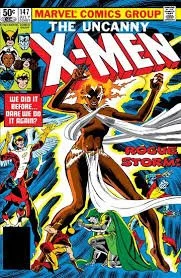
You bet they will! Again, and again, and again…
As the "Rogue Storm!" cover demonstrates, Jean Grey continued to haunt Claremont's X-Men after Phoenix's death. Even when Claremont was still adamant that Jean should remain dead, he kept returning to fill the book's Phoenix-shaped hole. The result was a set of multiple Jeans, Phoenixes, and substitutes for both that turned identity crisis and trauma into a kind of narrative repetition compulsion. What resulted was a complicated web of timelines, clones, and cosmic forces, a glorious excess of personality that carried the franchise through the decade.
It started with a young red-headed teenager named Rachel, who first appeared in Uncanny X-Men 141 ("Days of Future Past," by Claremont and Byrne). In the dystopian far future of 2013, Rachel is the telepath who sends adult Kate Pryde's consciousness back to 1980 in order to avert the nightmare scenario in which the live. Days of Future Past is one of the most acclaimed X-Men stories, and also the basis for the movie of the same name, but Rachel is just a minor character who watches all her comrades die (including her lover, Franklin Richards). She was intended to be the daughter of Scott and Jean, and conceived (by Claremont and Byrne, that is) before the decision was made to put Dark Phoenix to death. That would have been the end of it, but three years later, Claremont brought her back to what was then the present
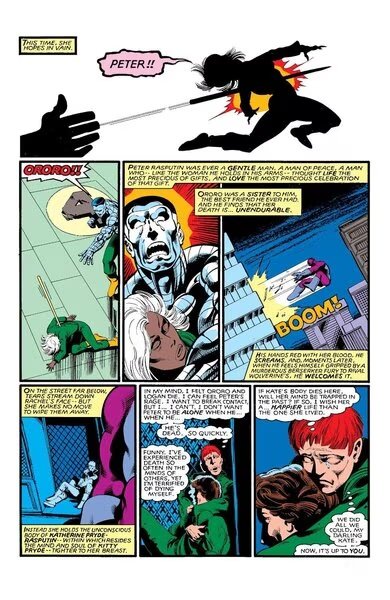
What little we know of Rachel's backstory at this point is more than enough to leave psychological wounds on the most healthy of minds: in her world, all the mutants and other super-powered individuals were rounded up and put in death camps. For her, Marvel Earth in 1984 is populated by ghosts. [3]. She spends her Uncanny X-Men present-day debut (Issue 184 "The Past...of Future Days", by Claremont, Romita Jr. and Dan Green) in a state of near-perpetual flight. Rachel is immediately targeted by the immortal mutant energy vampire Selene, who jumps out of a dark alley like a robber or rapist. A kind man named Nick takes pity on her, not entirely mistakenly thinking her an undernourished runaway. Selene kills him, and Rachel barely holds her own against Selene before she is rescued by the X-Men. And now she has to admit the obvious: this past is not her past.
Rachel is in the unprecedented position of the survivor of a trauma that hasn't happened yet--and might have been averted; she may be the only woman to whom the sexist admonition to unsmiling women, "Cheer up, it might never happen" could possibly be relevant. [4] Where the rest of the X-Men are outcasts in a bigoted world that refuses to accept them, she is a refugee from a reality so horrible that the X-Men's might as well be paradise. As her new (and, to her, not-so-new) teammates learn more about her, they do their best to understand, but it is difficult to empathize adequately with trauma that takes place in the conditional/subjunctive. With Jean dead and Cyclops married to Madelyne Pryor, her past (the X-Men's future) looks impossible, especially when Madelyne gives birth to a boy (the future Cable) rather than a girl. For the X-Men, this is good news: who would want her future to happen? In the abstract, it is good news for Rachel as well: the whole point of sending the adult Kate Pryde's consciousness back to 1980 was to prevent the "Days of Future Past" scenario from ever coming into being. It was a suicide mission in more ways than one, but Rachel's survival and trip back to the "past" makes their apparent success feel tragic. It's one thing never to have existed, but Rachel is forced to be the one remaining witness to decades of now-notional genocidal horror. Small wonder she occasionally lashes out; her very survival makes no sense.
Rachel is not just a survivor; she is a remainder, embodying both excess (who needs someone from an extinct timeline?) and shortfall (her entire past is missing).[5] Since childhood, her life has been marked by a near-total absence of agency: captured, imprisoned, turned into a mutant-seeking Hound (more on that below), and sent into the past by Kate Pryde through post-hypnotic suggestion, she has little experience making real choices. What choices she does make tend to be terrible: attacking the godlike Beyonder head-on after assuming the mantle of Phoenix, stealing the life essences of all her comrades to do so, infiltrating the Hellfire Club to try to kill Selene, attacking Wolverine after he attacks her, and following the villainous Spyral to another dimension where her identity will be all but erased.
Rachel leaves the Uncanny X-Men with issue 209, the first of many departures to clear clear the way for an eventual third spin-off ongoing title, Excalibur (which also includes Kitty and Nightcrawler, each injured and sidelined during the Mutant Massacre just a few months later). But before she leaves, Rachel tries to replay some of the original Phoenix's greatest hits, for ostensible reasons that don't make sense. Nearly every Marvel comic was crossing over with Secret Wars 2 for the occasional issue; as crossovers go, it was not too onerous in its demands. Secret Wars 2 did not hijack every monthly comic for its own purposes, but it did make the storytelling needless complex (with the Beyonder popping into a title to cause mischief, perhaps bring a little enlightenment, and leave). The X-Men were important to Secret Wars 2, but if a reader was not following the 12-issue series, the intensity of their struggle with the Beyonder was puzzling.
Uncanny X-Men 202 takes its title from Rachel's declaration to her teammates: "X-Men......I've Gone to Kill the Beyonder!" She does not succeed, of course, but she gets a power boost from the Beyonder himself, which, in the next issue, inspires her to seek more power in order to....destroy the universe. That will also being about the death of the Beyonder, and leave a Beyonder-less universe for the people who will somehow come after. This argument defies logic, but so does the entire issue: half the X-Men freely surrender their life energy to Rachel in order to give her a fighting chance. Where the original Phoenix used her teammates life energies (sparingly!) to help her stop the universe's destruction resulting from a flaw in the M'Kraan Crystal, Rachel (accompanied by the spirits of her friends) makes her way inot the Crystal in order to release the very threat that her mother had tamed. Instead, she briefly becomes one with the universe, realizes she cannot bring herself to destroy all reality, and then shares the experience with the Beyonder so that he will value life as well.
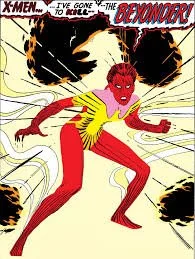
Yeah, that’s gonna end well
Her departure from the book is a mess, involving Wolverine actually stabbing her with his claws to prevent her from killing Selene, even though a few issues ago he was perfectly fine with her trying to kill the Beyonder. Removing her from the flagship book was a step towards the establishment of the next spin-off, certainly, but it also was an opportunity to try to dig Rachel out of a set of plots that were always going to focus on her survivor's guilty, her sense of herself as an outsider, and her connection to a dystopian future. It's a happy accident that the vehicle for her (temporary) escape from these endless loops is a villain named Spyral--though her name might suggest "spiraling out of control," at least a spiral can progress where a loop can only repeat. Spyral kidnaps Rachel and temporary erases her memories, allowing for a soft reset of the character in the lighter-toned Excalibur book.
Notes
[1] Some readers might object at the sidelining of Wolverine, an X-Men mainstay in virtually every iteration since Giant-Size X-Men 1. But Claremont understood that Wolverine needed to be used sparingly, even if the powers that be at Marvel made this impossible. During his run on Uncanny X-Men, Claremont centered attention on Logan only for particular, individual stories, and rarely for ongoing plotlines. On a team, Wolverine works well as a character mostly seen from the outside, with occasional, revelatory stories where we share his consciousness. In any case, whatever proprietary feeling Claremont may have had about the character in the early 1980s was impossible to sustain by the decade's end. Wolverine was ubiquitous, and he was out of Claremont's control.
[2] In a storyline that has not aged well, the Shadow King was responsible for making the New Mutants' Karma evil and fat.
[3] Of course, even though Days of Future Past is specifically anchored in 1980, and Rachel returns in 1984, the in-story gap between the two comics is a matter of a few months.
[4 Rogue even says as much to Rachel in Uncanny X-Men 196: "Hey, kiddo--that's your past, but still our future. For us, those events haven't happened yet--and maybe now they won't!" ("What Was That?!!" by Claremont, Romita Jr. and Green).
[5] This makes Rachel one of the few Marvel characters to share the experience of some of the "excess" survivors of DC's Crisis on Infinite Earths. In particular, Power Girl (the Supergirl of Earth 2) has her origin rewritten repeatedly in the aftermath of Crisis, before her confusion about her own superfluity becomes a plot point in the run up to Infinite Crisis. Unlike Rachel, Power Girl is haunted by a vanished world that was actually livable, and also be the possibility that it (or a version of it) might still be out there, somewhere in the multiverse. The differences between their dilemmas highlights the primary difference in Marvel and DC multiplicity during the late 20th century: DC relies on multiple earths in multiple dimensions, while Marvel explore alternate timelines that could be possible for the main Marvel Earth.
Next: Momma was a Genocidal Cosmic Bird Goddess