But sustained human contact is far in Rogue's future (even this particular encounter with Storm ends in disaster, through no fault of her own). Throughout Claremont's initial run on the X-Men, Rogue, on top of every other horrible aspect of her predicament, is a teenage virgin doomed to isolation and celibacy, sharing headspace with a grown woman who has the memories and feelings associated with the presumably active and fulfilling sex life that Rogue thinks she can never have. When Carol manifests again, this time entirely taking over Rogue's body with her assent, it is in a scenario that once again involves rescuing a man with whom Carol shares a past (Wolverine), but also echoes Carol's own experience with sexual assault.
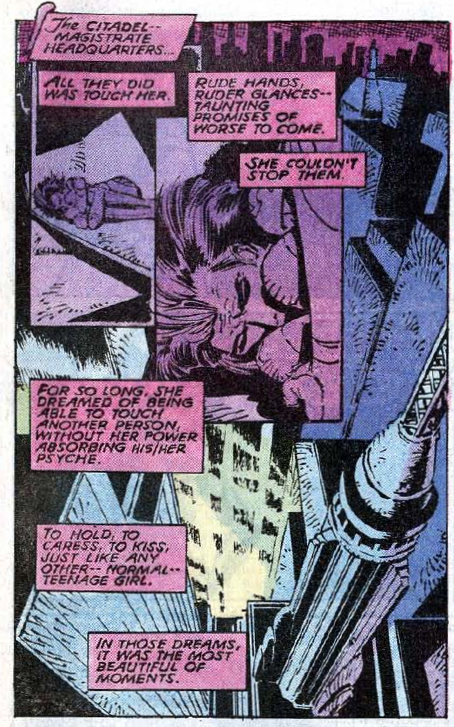
In Uncanny X-Men 236 (Chris Claremont and Marc Silvestri), the X-Men have invaded the authoritarian island nation of Genosha, where mutants are enslaved and transformed in the interest of the country's prosperity. In the course of the battle, Rogue is de-powered and imprisoned. She is also treated roughly by the guards, and Claremont's narration makes clear just how traumatic this is for her:
All they did was touch her.
Rude hands, ruder glances---taunting promises of worse to come.
She couldn't stop them,
For so long, she dreamed of being able to touch another person without her power absorbing his/her psyche.
To hold, to caress, to kiss, just like any other--normal--teenage girl.
In those dreams, it was the most beautiful of moments.
She never imagined being handled against her will.
Rogue withdraws from the world, trapped in her own psyche. [1] Her mind reacts to the assault by confronting her with all the psychic residues other people she has ever touched (and whose psyches she has absorbed); they all want a piece of her. The only thing standing in their way is...Ms. Marvel. She, of course, is more than a residue, and she offers her help out of enlightened self-interest (they share a body, after all). Rogue must agree to let her take over, and to trust that Carol will yield control later. It makes sense that she is able to cope with what Rogue cannot: she is a mature adult with more life experience, including surviving trauma of her own (i.e., Marcus). After the fight is over, she and Rogue seem to have reached an accommodation, with Carol taking over now and then when Rogue is in pain. Their detente is remarkable, but also consistent with one of Claremont's ongoing themes: the power of female solidarity.
It is also short-lived. Even during the Genosha adventure, Uncanny X-Men was gearing up for a huge crossover, Inferno, which would be the culmination of years worth of plotlines, none of which featured Rogue very strongly. This was the third such crossover in just over three years, following The Mutant Massacre and Fall of the Mutants, the second of which had set up a new status quo for the X-Men. Now believed dead, they worked out of Australia, but had access to the entire world thanks to the aid of the silent Aborigine mutant Gateway, who could teleport them wherever they wanted to go. Inferno aside, Uncanny X-Men was somewhat rudderless, alternating between the main X-Men in Australia and a group of second-stringers possessed by the Shadow King on Moira MacTaggart's Muir Island.
Two years after Inferno, Claremont uses the convenient magical device called the Siege Perilous to reset the X-Men. The Siege had been given to them by the goddess Roma as the gateway to a second chance if things worked out poorly for them in Australia. Through a complicated set of circumstances, the X-Men go through the Seige, most of them starting new lives, with only Rogue seeming to pick up more or less where she left off. Uncanny X-Men 269 ("Rogue Redux" by Claremont and Jim Lee) follows Rogue after the Siege has done its work on her. Back in Australia, she is suddenly confronted by Ms. Marvel, apparently back in an independently functioning body, while Rogue discovers she no longer has Carol's old powers.
It is thus implied that the Siege has done its work as a "get out of jail free" card for Rogue after all. Instead of removing her memory (as it does with Colossus), or putting her in a situation where she can be brainwashed and have her mind transplanted into the body of a Japanese ninja (Psylocke; don't ask), Rogue gets to be truly herself, with Ms. Marvel as a ghost rattling insider her consciousness.. Unfortunately, only one of their bodies can survive. Even less fortunately, Ms. Marvel finds herself a captive of the X-Men team enslaved by the Shadow King on Muir Island, Now when Ms. Marvel finds Rogue again, not only is her body falling apart, but she is throughly evil and bloodthirsty. This circumstance (which really does come out of left field) removes the moral ambiguity in the fight between these two women; for once, Rogue is not the aggressor, and Ms. Marvel is the villain. Even here, though, Rogue is spared further moral compromise: the killing blow comes not from her, but from Magneto (moral compromise's poster boy in the X-Men's world).
Is this a satisfactory resolution to Rogue's trauma and overall psychological troubles? Not in the least. It is, however, entirely consistent with the Siege Perilous as a plot device. The Siege allows Claremont to reset any scenario that has become too tedious (as the Australian years certainly had). Part of that reset is to bring down the overall level of trauma to a more manageable scale. The moment when Roma gives the Siege to the X-Men is its own moment of reset. It's not just that the X-Men have all died and come back to life in their fight against the Adversary--for the X-Men, dying and coming back to life is an ordinary Wednesday. Nearly all of them had been stuck on a darker path since the Inferno event, and were wearing their trauma on their sleeve: Ororo had only just regained her powers after more than three years real time; Madelyne Pryor had lost her husband to his first love, her baby to unknown kidnappers, and her life to the same enemies who faked her death; and Dazzler had had Destiny's golden mask fused to her face with a magical dagger that remained protruding from her forehead. The reset was a gift to both the characters and the writers.
The abrupt disappearance of Carol Danvers from Rogue's does not turn out to be a guarantee of happiness and mental stability, but it does allow Rogue to develop as a character in ways that are no longer dependent on her dual selves. Over the next decades, she will grow more confident, both professionally and romantically, even leading a joint team of X-Men and Avengers. The fact that new writers inevitably re-traumatize Rogue (usually through the use of her powers) could be seen as a lack of imagination, but a more charitable reading is that Rogue, as a character, allows for the possibility of real psychological progress while never succumbing to the illusion of a permanent cure.
Note
[1] Claremont is curiously fond of this motif. Professor Xavier, Gabrielle Haller, Emma Frost, and Magneto have all suffered a similar affliction.
Next: Daughter from Another Mother