Claremont also quick to develop the X-Men’s distinct personalities (well, for most of them: Thunderbird was killed off almost immediately, while it took years for Colossus to be anything more than a simple Russian collective farm boy with a propensity for spouting non-existent Russian oaths). Though Storm lived as a "goddess" in Kenya when Professor Xavier found her, she was actually the Chicago-born daughter of an American journalist and an African mother; when she was a child in Cairo, her parents were killed during an air raid, and her time trapped in the rubble left her with debilitating claustrophobia. [1] Nightcrawler offset his anxieties about his monstrous appearance with an easy sense of humor and a swashbuckling air. And the book's breakout character, Wolverine, combined a propensity for savagery with nobler impulses, while coping on his own with a confusing and traumatic past.
Remembering the 1970s X-Men is complicated by a strange set of circumstances. The comic entered the 1980s on the verge of becoming the company's biggest franchise, on the strength of the Claremont/Byrne run that began earlier and ended before 1980 was out. Claremont & Byrne's stories are widely regarded as foundational, the X-Men's golden age, and yet the franchise's commercial success came later; when Byrne started on X-Men, the book was still bimonthly (a sign of precarity). Their biggest storyline, the Dark Phoenix saga, was the culmination of years -long plotlines in the 1970s, though most of it came out in 1980s. Perhaps the best way to look at would be to say that Claremont & Byrne's X-Men run was the 1970s comic that created 1980s Marvel.
In the lead-up to the Dark Phoenix Saga all the way through the first two years of the 1980s, Claremont (first with Cockrum, then with Byrne, then Cockrum again) established lore that would become fundamental to the X-Men going forward:
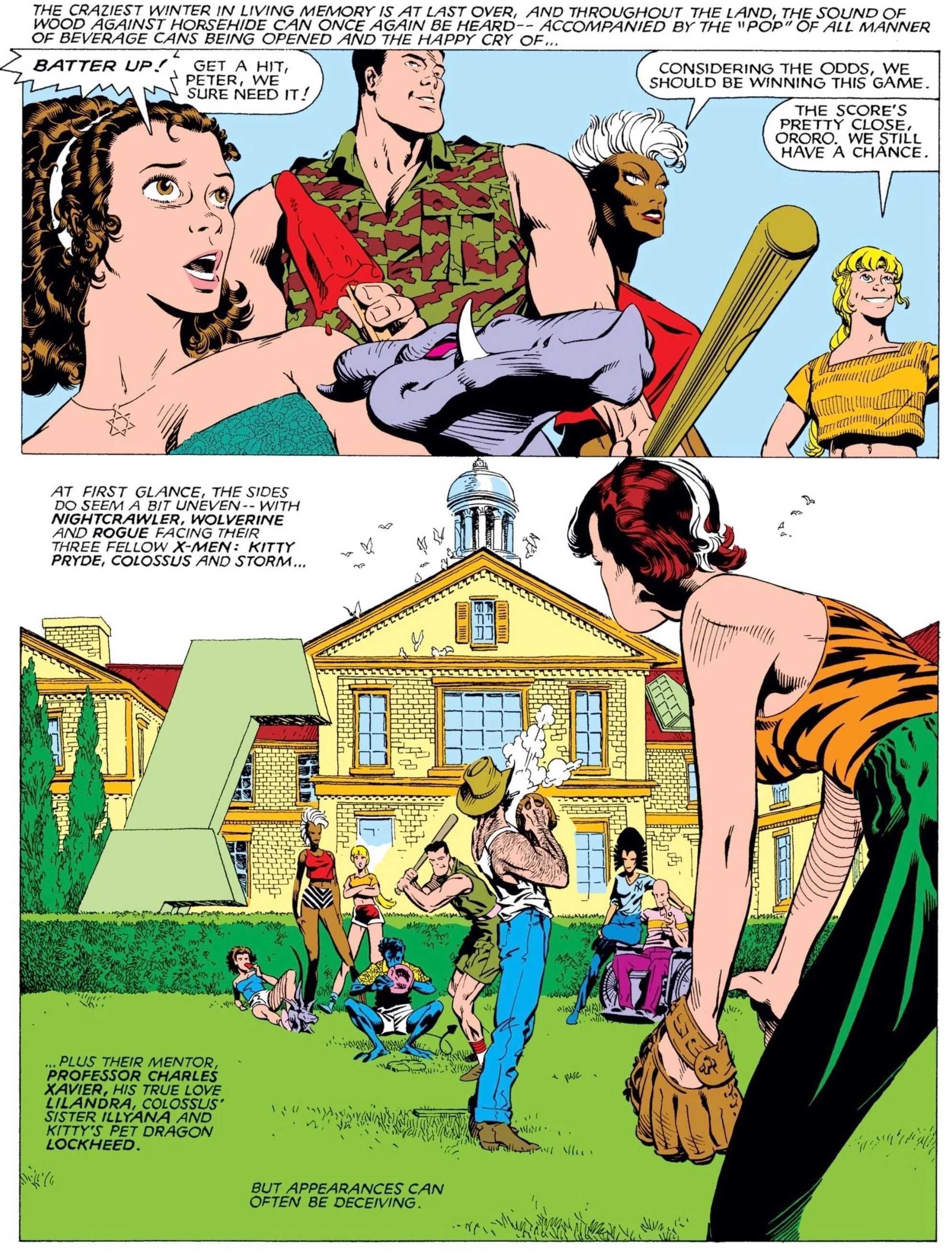
Would mutants be less hated and feared if they played more baseball?
The divided self. Claremont's characters are constantly torn between two poles, hence the common refrain "Part of me wants... but part of me also..."
Mutant hatred as a long-term, constituent element of the X-Men's world, from local hate groups to secret societies to the top reaches of government
Seduction to the dark side
Tortured romance
A strong focus on female characters, and (eventually) their friendships
Trauma
Revelations of characters' secret backstories (Magneto, Moira MacTaggert)
The humanization and even rehabilitation of villains (tentatively begun with Magneto in X-Men 125, but becoming much more common in the 1980s)
Japan as a frequent location and set of tropes
Professor X's departures and returns
Space Opera (a favorite of Cockrum's). The introduction of the Shi'ar Empire (whose empress falls in love with Charles Xavier) and the Starjammers (whose leader turns out to be Cyclops' father)
Moral dilemmas about killing
Long-running subplots that could take years to pay off (if they ever do)
Alternate futures
Death and resurrection
Islands [2]
Magic (not a strong part of the Byrne and early Cockrum runs, but picking up immediately after)
Mind control that leads to the adoption of outfits resembling fetish gear
Baseball. Lots and lots of baseball. [3]
This is not even counting the many set phrases that Claremont uses throughout his run on the X-Men, to the point of near self-parody. [4]
Notes
[1] As if this backstory were not complicated enough, Claremont would eventually reveal not only that Ororo had a latent talent for magic because of a hitherto-undisclosed sorcerous heritage, but that, in her teenage years, she had a budding romance with T'Challa, the future Black Panther.
[2] The revived X-Men's first adventure involves the living, mutant island of Krakoa. Issue 104 reveals that Moira MacTaggert, introduced as the X-Men's new housekeeper, is actually a Nobel-prize winning biochemist with a Scottish research facility on Muir Island. The storyline culminating with Issue 150's "I, Magneto," takes place on a mysterious island that will briefly serve as the X-Men's home (as well as the gateway to Limbo). Over the years that follow, Krakoa is brought back in various forms, Wolverine spends a great deal of time on the corrupt island city-state of Madripoor, the X-Men have numerous adventures involving the island city-state Genosha, which starts out as a country that enslaves mutants, is taken over by Magneto as a new mutant homeland, only to be the subject of the single largest genocide in Marvel Earth's history when Cassandra Nova wipes out the entire population. Later Cyclops establishes a mutant island utopia with the unimaginative name "Utopia." When Jonathan Hickman revitalizes the franchise in House of X/Power of X, he engages in a creative distillation of key X-Men tropes, not just resurrection from death and mutant separatism, but also the centrality of the island utopia (Krakoa once again).
[3] The X-Men first play baseball in issue 110, guest penciled by Ton Dezuniga. Eventually it would become a frequent X-Men pastime.
[4] "I'm the best there is at what I do, but what I do isn't very nice." "Part of me... but part of me..." "And I, you, with all my heart." "For all my vaunted power..." "I possess you, body and soul!" "No quarter asked, none given." "I...hurt"
Next: Flight of the Bird Metaphor