Claremont was a master of the team book, developing back stories and inner lives for nearly all his characters. But with the benefit of hindsight, it is clear that, even as he deftly balances the X-Men ensemble, there is usually one character or relationship around whom most of the action and angst revolves, even threatening to dominate the entire book. By the time the series was reaching its 100 mark, all the way through the Dark Phoenix Saga, the center of gravity was Jean Grey (and, to a lesser extent, her relationship with Scott Summers). This was not a foregone conclusion; one could easily imagine a new writer on a revitalized franchise gravitating towards the characters with the least amount of backstory and, therefore, the most room for development. Instead, Claremont and his collaborators used this longstanding, but rather undeveloped, relationship as the anchor for the series.
Claremont's transformation of Jean Grey now looks like the embodiment of his unspoken mission statement: to create a comic about powerful women. When Jean Grey was introduced as Marvel Girl, the newest member of the team in X-Men 1, she was yet another example of Stan Lee's nearly interchangeable heroines. The early Marvel women tended to have non-physical powers that nonetheless put a strain on their delicate constitutions; Marvel Girl, the Invisible Girl, and the Scarlet Witch typically used their minds to intervene in battle, and then swooned from the effort. In their interactions with their team mates, they asked the questions that gave the men chance to explain things, exclaimed their shock and horror, and revealed their unspoken passions in thought-balloon encased monologues. Every now and then, they expressed dissatisfaction with being coddled or sidelined, but their complaints were usually presented as amusing petulance. The best that could be said about them was that their presence at least meant that the teams weren't made up entirely of men.
Claremont and Cockrum brought Jean back in Issues 97 and 98, only to have her (along with Wolverine and Banshee) captured by the Sentinels and transported to a space station. The other X-Men come to the rescue, but the ensuing battle destroys the station. Barely escaping on a cramped shuttle, they have to make their way back to Earth through a solar flare. Part of the craft is shielded, but not the cockpit. Jean decides that her telepathy and telekinesis make her the only one who has a hope of surviving long enough to pilot the shuttle back to earth. A cliffhanger at the end of issue 100 sees her overwhelmed by radiation; in the next issue, the X-Men crash land in Jamaica Bay. Jean, who had been presumed dead, suddenly shoots up from the depths of the bay wearing a new costume, proclaiming the now-famous words: "Hear me, X-Men! No longer am I the women you knew! I am fire and life incarnate! now and forever, I am PHOENIX!"
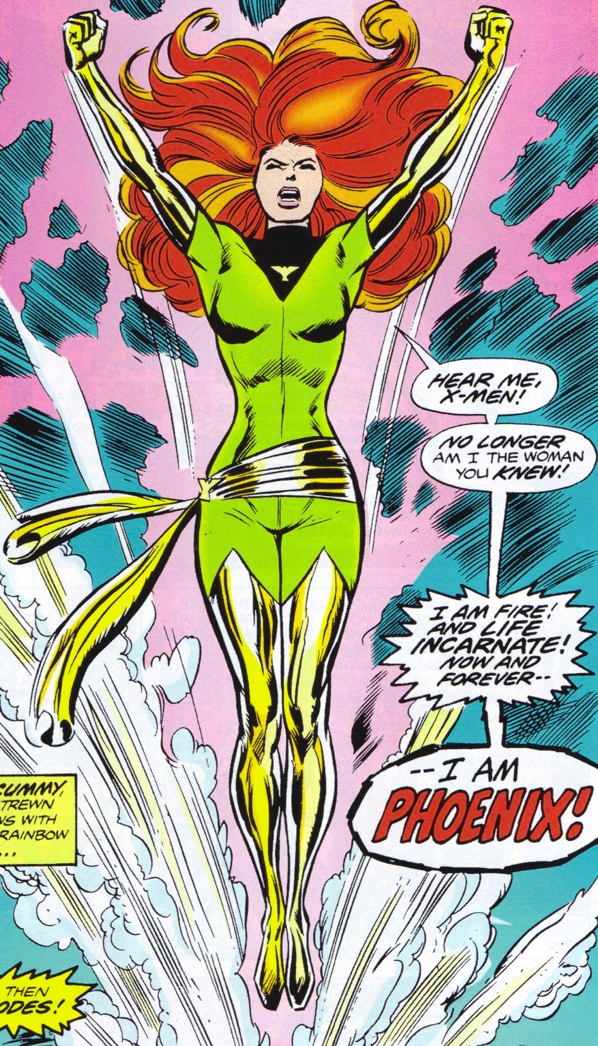
In real life, a man would immediately start imploring her to “calm down”
It would take months for the ramifications of Jean's new identity to begin to play out, since she spends a fair amount of time after Jamaica Bay in a coma. But when Claremont and Cockrum are finally ready for Phoenix's real debut, they immediately make it apparent that she is now operating on another level entirely: the first antagonist she faces is Firelord, a former herald of the world-eating Galactus. If it were not already clear enough that Jean is now a cosmic-level hero, she interrupts the fight to use to open a stargate to the far-off Shi'ar Empire with her power, learns that a crack in an ancient MacGuffin called the M'Kraan Crystal is about to destroy all reality, uses the strength of the Phoenix to bind her teammates' vital energies together into a gestalt organized along the principle of the Kabbalah's Tree of Life, and saves the universe.
After this story, her power levels would fluctuate, largely because Claremont and Byrne disagreed over the wisdom of including an omnipotent X-Man (Claremont was for it, Byrne against). The course of the Phoenix Saga translated Byrne's and Claremont's arguments over Jean's powers into a crucial aspect of both the plot and her character development. If Byrne's point was that a character so powerful made her team members extraneous (that is, undercut the very nature of a superhero team book), the story represented her near omnipotence as a threat to Jean's own selfhood (not to mention the continued existence of the universe). The result was a fascinating combination of the cosmic and the personal accomplished while also permanently grafting space opera and metaphysical drama onto the X-Men formula.
Jean's time as the Phoenix is the story of two simultaneous seductions, one by the power itself, and one by bad actors taking advantage of her situation: Jason Wyndgarde, better known as Mastermind, using his illusion-casting powers with the help of the telepathic White Queen to make Jean think she is mentally traveling back to the lives of previously unknown ancestors. At roughly the same time that the first Star Wars trilogy was developing a none-too-subtle drama involving the lure of the "dark side" of the Force, Jean was confronting her inner demons with the assistance of a few of their outer counterparts. While both Star Wars and the X-Men are thoroughly melodramatic, there are two key differences: first, that Claremont is much better at getting into his characters' heads than George Lucas, and second, that the Phoenix is female.
Next: What Does Superwoman Want?