What Does Superwoman Want?
Four decades later, it is clear that Phoenix is the first in a long list of female characters whose godlike superpowers must be tempered, removed, or contained, and whose inability to cope starts to look as much like a reflection on their gender as on their individual character. But at the time, Phoenix's dilemma was novel, as was her descent into the dark side. This does not shield Claremont's, Byrne's, and Cockrum's decisions about her character from a critique on the ground of gender, but it does mean that, when Jean Grey constituted a sample size of one, there was space to consider her character development as something more than a sexist trope that hadn't even been fully established yet. As we shall see, Claremont's own preoccupation with powerful, but traumatized women retroactively makes Phoenix one of many female characters treated in this manner, but for the moment (and only for the moment) I propose giving Claremont and company the benefit of the doubt. They were among the first to give a Marvel superheroine real power and personality, and seemed to have been attracted to the greater emotional range imputed to women than men in a heteronormative framework. The very things that made Jean and characters like her feel more real were their contradictions, weaknesses, and flaws. Gender cannot be removed from this equation (look no further than how these women are drawn), but it is not the only factor.
In Marvel Comics in the 1970s, I argued that the best writers of Marvel's second decade took the limitations of the form and the medium as a challenge to represent the inner lives of characters who were available to their readers primarily through visual representation. Many of them moved away from Lee's predilection for monologues to voiceover narration (via captions) and introspection (via thought balloons), in order to demonstrate the relative complexity of the characters whose adventures they chronicled. They also tended to complicate the metaphor implicit in the secret identity: rather than simply contrast the civilian identity and the alter ego (most dramatically in the cases of Thor and the Hulk, who became different people in order to wield their powers), they gave the reader access to the inner workings of characters whose complexity could not be encapsulated by simple binary oppositions (quite literally in the case of Deathlok, whose narration initially included the three different voices arguing in his head).
Claremont did something different from Gerber, McGregor, and company: he doubled down on Stan Lee's declarative mode. The monologues moved from word balloons to thought balloons (and back), but his characters still expressed themselves in soliloquies. The result felt like a continuation of his colleagues' preoccupation with inner states of mind, but with an almost complete lack of subtlety and a greater interest in melodrama (of both inter- and intra-personal kinds). He revived Lee's binarism, but turned it into something resembling introspection: Claremont's characters, rather than being split between one identity and another, were constantly balancing the opposing impulses that made them who they were. It was almost as though the heroes had a devil on one shoulder and an angel on the other, except that the devil and angel were the two halves of the characters themselves.
In the case of Jean Grey, this meant that the power of the Phoenix constantly tempted her to throw off the WASPy repression of her Lee/Kirby/Thomas/Adams years and give herself over to her emotions. The Phoenix, we are told, is a creature of passion, and Jean is always aware of the surprising satisfaction that comes from letting her powers (and passion) loose. One of the strengths of Claremont's writing is how he takes advantage of the inherent contrast between words and pictures: while Phoenix is blasting Firelord with all her might, she is also watching herself from a distance, noting her own reactions. Inner Jean both experiences her feelings and records them like an unsettled observer who is too fascinated to look away.
Where the story becomes undeniably gendered is its representation of Jean's two sides through romance, particularly through the men she finds attractive. On one side is Scott Summers, the X-Man whose superpower may as well be repression. If Phoenix is a metaphor for women who embrace their sexuality, Cyclops is the adolescent male who is afraid of his own desire and its capacity to cause harm. As often happens in superhero comics, the metaphor is quite clear (only Edward Scissorhands is more obvious about it): Scott's optic blasts are so powerful that if he opens his eyes without the benefit of his visor or protective glasses, he could kill anyone he looks at. In X-Men 94, when he considers leaving the team along with all the rest of the original X-Men, he stands at a window, delivering an impassioned soliloquy about his inability to live a normal life because of his "cursed, mutant energy-blasting eyes." The Hulk and the Thing can also function as a stand-in for the adolescent boy who doesn't know his own strength, but Cyclops's case is more clearly interpersonal and sexual: he cannot look anyone in the eye, and the projectile force he emits from his body is potentially lethal. This is why the scene in X-Men 132, when Jean removes his visor and uses her powers to block his optic blasts, is such a powerful rendering of Scott's vulnerability and Jean's strength: finally, he does not have to be afraid of hurting her. And it is strongly implied that at last they have sex for the first time.
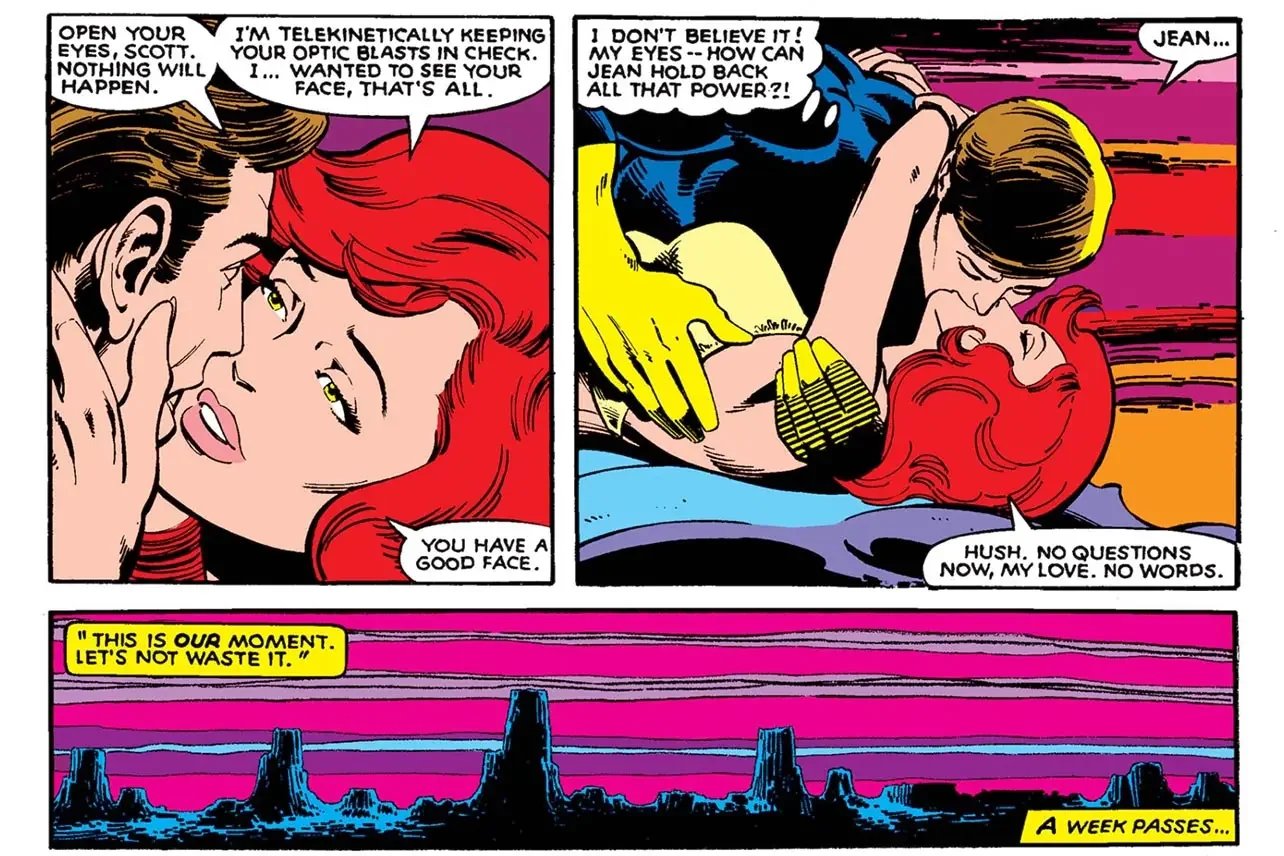
This one’s a keeper, Scott! I hope she doesn’t, I dunno, go crazy, eat a star, and kill herself on the moon
In contrast to Scott, we have two different men. Decades of lore and some intense retconning by Claremont would have one of them be Wolverine. When Jean is in the hospital after becoming Phoenix, Logan buys her flowers and hopes to reveal his feelings for her, before seeing that the rest of the X-Men have beat him to the waiting room (X-Men 101). By the time Jean becomes Dark Phoenix, the readers know Wolverine is in love with her. But it is only later, after she has died for the second time, that Claremont goes back and adds Jean's side of their relationship in the brief stories included in the Classic X-Men series. There we find out that Jean's decision to leave with the original team was because of Logan. While Scott was monologuing by his window, Wolverine was hitting on Jean, and Jean found herself responding.
Next: Evil Mutant Bondage Goddess