Rehashing the post-Infinite Crisis reality-bending DC events would be tedious and confusing; depending on how you count them, there have been at least eight (52, Final Crisis, Flashpoint, Convergence, Dark Nights: Metal, Doomsday Clock, Dark Nights: Death Metal, Dark Crisis on Infinite Earths) with the 2024 DC All In Special possibly serving as a ninth (despite its status as a one-shot comic). All of them are about the DC Multiverse, which 52 revealed was back in a new form after Infinite Crisis, and which expands to include a Dark Multiverse, Multiverse 1 and Multiverse 2, the DC Omniverse, and the Absolute Universe. The sheer volume of reality-altering events is one more sign that corporate superhero comics have entered their decadent phase.
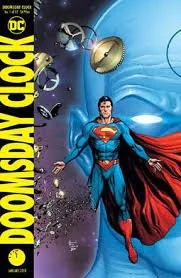
Witness Geoff Johns final statement on DC continuity to date, Doomsday Clock, a twelve-issue series with art by Gary Frank that was published from November 2017 through December 2019. This is not the place to adjudicate Doomsday Clock as a Watchmen sequel, either in terms of its comparative quality (low) or the ethics in publishing this series at all (given Alan Moore's feelings on the matter, highly questionable). It was not the first time that DC would revisit the classic series; the multiple Before Watchmen miniseries paved the way. But it was the culmination of a process that became visible to readers two years earlier, in the Batman/Flash crossover The Button. Written by Tom King and Joseph Williamson, with art by Jason Fabok and Howard Porter, The Button reintroduced not only the Flashpoint timeline (in the figure of the Thomas Wayne Batman), but also a blue hand clearly belonging to Doctor Manhattan himself (not to mention the Comedian's eponymous smiley face button). Now DC was deliberately and spectacularly breaching the firewall that had always existed between the DCU proper and Watchmen, now subsumed to the DC multiverse. The result may not be quite as crass as a parody VHS tape featured in a comics-themed Simpsons episode ("Watchmen Babies in V for Vacation"), but it was a step in that direction.
The wholesale appropriation of Watchmen is perhaps the most Geoff Johns of all Geoff Johns moves: it was the result of clever, intricate plotting that gathered together a disparate set of readymades into a new, but familiar and nostalgic, display: not just Watchmen, not just the DC Golden Age, but also obscure, non-DC auteur projects such as Don McGregor's and Gene Colan's Nathaniel Dusk (here transformed into a film series). It was also yet another example of Johns bleeding an Alan Moore idea for all it was worth. Johns is the Anti-Monitor to Alan Moore's Monitor: structurally, he is doing the same thing as Moore, who is a past master at adapting and renovating old IP, but what he produces tends to blow up the original material with which it comes into contact. Perhaps the most perverse, and most revealing, thing that Johns has ever said about Doomsday Clock: "It is the most personal and most epic, utterly mind-bending project I have ever worked on in my career.” A continuity-bending 12-issue series that runs roughshod over a living creator's intentions is an odd candidate for the category of the "most personal," particularly considering that Johns's signature DC creation, Stargirl, was based on his sister who died on TWA Flight 800 in 1996. [1]
A Watchmen purist would have no difficult making the argument that incorporating the graphic novel into DC continuity cheapens the original. At the very least, it makes it more difficult for the reader to maintain the conviction that Watchmen is a free-standing story. Yes, it still and must stand on its won, but, once read, the prequels, The Button, Doomsday Clock, and, later, Tom King and Jorge Fornés Rorschach cannot be unread. One can treat these other works as fan fiction even if their corporate owners do not, but the fact remains that the page count for Watchmen material not authorized by Alan Moore far exceeds that of the 1986 series (and that is without even accounting for the HBO series). To paraphrase Moore's own paraphrasing of Juvenal: Who watches which Watchmen?
If it were just a matter of ignoring Alan Moore's wishes in pursuit of profitable content, there would be little reason to discuss Doomsday Clock here. But what Johns does here is not just one in a series of offenses against Alan Moore. In the traditions of the DC Crisis Events, as well as Moore's and Johns's own work, Doomsday Clock is a meta-offense. As Johns himself puts it: "I love the idea that Watchmen influenced DC, but what would that look like in reverse? And it goes well beyond that." Now Watchmen, instead of functioning as a critique that closes the door on the superhero genre, is retconned as existing at the heart of DC continuity. It is Dr. Manhattan who is responsible ffor the New 52. Johns, whose claim to fame is his capacity for reinventing DC comics based on all the previous iterations of a given character or story, and who never hesitates to develop one of Alan Moore's ideas far beyond its original scope, is essentially blaming Alan Moore's Watchmen for the biggest and least satisfying disruption of the DC storyworld (the New 52) and also using it as the solution. Doomsday Clock is the triumph of a particular kind of DC editorial vision, one that blithely burns bridges with its major talents in the service of corporate mandates.
It turns out that when Dr. Manhattan left Earth and the end of Watchmen, he ended up in the DC Universe in 1938, the year Superman revealed his existence to the world. Over time, Dr. Manhattan comes to realize that history is continually rewriting itself, with Superman arriving later and later. In other words, Dr. Manhattan, who already displayed "comic book vision" through his fourth-dimensional perspective in Watchmen (skipping around in time like a reader flipping back and forth through a comic), has now gone one step further: he has comics fan vision. He can see the continuity that is otherwise invisible to the denizens of the comic book universe. Dr. Manhattan is a more powerful, more mature, and less annoying version of Superboy Prime, in that he is the incarnation of superhero comics as a self-aware, self-referential phenomenon. In the person of Dr. Manhattan, the DC Universe has awakened and is now observing and changing itself. Intentionally or not, Johns has now made the DCU a text that consciously edits itself.
The “Who would win in a fight” question nobody was asking
Whatever else one might think of Watchmen's intervention in the DC Universe, it is well-timed. As a result of the next big Crisis event (Dark Nights: Death Metal, 2020-2021), both the heroes and the everyday citizens are now aware of the various Crises that have disrupted their reality, including the fact that their histories have been repeatedly rebooted. The resulting status quo has ontological repercussions that are yet to be explored: what does it mean for people to know that their lives are subject to rewriting? This is the sort of thing that has been dealt with head-on in creator-owned superhero universes, such as Kurt Busiek's Astro City (which includes a short story about a man who misses a wife that, thanks to a recent crisis, now no longer existed), and Assorted Crisis Events.
No doubt, forty years of Crises have repeatedly transformed the DC Universe, but that is far from the full extent of their influence. If we go by the initial remit of Crisis on Infinite Earths, they have all been a spectacular failure: rather than resulting in a simplified, accessible storyworld that welcomes new readers, each successive Crisis has furthered the evolution of DC comics into a hermetically sealed, self-obsessed fictional universe catering to an ever-dwindling audience. A reader with no knowledge of DC lore is as likely to follow and enjoy Dark Nights: Death Metal as a viewer of Twin Peaks: The Return who never watched the original series. If comics were the American political system, DC would look like the result of very aggressive gerrymandering.
It is not just this vestigial comics readership that is so different from forty years ago; it is the characters themselves, and the universe in which they operate. When Cary Bates and Ross Andru created Earth Prime in "The Flash -- Fact or Fiction" (The Flash 179, May 1968, with inks by Mike Esposito), it was probably a one-off in-joke, but "our Earth" occasionally reappeared over the next 15 years, before the introduction of Superboy Prime and the almost immediately destruction of his world in Crisis on Infinite Earths. The conceit was that Earth Prime, like all the other Earths, vibrated at its own frequency, which was why the infinite earths could exist in parallel but be largely unaware of each other. This was a much more formal arrangement than the occasional overlap between the Marvel Universe and its creations, which would have Lee, Kirby, and the rest of the bullpen brought in for laughs now and then (primarily on the pages of Fantastic Four). We have seen that Earth Prime has since been restored, but its metafictional function is no longer limited to that vibrational plane in which that particular Earth is located.
Now that the multiverse and its reboots are common knowledge among DC's characters, the boundaries between reader and character are, if not erased, than significantly weakened. We have gone from Dr. Manhattan and his fourth dimensional comic book vision to Superboy Prime, the insider/outsider who is his fictional universe's own harshest critic, to a metafictional, multiversal perspective shared by everyone. The people who populate DC comics are also now an audience for the repeated Events, Crises, and reboots of their own reality.
Thanks to these infinite, never-ending Crises, we are all Superboy Prime.
Note
[1] Johns also brought this personal loss to a JSA storyline involving the death of Atom Smasher's mother in a terrorist attack on her plane (JSA 11-15).
Next: Chapter Five: Truth, Justice, and the American Way of Death