Crisis at the World Trade Center
Perhaps the problem with these superheroic interventions is not just that the tasks are too great (even if they are); perhaps the insertion of these costume-clad figures of fantasy into an event that is actually happening is either simply in too poor taste, or too jarring to take seriously. When Dr. Doom stood at Ground Zero in the J. Michael Straczynski and John Romita Jr. special issue of Spider-Man that came out immediately after 9/11 (Issue 36), the tears welling in his eyes were not only ludicrous, but led to ludicrous fan discussions. Putting a crying supervillain in this situation is, at minimum, tacky, but it also breaks the frame in an unproductive manner. Fans and critics online repeatedly pointed out the absurdity of this moment; why would Dr. Doom, who has killed countless people and destroyed his fair share of major cities, care at all about this? This is a sensible objection, but it is also symptomatic: with a single panel, the creative team got people to expend their mental energy on the possible reactions of a comic book supervillain to a real-life tragedy that had just happened. It is only a short step from "Would Dr. Doom cry over 9/11?" back to, "Who would win in a fight, the Hulk or Thor?"
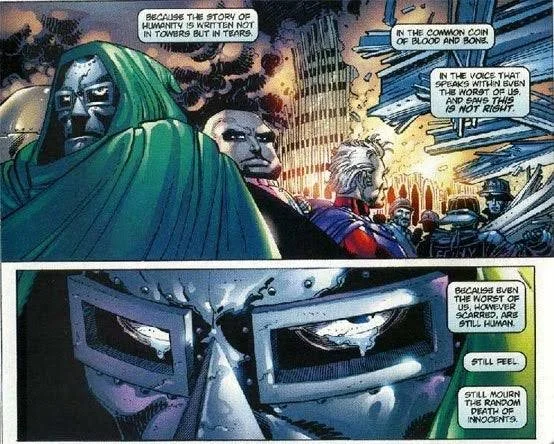
Dr. Doom’s heart grew two sizes on 9/11
Even more than the Ethiopian famine, 9/11 is a case study in the incompatibility of superhero comics with real-world disasters; in Marvel comics, at least, 9/11 would have happened in the city that is home to nearly all the company's heroes. By "incompatibility," I do not mean to suggest that superhero comics cannot be serious or weighty, or legitimate works of politically-inflected art. It is a question of genre, tone, and believability. This is not exclusively a problem of superhero comics; when HBO's Sex and the City returned after September 11, the iconic shot of the Twin Towers was removed from the opening credits, but the producers wisely declined to make a "very special episode" about the event. Executive producer Michael Patrick King was adamant that "the series should provide escapist pleasures, not debates about bin Laden over brunch." Even though the series took place in "the City," it did not have a way to address 9/11 adequately without becoming an entirely different show.
Of course, no one expected Carrie Bradshaw and her friends to actually do something about bin Laden, or to provide disaster relief at Ground Zero. Superheroes, on the other hand, should be expected to do precisely that. Which was the problem with Amazing Spider-Man 36 in particular and superhero comics involving 9/11 in general. Just how many times have superheroes foiled terrorists and stopped airplanes from crashing? How many buildings have they saved from total destruction? The only reason Marvel or DC superheroes would be unable to save the Twin Towers is that, in our world, they were not saved. Even setting aside the heroes' inexplicable failure, there is the question of continuity and tone. Entire cities have been destroyed in mainstream superhero comics, but with limited consequences. When Green Lantern Hal Jordan's home town of Coast City is erased from the map, it sets him down the path of villainy, leading him to commit mass murder and try to reboot the timeline, but the rest of the country moves on rather quickly. Coast City's destruction is only referenced when it is useful for the plot. Even worse, nearly everything about this tragedy is undone by later events; Hal was possessed by a fear entity called Parallax (don't ask), and Coast City is eventually rebuilt (although the original population remains dead). There is too much casual destruction and megadeaths in superhero comics for 9/11 to resonate properly.
Or at least as a current event and a recent trauma. With the passage of time, 9/11 can become one of many horrible historic events that is assumed to have happened in the superhero comic's past, making it available as a referent. Brian Vaughn and Tony Harris strike a delicate balance by making 9/11 a central part of the backstory to their WIldStorm comic Ex Machina (2004-2010), and it works because of the total control they have over their particular storyworld. Ex Machina takes place in a New York that has always had the same superhero comics we have, but no actual superheroes. The protagonist, Mitchell Hundred, is the newly-elected mayor of New York City who had a brief period as his world's only superhero, the Great Machine. Three years before the comic beings, Hundred used his ability to communicate with technology in order to prevent one of the planes from hitting the World Trade Center. As a result, one of the towers still stands, many lives were saved, and Hundred is able to capitalize on his newfound celebrity to successfully run for office. But Ex Machina is set in an alternate universe, where Hundred, the forces behind the events that gave him his powers, and the partial prevention of 9/11 are the only crucial differences from our own world.[5] In the absence of the daily superhero attacks and mass destruction that menace cities in DC and Marvel comics, Vaughn and Harris have created a space in which a superhero comic can reasonably address the 9/11 attacks.
From World War II to the Ethiopian famine to 9/11, the common element of all these representational failures is literalism. Literalism has never been the superhero genre's strong point; on the contrary, literalism is (figuratively) superhero kryptonite. It is the thematic equivalent of one of the many useful formal observations made by Scott McCloud in Understanding Comics. McCloud shows the broad range of representational styles available to the comics artist, from the extremely cartoonish on one end to the photorealistic on the other. The cartoonish figure is stripped down and iconic, with only a few lines needed in order to create a recognizable, and even unique face (like Charlie Brown). The photorealist tries to represent the human figure as accurately as possible, something few comics artists actually attempt (the 70s art of Neal Adams, while still relying on a great deal of caricature, comes close, as does the art of Alex Ross). McCloud argues that the cartoonish representation takes advantage of what he calls the masking effect: by avoiding excessive realism, it allows readers to project themselves onto the characters, to "be" them while reading. Realistic drawing, instead of encouraging identification, turns characters into objects to be looked at. [1]
By the same token, superhero comics that are explicitly about a recent, consequential event run the risk of either getting bogged down in extraneous detail, or getting the details wrong. Superhero comics successfully comment on current events by doing what superhero comics do best: operating in the realm of metaphor. Steve Englehart and Sal Buscema's classic Secret Empire storyline in Captain America 169-175 (January-July 1974) was transparently about Watergate, but without pitting Steve Rogers against G. Gordon Liddy, or meeting with Deep Throat in a garage. [2] At both Marvel and DC, there is a long tradition of publishing stories that comment on current events and hot-button political issues by transposing them into the superhero universe. In some cases, it is a matter of the themes that are embedded into the books themselves: the X-Men franchise has always been a useful vehicle for examining xenophobia, racism, homophobia, and generalized intolerance thanks to the flexibility of the mutant metaphor. Tellingly, it is when the basis for the metaphor is made more explicit that it starts to fail: assertions that Magneto is the Malcolm X to Professor Xavier's Martin Luther King practically beg to be refuted. It does not take a deep knowledge of history or even a highly developed racial sensitivity to realize that comparing Malcolm X to a (sometimes reformed) terrorist and mass murderer is problematic. But the flaw in the comparison is not a problem with the X-Men's storytelling; there is no reason why a fantasy scenario cannot involve a leader who makes compelling separatist arguments while also committing murder. The problem is equating him with a real-life historical figure who committed no such crimes.
Marvel has doubled down on its politically-inflected storyline in the twenty-first century. Civil War can be read as a response to the Patriot Act, Civil War II as an (overly) extended interrogation of profiling, and (the second) Secret Empire as a reflection of anxieties about the rise of fascism over the past decade. But again, they work because their approach to these questions is not literal. As cathartic as it might be to see Captain America punch Donald Trump in the face, it would make little sense as a comic and be of minimal political value. Moreover, the vagaries of comicbook time mean that every instance that fixes a hero or an event in a particular historical moment will cause continuity troubles down the line, from Batwoman being discharged from the military under the "Don't Ask/Don't Tell" policy to the Fantastic Four trying to beat the "commies" to the moon. Curiously, even the solutions to these continuity problems end up serving as comments on American politics at the same time that the move the comics away from actual political events. A number of Marvel characters had the Vietnam was as an important part of their backstories, from Tony Stark's capture by the Viet Cong to the Punisher's time fighting in the war. Marvel's solution has been to move all Vietnam-related personal histories to the fictional country of Sin-Cong. Sin-Cong itself has Marvel roots that are long, but not deep; it was introduced in an issue of The Avengers in 1965, and mostly forgotten for decades. Now the assumption is that at any point in the recent past, Marvel's America was involved in a foreign adventure in Sin-Cong, which can account for all the previous Vietnam- and Korea-related origins (and, in a pinch for World War II). Is there a better summation of American foreign policy than blithely assuming that at any given point, the U.S. can be assumed to be bogged down in an ill-advised foreign adventure?
Notes
[1] Overly realistic comics art can be so distracting as to make the comic seem less real, something most obvious in comics based on movies or television series; the Gold Key Star Trek comics (1967-1979) try so hard to render the actors recognizable that the result feels stiff and posed. By contrast, Georges Jeanty's art on Buffy the Vampire Slayer Season Eight works brilliantly because he manages to distill the characters' look without working too hard to draw the actors. The star of his comic was identifiably Buffy, but she was not Sarah Michele Gellar.
[2] The metaphor almost breaks when the leader of the Secret Empire turns out to be Richard Nixon, but, critically, he is never actually shown or named.
Next: This Is a Job for....Procedural Democracy?