We Are the World (of DC and Marvel)
Occasionally, both DC and Marvel would bring out a special, out-of-continuity comic in which the heroes addressed a contemporary disaster, with sales going towards disaster relief. The goals were noble, but the aesthetic results were, well, disastrous. Particularly egregious were two comics put out by Marvel and DC in response to the mid-1980s famine in Ethiopia: Heroes for Hope (Marvel, 1985) Heroes against Hunger (1986). It feels somewhat churlish to lambast comics created by the combined efforts of over forty different writers and artist (for each) on aesthetic grounds; this was hardly the recipe for creating the comics equivalent of Citizen Kane. And did anyone really think that USA for Africa's 1985 charity single "We Are the World," which somehow had to accommodate everyone from Dionne Warwick to Bob Dylan (while leaving room for Dan Ackroyd and Willie Nelson) was God's gift to music? This is the sort of creation-by-committee that, when combined with a tight deadline and a seriousness of purpose that lends to stultifying piety, can at best aspire for mediocrity. It was as a mediocrity that "We Are the World" succeeded--it is an inoffensive, vaguely catchy pop tune that did the job it set out to do (raising more than $63 million in humanitarian aid). Unfortunately, neither DC's nor Marvel's efforts in this regard managed to rise above the level of the awful.
On his late, lamented web site The Middle Spaces, Osvaldo Oyola posted a scathing (and hilarious) indictment of both companies' charity comics. In particular, he takes each of them to task for their unadulterated Orientalism, beginning with the reduction of an entire continent to an "Africa" consisting exclusively of arid, famine-stricken deserts (the Marvel comic doesn't even specify Ethiopia), continuing through a level of casual racism and sexism that led Oxfam to refuse to work with Marvel on the project, and ending with the way in which each book reinforces a sense of fatalism and hopelessness about "Africa" even as they call for monetary assistance.. Oyola's article stands perfectly well on its own; for our purposes, though, it is worth looking specifically at the question of superhero involvement in "real-world" problems, and in that regard, I would only add that Oyola's criticism of the comics applies so well to Eighties rhetoric of African relief that these comics are actually an accurate representation of an important aspect of the world that produced them. This would then be the only thing about their combination of superheroes and the real world that really holds together.
Well, that, and the useful reminder that while teamwork is admirable among superheroes, writing and drawing by committee can bring on a crisis of infinite pedestrianism. DC's Heroes against Hunger was plotted by Jim Starlin (with an assist from Bernie Wrightson), and features an unlikely team-up of (pre-Crisis) Superman, Batman and Lex Luthor as they try to save "Africa" from starvation. As Oyola notes, there are some gestures in the direction of real-world politics, mostly put in the mouth of a foreign aid worker, but the comics fails both as a superhero story and as a real-world inspiration. Early on, Superman has to admit that he can't refresh the entire continent's topsoil by himself, acre by acre; soon, he and Batman discover that an alien called "The Master" has secreted himself underground to feed on the "entropy" resulting from African suffering. They can defeat him (not that much in the story would make us care about him), but they remain helpless in the face of famine. Even visually, the comics reminds us of the book's shaky underpinnings: Superman's and Batman's full-body spandex outfits, and Luthor's purple-green armor, have no place in panels surrounded by admittedly stereotypical images of starving Africans.
Marvel's Heroes for Hope had one thing going for it: rather than spend time explaining why a particular set of individual characters was involved (as DC did), it focused on their biggest hit, the X-Men, and was co-written and co-edited by the two people most embedded in the franchise at the time: writer Chris Claremont and writer and editor Ann Nocenti. [1] The X-Men were better suited for this sort of thing than most characters, since their remit usually included the exploration of xenophobia, guilt, and redemption. One of its leads, Ororo (Storm) spent years living as a "goddess" in Kenya; another, Magneto, is both a Holocaust survivor and reformed terrorist/freedom fighter/mass murder; and a third, Rachel Summers, grew up in a dystopian timeline in which the mutants who survived genocide were enslaved, and in which she had been brainwashed to hunt down fellow mutants who tried to escape. Suffering, high death rates, and tragedy were baked in to the franchise.
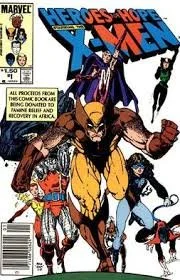
Don’t worry, Africa! We’re here to save you!
And yet it could never work. Even if we set aside the tone-deafness, misery porn, and casual racism Oyola rightfully condemns, the problem remains that this is a superhero comic, and superhero comics need villains and fight scenes. Even for the most praiseworthy of causes, no one wants to read 48 pages of superheroes distributing food and medicine or lobbying congress. So instead they face the allegorical embodiment of famine, at times referred to as "Hungry," who arranges psychodrama set pieces for each of the individual X-Men before taking over Rogue's body and become a grotesque, tentacled monster for the X-Men to physically fight and temporarily defeat. Along the way, many stirring speeches are given, lessons are learned, and nothing really changes.
Note
[1] Bernie Wrightson, Jim Starlin and Jim Shooter are also given a "story by" credit at the top of the page, along with Claremont and Nocenti. Sixteen other writers are credited with specific pages.
Next: Crisis at the World Trade Center