Earth's Mightiest Punching Bags
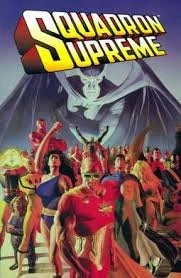
Though it has its share of admirers, the Squadron Supreme miniseries (September 1985-August 1986) was the victim of unfortunate timing, sandwiched between two DC projects that were destined to gain the industry's attention: Crisis on Infinite Earths (April 1985-March 1986) and Watchmen (September 1986-1987). Set on an earth parallel to that of Marvel's main continuity, it shared the multiversal preoccupations of Crisis, but on a smaller scale. Like Watchmen, it reexamined the superhero's role, but in a much less nuanced fashion. And like both, it featured heroes who were variations of previously established characters: Crisis's multiple earths included multiple iterations of Superman and Batman; Watchmen was originally pitched as a story about the heroes DC had recently purchased from the defunct Charlton comics, transformed into new characters for the purpose of the story; and Squadron Supreme was a longstanding variation on DC's Justice League.
In Marvel's hands, the Squadron would always have to be in some way inferior to the Avengers; after all, the Avengers were the home team. [1] But the Squadron was more than just Marvel's answer to DC's most famous superteam; over the years, the Squadron grew from a parody or set of in-jokes into an unusual type of foil for the Avengers: not just opponents (though they were that, too), but a political cautionary tale. This would seem to be an unlikely evolution, since everything about the Squadron initially pointed inward towards hardcore comics lore, rather than outward, towards the world of the readers.
The Squadron Supreme was not even directly based on the Justice League; it was a variation on a group of supervillains introduced in Avengers 70 (November 1969) called the "Squadron Sinister." Created by Roy Thomas and Sal Buscema, the villainous squadron was an answer to that most fanboyish question, "Who would win in a fight: the Avengers or the Justice League?" The answer, of course, was predetermined; if even the Squadron Supreme would never win, a team of bad guys never had a chance. The original Squadron Sinister consisted of Doctor Spectrum (Green Lantern), Hyperion (Superman), Nighthawk (Batman) , and the Whizzer (the Flash). This team had a relatively limited impact on Marvel's main continuity; only Nighthawk became a character in an ongoing series (The Defenders) after renouncing his criminal past.
Thomas returned to the concept in Avengers 85 (February 1971), when the Avengers end up on the home world of the Squadron Supreme, a team of heroes who just happen to be identical to the villains whom they battled just over a year ago in real time. Naturally, a fight breaks out; not only does this always happen whenever two superheroes meet for the first time, but the Avengers mistake this earth's heroes for the Squadron Sinister. The Squadron Supreme only became a vehicle for political commentary when they returned for the "Serpent Crown" storyline that ran from Avengers 141 (November 1975) through Avengers 149 (July 1976), written by Steve Englehart. [2]. That this was Englehart's doing should come as no surprise; his run on Captain America (a book he had just left) included the previously-mentioned "Secret Empire" storyline whose villain was Richard Nixon in disguise. [3] Here the Squadron are reintroduced as "sell-outs" working for Roxxon, the company Marvel uses any time they need an evil corporation as a heavy (Englehart introduced Roxxon in Captain America 180 (December 1974). [4]
Face it, Tiger: you’re a loser
When the Avengers journey to the Squadron's world, they not only can see how it has gone wrong, but they are in a position to rub the Squadron's noses in it. At the end of the story, the Beast disguises himself as that world's president, Nelson Rockefeller, and tells Hyperion that his team has lost its way, and that Rockefeller's government is corrupt. The Beast's disguise is almost immediately exposed, but the truth of his words hit home. The movement back and forth between mainstream Marvel and the Squadron's world allows the political satire to be kept at one step's remove from the world of the Avengers, which, unlike the Squadron's, will not have to embark on the long work of rebuilding democracy after an oligarchical coup. But the interplay between the two dimensions also lets the satire target two different worlds: the "real world" and the one that the Squadron's is modeled on: that of DC comics. After all, while Marvel occasionally told stories of alternate worlds in the 1970s, "multiple earths" was very much a DC thing. Compared to Marvel, DC was the stolid, traditional comics company whose heroes were "squares," and who questioned the established order even less frequently than their Marvel counterparts.
Perhaps inadvertently, Englehart's reintroduction of the Squadron Supreme established a pattern for them that Kurt Busiek would finally lampshade in his Avengers/Squadron Supreme Annual '98: the Squadron is a team of weak-willed naifs who are conned again and again. To be fair, Busiek has the Avengers speculate that something about their home universe makes them unusually susceptible to mind control, and, knowing the writer's facility for making connections with previous continuity, the explanation is probably sincere. But it also doesn't take much to imagine that, after the Avengers send the Squadron back into the multiverse, they indulge in a collective eye-roll about how easy it was to make them feel better about their inability to resist a bad idea.
Such disdain would have been well-justified. In the interim between The Serpent Crown Saga and Busiek's story, the Squadron demonstrated a stunning capacity for screwing up. In a sequence of Defenders stories they turned their world into a fascist dystopia nominally run by Kyle Richmond (Nighthawk), but actually controlled by an alien entity called the Overmind (in turn the vessel for an entity called Null, the Living Darkness). Gruenwald's Squadron Supremeseries takes place in the aftermath of that particular disaster. Cleaning up after Rockefeller's corruption was one thing, but the Overmind had used the Squadron to take over the world. How could they recover from that? Gruenwald's Squadron comes up with a terrible answer: to take over the world again, but this time as good guys.
The series gets off to a slow and difficult start, with several pages of the characters recapping the events of The Defenders to each other for no one's benefit but the reader's. Unlike Watchmen, which existed in a world created entirely for the purpose of telling one specific story, Squadron Supreme was bogged down in continuity right out of the gate.[5]. But to Gruenwald, continuity was always a big part of the fun. Gruenwald's obsession not just with comics lore, but with making all the lore fit together, was over the top even by fan standards. Before becoming a professional writer, Gruenwald published a fanzine called Omniverse that was dedicated to exploring the nuances of continuity. He brought this same sensibility to his comics work, creating The Official Handbook of the Marvel Universe (1982-1984), a fifteen-issue illustrated guide to the company's characters and events. His series Quasar (1989-1994) deployed his esoteric Marvel knowledge as the building blocks of storytelling; there was hardly a cosmic character who failed to at least make a cameo over the course of the series' 60 issues.
In 1988, he scripted an 11-part series of back-up stories about the High Evolutionary, a frequent Marvel antagonist whose complicated backstory was Gruenwald catnip, and, together with Ralph Macchio and Peter Gillis, he wrote a series of back-up stories in What If? centering around Jack Kirby's Eternals. Fresh off finishing off Roy Thomas' extended sequence of Thor comics that brought Kirby's characters into Marvel's main continuity, he and Macchio (and eventually, Gillis) set out to tell the characters' history in such a way that thoroughly (and permanently) integrated them with the rest of Marvel lore. The principle behind these stories appears to be narrative economy: they united three disparate hidden communities of super-powered beings into one common point of origin. The Celestials created the Eternals, and their experiments on primitive proto-humans were what inspired the Kree to develop the Inhumans (Kirby's earlier creation). Early in their history, the Eternals suffered a schism, resulting in an offshoot moving to the planet Titan, where they became the ancestors of Jim Starlin's Thanos and Eros. These were not necessarily bad ideas; in fact, they resulted in many good stories. Unfortunately, none of them were by Gruenwald, Macchio, or Gillis. [6]
Forty years later, it's easy to fault Gruenwald for the sheer nerdiness of his preoccupations, especially now that there actually is a market for comics/graphic novels that can be picked up and read on their own. While the book's entrenchment in decades of Marvel storytelling is a distinct obstacle to Squadron Supreme functioning as Marvel's Watchmen (i.e, as the book you can give to non-comics readers to show them why comics are good), we should at least be aware that we are judging the book by standards that it had no interest in meeting. Squadron Supreme was designed to reward the efforts and enthusiasm of the dedicated Marvel reader, in a fashion that required the recognition of continuity.
Even if the Squadron was composed of second-stringers derived from a Justice League template, they were a familiar Marvel fixture. It is one thing to watch an entirely new set of characters deviate from the run-of-the-mill superhero story, but it is another to see heroes you already know take over the world in order to build a utopia. As an established team on an established alternate Earth, the Squadron's actions felt far more consequential than an issue of What If? (or an "Elseworlds" story, DC's later designation for non-continuity stories about established characters (or variations on them). The Squadron's world was "real" within Marvel continuity, but not essential: it was possible and permissible to radically change their status quo without having to undo everything that happened by the story's end. In fact, this had already become the main rationale for Squadron stories starting with Englehart's Avengers: their world is supposed to be subject to radical change. And, unlike in Watchmen, the consequences could continue to be explored in subsequent stories. [7]
Notes
[1] Kurt Busiek and George Perez introduced a clever metacommentary on the home team dynamic in JLA vs. Avengers, the miniseries that could final dispense with thinly-veiled proxies of each company's rivals. Things worked better for each team in their home universe. Grant Morrison and Frank Quitely took the idea further, essentially embedding the rules of the superhero genre into the nature of DC's multiverse. In their Earth 2 graphic novel, when the Justice League tries to clean up the alternate earth dominated by their villainous counterparts (the Crime Syndicate), they discover that they simply cannot win in this other world, which exists for the triumph of evil.
[2] Issues 145 and 146 were a two-part fill-in story that had nothing to do with the ongoing plot.
[3] See my Marvel in the 1970s for an extended discussion of this storyline.
[4] Writers in the 1970s often began plotlines in one book, only to develop them on the next book they would be assigned. The Serpent Crown storyline gave Englehart the opportunity to wrap up threads from his run on Amazing Adventures (starring the Beast and featuring Patsy Walker) and Captain America.
[5] Even worse, it was continuity based on a comic not many people were reading. J.M. DeMatteis' run on The Defenders had many bright spots, but it was not exactly a bestseller. Assuming familiarity with the Squadron's last appearance would have been short-sighted.
[6] These historical stories were pleasant enough reads for the die-hard Marvel reader, but their payoff would only come later, especially when Kieron Gillen was writing The Eternals.
[7] There is some continuity that is too much even for Gruenwald. At the end of the Defenders storyline, Kyle Richmond's body is inhabited by the mind of his mainstream Marvel counterpart. The Squadron Supreme makes no mention of this fact.
[19] Or at least, unlike Watchmen as originally conceived. DC's decision to continue the franchise against Alan Moore's express wishes changed all that, but only after decades had passed in real time.
[20] Amphibian also votes against it, but, unlike Nighthawk, he agrees to defer to the will of the majority.
Next: Plot Cancer