A Magnificent Failure
The failure of Squadron Supreme is also its brilliance, because it is turned into a theme at various points throughout the book. This is also where Gruenwald's continuity obsession pays off: yes, we have pages of exposition and summary in the first issue, but it is in the service of establishing just how bad things have become on the Squadron's world. Despite Gruenwald's own never-ending fannish enthusiasm, Squadron Supreme excels at bringing the jaded sensibility of fan who finds that superheroes are in decline. The first issue does a remarkable job of transforming a metafictional superhero malaise into the condition of the superheroes themselves.
Defeated even before the series began, the Squadron spend much of the first issue continuing to fail. Hyperion tries to stop the team's orbital headquarters from tumbling to earth, but manages only to steer it away from populated areas. In case the reader missed the metaphor, Hyperion and his colleagues make it crystal clear:
Hyperion: Maybe it was meant to come crashing down on our heads....like everything else has come crashing down on the Squadron lately.
Whizzer: I know what you mean, pal. The satellite, the world--we've all seen better days.
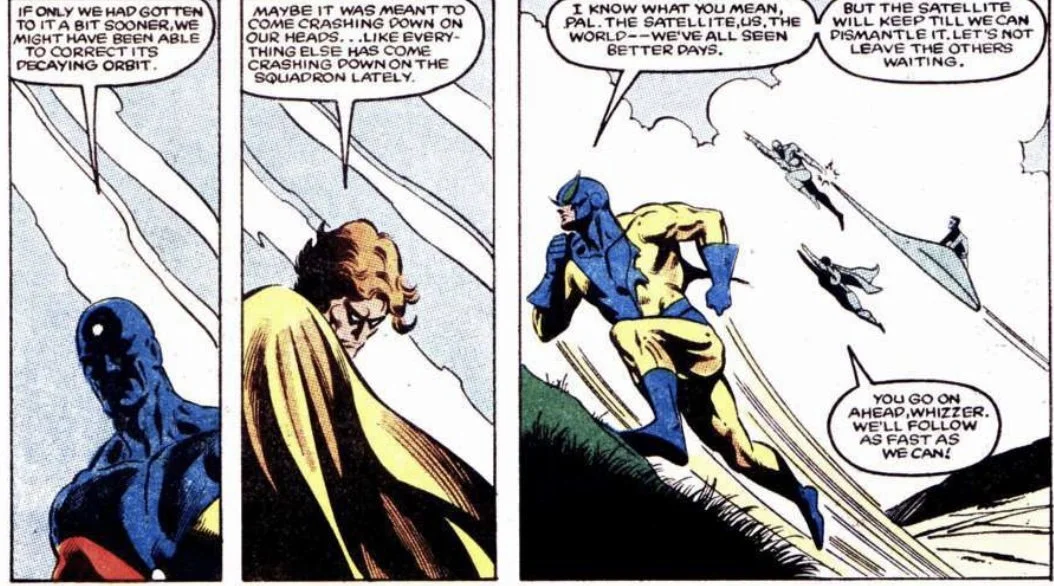
It doesn’t take a giant metaphor to hit you over the head…. oh, wait
The rest of the Squadron is no better off. Power Princess, Nuke, Captain Hawk, and Arcanna try to stop a food riot, but only make things worse. Golden Archer, Lady Lark, Nighthawk, and Tom Thumb manage to put out some fires caused by exploding gas mains, but they know that similar disasters are playing out all over the country. When the Squadron finally assembles, both Hyperion and Nighthawk lament that this situation is "all our fault," with the Whizzer confirming that the rest of the world is in even worse shape than the United States. The despair is palpable, and the book is slipping dangerously away from superhero territory and into the direction of a Democratic focus group during the Trump administration.
What they need is what the best superheroes provide: inspiration. So it falls to Power Princess, the Squadron's stand-in for Wonder Woman, to argue that the heroes are thinking to small. She grew up in a utopia; why can't the Squadron turn the rest of the world into a paradise? Hyperion quickly agrees, and soon the entire Squadron votes on a "Utopia Project" that is not content with merely stopping the bad guys:
Hyperion: We should actively pursue solutions to all the word's problems---
---abolish war and crime, eliminate poverty and hunger, establish equality among all peoples, clean up the environment, cure diseases and---
---even cure death itself!"
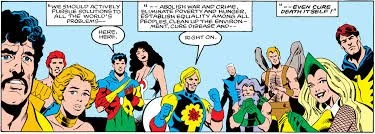
“Right on!” “Boo, death!”
It's an astonishing leap--just three pages ago, the Squadron was whining about the hopelessness of their situation, and now they're going to put a stop to death. Only Kyle Richmond (Nighthawk), still technically the president after being controlled by the Overmind, makes an impassioned argument against the plan. [1] As the team's version of Batman, he is the sole non-superhuman in the Marvel version of what has come to be called DC's "Trinity" (Superman, Wonder Woman, Batman), so it is only right that he be the voice of the opposition. But the scene is clumsy and rushed. In the previous chapter, we saw how Moore and Gibbons used each of the Watchmencharacters to embody a philosophy (Existentialism, Objectivism), but even in the scenes that make their views most explicit (the first and only meeting of "Crimebusters" and Dr. Manhattan's final confrontation with Rorschach), they never speechify or even truly debate. But a more charitable reading of the speed with which the Squadron leaps into the utopia program points to the deficiencies of the superhero genre: these characters are simply not designed to refrain from taking action, and will always choose intervention over introspection.
In trying to think big, the Squadron Supreme (the team) displays an astonishing lack of imagination; whether or not Squadron Supreme the miniseries does as well is an open question. Their ideas are bold, to be sure, but hatched too quickly and never really thought through. Much of the plan is to transplant the idea and technology of Power Princesses homeland, Utopia Isle, in the broader world. But in its form, the plan looks more like a repetition compulsion: not only are the Squadron taking over the world (again), but the key weapon in their arsenal is also their Achilles' heel: mind control. Instead of simply fighting the bad guys, they will use advanced technology to turn them from adversaries into team mates.
At this point Squadron Supreme could have turned into a dystopian nightmare about the rise of an irresistible form of fascism, but that would have required the book to broaden its focus to the general populace. Ordinary people are only of interest to the narrative to the extent that they intersect with its super-powered protagonists: they are necessary in the first issue in order to establish how bad things have gotten, but, otherwise, they show up (less and less frequently) as the Squadron's friends and family. Small wonder that Hyperion becomes functionally blind halfway through the series; his multiple forms of advanced vision have never allowed him to perceive the most basic facts that are in plain sight. Equally ironic is the cause, a fight with his evil, extradimensional doppelganger: the Squadron is its own worst enemy.
Note
[1] Amphibian also votes against it, but, unlike Nighthawk, he agrees to defer to the will of the majority.
Next: Move Fast, Break Things