Somewhere in the process of writing Infinite Crisis, Prime seems to have become a favorite of Johns. Something about a super-powered, immature toxic fanboy clearly resonated with a writer who started as a fan and acolyte (mentored by Superman director Richard Donner), had a meteoric rise in DC that leveraged his encyclopedic knowledge of, and emotional engagement to, DC lore, and became a target for online vitriol as his influence over DC comics, film, and television became hegemonic. So many of his signature projects are not just in the DC Universe, but about it, with continuity, reboots, and restoration all taking center stage. If, as I have asserted, Flashpoint was an incoherent failure, and if his scattershot reboot of DC in the New 52 grew increasingly disappointing to readers, Rebirth, the more commercially and critical project for reconciling the New 52 and the the company's past, was also masterminded by him. Johns's growing comics output and outsize role in the company's direction made him identifiable to DC fans as both the cause of the company's problem and its solution. With Superboy Prime, Johns weaponized both positive and negative fan response in a perfectly Johns way: he dug deep into DC continuity in order to add dimension to a character in manner consistent with the character's roots. Initially a denizen of Earth Prime, this particular Superboy was meta from start to finish, the project of "our" world's fannish desires into an imaginary universe that already existed as fans' and creators' fictive projections.
Prime is a particular kind of bad fan: nothing new makes him happy, and every attempt to restore or revisit the old only leaves him more unsatisfied. His reflexive nostalgia is sterile at best, toxic at worst. He also proves the argument some creators have made about critics for ages: it's easier to tear something down than build it up. Tearing down is all Prime can do. After he breaks free and does a brief stint in the Sinestro Corps, Prime returns in the weekly series Countdown to Infinite Crisis (which Johns did not write), where he destroys not one, but two earths, out of frustration with their persistent imperfections. As of this writing, Prime has managed to come back every few years, but Johns had already given him his defining moments in two of the last Prime storylines he has written to date. In Final Crisis: Legion of 3 Worlds, Prime is appalled to discover that, by the 31st century, he is barely a footnote in the history of Superman. At the end of a very complicated plot involving a future version of Prime who has become the Time Trapper, Superboy Prime is catapulted back to Earth Prime. His status as ultimate fanboy stereotype is now complete: he literally lives in his parents' basement and spends most of his time trolling DC fans online. He has also alienated everyone around him, because they have read about his exploits in the DC comics that featured him.
Yeah, we’re not thrilled either, Prime
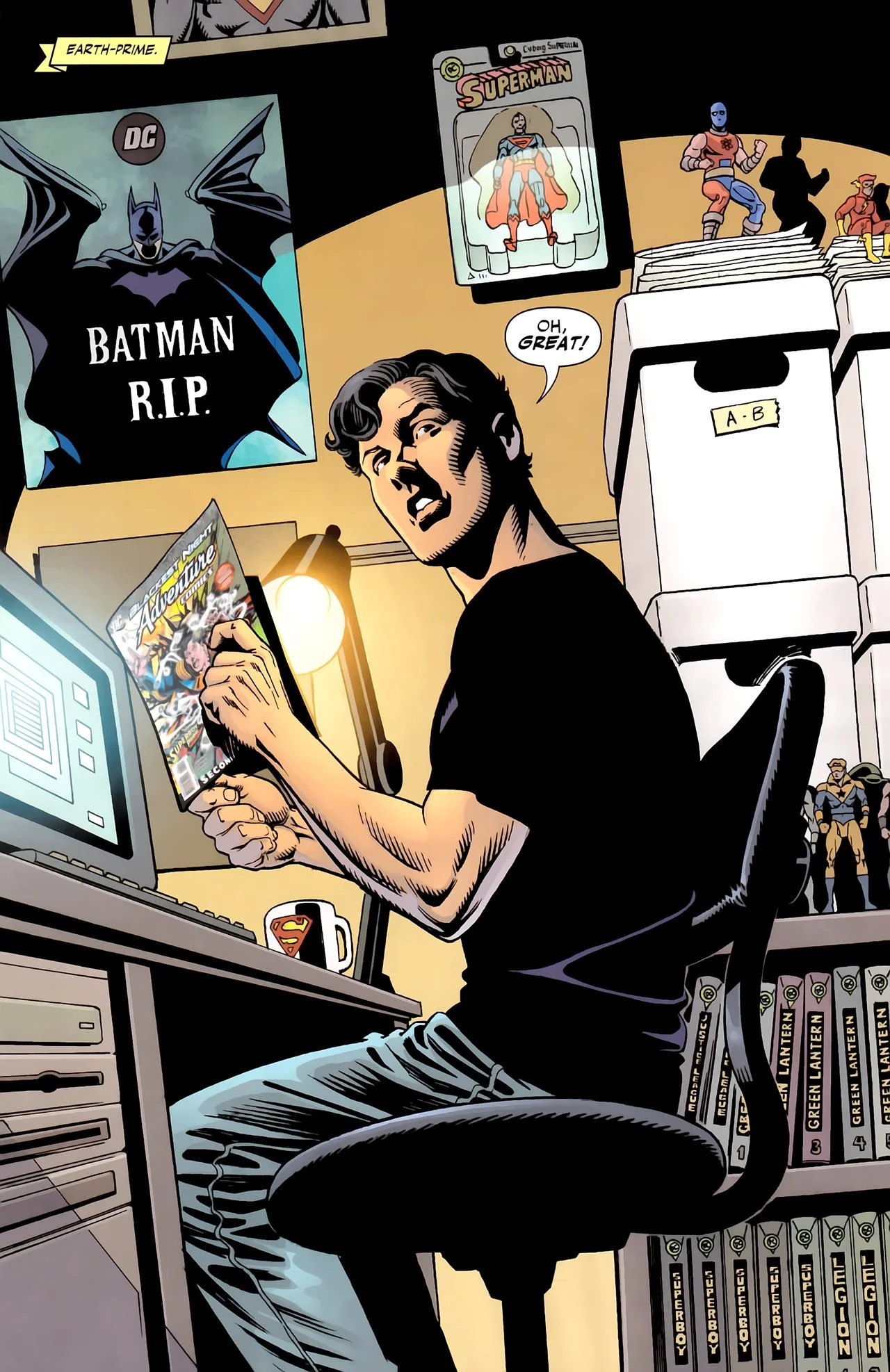
Appropriately Johns' made his next statement on Prime in a line-wide event that was all about deadly nostalgia: Blackest Night confronted the DC heroes with the malevolent, reanimated corpses of their loved ones, comrades, and enemies. The current volume of Adventure Comics had been devoted to the exploits of the Conner Kent Superboy and the Legion of Super-Heroes (each getting half the book); Issue 4 ("He Primed Me, Part One: Spoiler Alert," written by Johns and Sterling Gates, with art by Jerry Ordway and Bob Wiaceck, January, 2010) ironically gives Prime what he always wanted: he has displaced Conner Kent as the Superboy headlining the series. It opens where we left him, in his parents' basement, annoyed by the realization that DC has involved him in this latest crossover (in a nice touch, that realization hits him simultaneously on two fronts: he is holding Adventure Comics 4 in his hands while looking directly at the reader he knows is watching him).
Though the metafictional storytelling is rather postmodern, it is also a restoration of Prime's (and Earth Prime's) historical roots: Earth Prime is precisely the world in which a superhero visiting from a fictional Earth can meet his creators and make demands. He forces his terrorized parents to drive him to the local comic book store (while they plot yet another attempt to escape from their monstrous offspring), where he demands to find out what happens in Adventure Comics 5. Of course, the staff can't help, but they do direct him to the Internet (which is also useless). But this is a Blackest Night tie-in, and suddenly a zombified Alexander Luthor appears in the shop, restores Prime to his full power and Anti-Monitor-inspired costume, and trashes the store, reminding Prime that everyone (the readers, the staff at the story) hates him because he is a bad character.
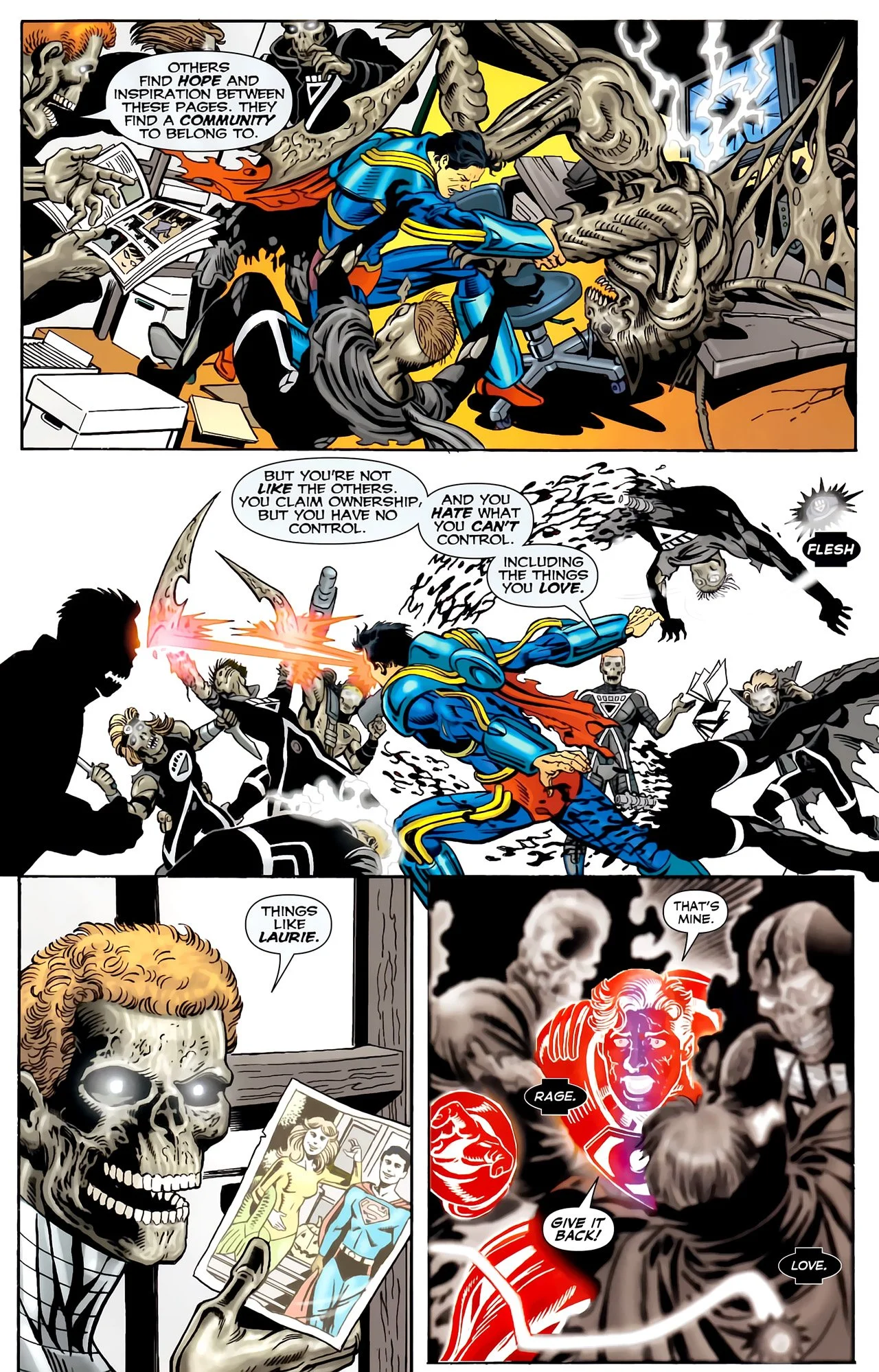
Like all comics readers, Prime had to wait until the next issue to find out what happens next. In "He Primed Me: Part Two: Flame War" (Adventure Comics 5, February 2010, by Johns, Gates, Ordway, and Wiaceck), Johns doubles down on the metafiction, with Prime fighting the Black Lanterns in DC offices as he yells at Editor-in-Chief Dan DeDio and other DC staffers that "These aren't just stories you're making up!/ Somewhere out there, they're all happening!" But even from his privileged vantage point as an Earth-Prime resident who has travelled the multiverse, he has neither control nor perspective. Instead, it is the undead Alexander Luthor who serves as Johns' and Gages' mouthpiece, telling Prime that his comics are his kryptonite:
Others find hope and inspiration between these pages. They find a community to belong to.
But you're not like the others. You claim ownership, but you have no control.
And you hate what you can't control.
Including the things you love.
You know things are bad when the voice of wisdom is a zombie villain from a vanished evil Earth
The emotionally-stunted fan is forced to confront the entire emotional spectrum that happens to be the macguffin for Blackest Night: will, fear, love, compassion, avarice, rage, and hope. Surprisingly, Johns and Gates send Prime on a superficially positive note, but one that still fits the book's judgement of this most toxic of fans. Having purged himself of the various Lantern energies, Prime whines that "I never get what I want. The don't want me to h-have it. They made me into their puppet. " He admits that he does hate himself, but clings to his grievance that "they" turned him into a villain: "Why don't they give me a happy ending?"
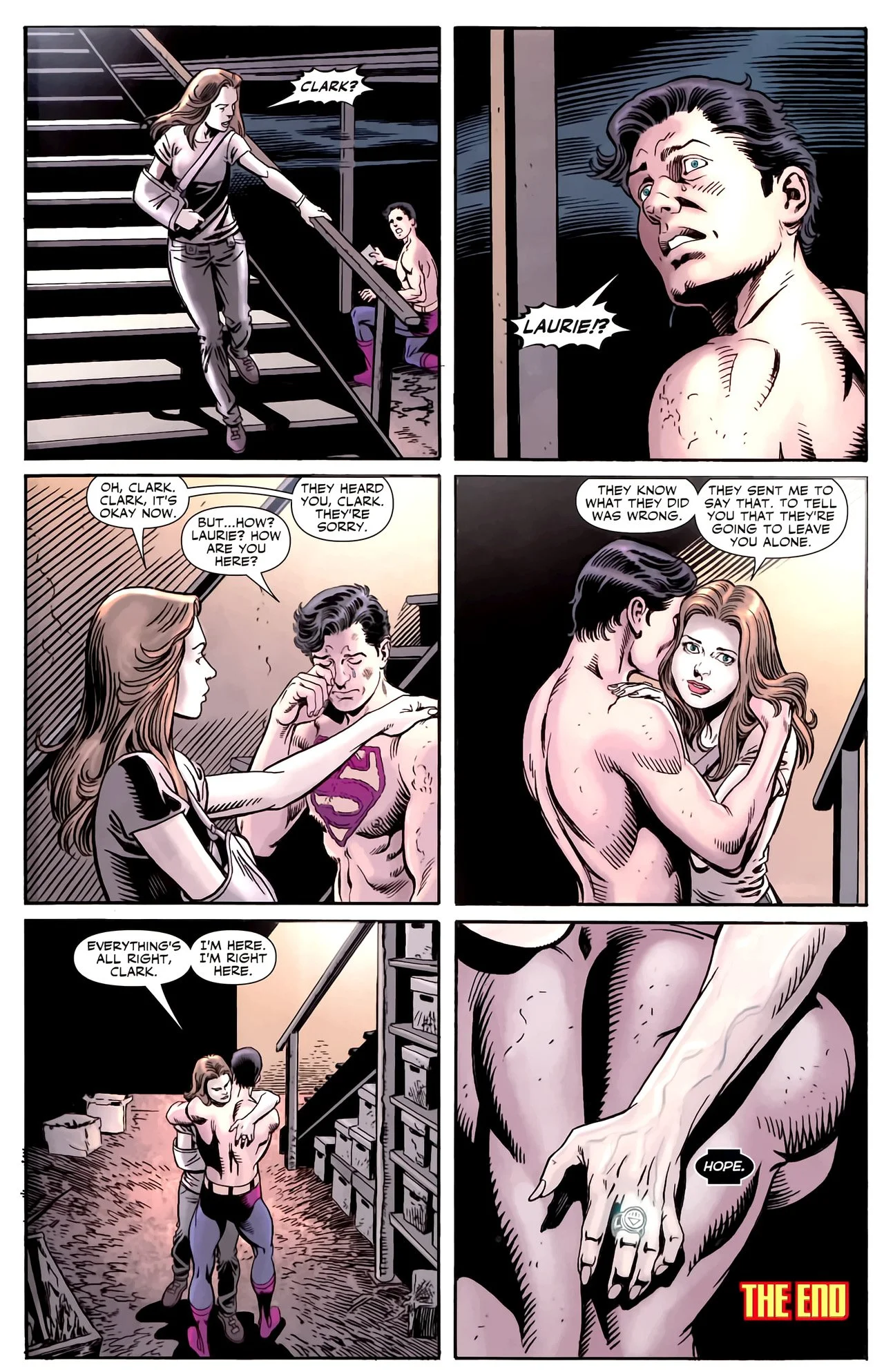
As if on cue, Laurie, his girlfriend whom (it has been strongly hinted) Prime killed in a fit of rage at some point after Legion of 3 Worlds, shows up in his ruined basement:
"They heard you, Clark. They're sorry.
They know what they did was wrong.
They sent me to say that. To tell you that they're going to leave you alone.
Everything's all right, Clark.
I'm here. I'm right here."
Super-Incel wins the prize
The last panel closes in on a black lantern ring on her finger, with the word "hope" representing the emotion she is presumably channeling. This "Laurie ex machina" makes little sense on the level of plot, but adds a great deal to the story's themes. Prime is still the entitled, immature child he always was, with Laurie's primary function in his life reinforced: she is more a reward than a person (indeed, she is apparently an animated corpse). In a superhero world that casually "fridges" girlfriends in order to give the hero something to get upset about, Laurie has been defrosted and offered up to a bitter fanboy who has never really learned his lesson. Only a troll like Superboy Prime would see a reunion with his dead girlfriend ins his parents basement as a "happy ending."
Next: Fixing the Unfixable