Violence Really Does Solve All Our Problems!
While in limbo, the four Crisis refugees repeatedly encounter odd, crystalline walls that display the present and past of New Earth. This is how they grow disappointed in the world they inadvertently helped create (with Alexander stacking the deck by making sure they see the worst possible moments). At some point, Alexander notices that if Superman or Superboy-Prime hit one of these walls in anger, it somehow triggers a transformation in post-Crisis reality. Soon Alexander encourages Prime to hit the wall again and again (before its eventual, final destruction). Each one of these blows turns out to be responsible for a unique, longstanding continuity problem: one punch leads to the Hawkman mess, another to the resurrection of Jason Todd, a third to the complete reboot of the Doom Patrol, and a fourth to a bizarre revamp of the origin of the Metal Men.
That's right: all the various glitches in DC continuity happened because Superboy Prime literally punched the walls of reality. An elegant solution to a complex web of problems while also a sublimely stupid idea, the Superboy Punch is a hilarious parody of the problem of justice in a superhero universe. Crime, inequality, and racism cannot simply be punched in the face, but it turns out that, in modern DC comics, reality is eminently punchable. Infinite Crisis flirts with the possibility that physical violence on the part of a self-righteous, empowered vigilante may actually be the solution to the world's problems. It's just a matter of finding the right way to punch.
This represents Infinite Crisis in a nutshell. Infinite Crisis is steeped in the continuity wonkiness of its predecessor while also exemplifying something from every age of DC comics, all converging on Superboy Prime. Superboy aligns himself with Kal-L, the original Superman, who embodies the good-natured naivete of the Golden Age, while Prime's reality punch and rearrangement of entire planets to give the universe a new center is Silver Age nonsense at its finest. The death and dismemberment he doles out in the last few issues are everything about the post-Crisis DCU that he purports to loathe. Infinite Crisis has it's geek and eats it, too.
At this point, it should come as little surprise that so much of Infinite Crisis is about reading DC comics. The four refugees in limbo represent three critical takes on the post-Crisis era: for the Earth-2 Superman (and presumably, Lois, though she doesn't comment very much), this new world is too cynical. For Alexander Luthor, it's a missed opportunity. For Superboy Prime, though, the contemporary DCU tarnishes his dreams. When he repeatedly watches his happy life on Earth Prime get erased by the first Crisis, one can almost hear the lament of the conservative fanboy: this new material is "raping his childhood."
As written by Johns, Superboy Prime is the apotheosis of the bad fan. A caricature of the teenage fanboy, he's an opinionated bully who stutters every time anyone challenges his judgments. He may have superpowers, but he is still engaged in cosplay, trying out new looks for his audience. Indeed, the back-up story in his first appearance in a Crisis tie-in ("The Origin of Superboy-Prime," DC Comics Presents 87, by Elliott S. Maggin, Curt Swan, and Al Williamson, November 1985) shows him dressing up in a Superboy costume for a beach party, when his powers first manifest themselves. After his heel-turn halfway through Infinite Crisis, he returns to New Earth in a new costume inspired by the Anti-Monitor; finally, in prison on Oa, he cultivates a more extreme look by burning the Superman shield onto his bare chest. His aesthetic starts in the 1950s, morphs into the 1980s, and ends in the 1990s.
Dude. Not cool.
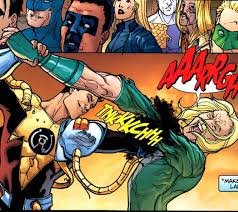
By the time Infinite Crisis is over, Prime has wracked up an impressive death count. Before killing dozens of Green Lanterns and the Golden Age Superman in the final issue, he's left a lasting impression on the Teen Titans: accidentally murdering the obscure heroine Pantha (punching her head off), tearing off Risk's right arm, and killing Connor Kent, the current Superboy. Though the main villain of Infinite Crisis is technically Alexander Luthor, Prime has proven himself a one-man Crisis, taking out characters from multiple DC eras and franchises. He has destroyed the very origin of DC comics (as Alexander puts it: "The Superman of Earth-Two is the key to the return of the rest of the multiverse./ For some reason I can't explain or understand, and probably ever will..../ everything comes from Superman.")
Alexander, who comes as close to DC godhood as anyone can (replacing the hands of creation with his own) can't understand Superman's role, but certainly Prime can: he is, after all, from "our" Earth, and spent his childhood reading DC comics. By the end of Infinite Crisis, Prime has assumed one of the roles previously played by the Psycho-Pirate: he seems to be aware that he is living in a comic book. Indeed, that is the whole point of Prime: he was a seemingly ordinary comics fan (who happened to share Clark Kent's name) who gets to live out the wish fulfillment fantasy of becoming super, though at the expense of every aspect of his previous, ordinary life. Prime is a cautionary tale, so immersed in comics that he has lost the ability to treat those around him as real people rather than characters.
Next: Super Bad Fanboy