What Child Is This?
The previous decade's panic over the fate of Russian children in American hands yielded to the cynical population transfer of Ukrainian children to the Russian Federation, all ostensibly in the name of children's welfare. It requires little effort to see that the individual children themselves are the pretext for concerns far removed from orphanages and classrooms. The children are rhetorical weapons in Russia's geopolitical battles with its chosen enemies. The question is not, "What is best for these children?" but "Who shapes the Russia of the future?"
If the children themselves are merely symbolic pawns in an ideological battle, their biological parents are close to irrelevant to the struggle into which their offspring have been dragooned. However disputed their virtues or vices as parents may be, this, too, is a proxy for the fitness of the countries themselves. In the Introduction, we looked at notions of Russia as a collective body, wrestling with its enemies on the world stage. In a military or diplomatic context, that body is almost always male, but in the discourse of international adoption and the appropriation of children, the symbolic body is maternal.
Dima Yakovlev's birth mother may well have been an alcoholic, and Miles Harrison, his adoptive father was unforgivably negligent in leaving him in a parked car for nine hours, but the conclusions drawn about international adoption are huge leaps from the specific to the general. The story is evidence for what each side already knows: to would-be American adoptive parents, Russia is a land of drunks practically designed to produce fetal alcohol syndrome; to Russian opponents, the Americans are either religious fanatics or selfish individualists who cannot be trusted with Russian babies. The Fairfax County Circuit Court acquitted Harrison of involuntary manslaughter; in passing the Dima Yakovlev law, the Russian State Duma implicitly found him guilty. The father or mother may be found wanting, but the verdict's object is the fatherland or motherland.
The crux of the ideological debates over the fate of children is the question of synecdoche: the relationship between the part and the whole. Sting's hope that "the Russians love their children, too" is cast in the plural, but the whole point is that "the Russians" here are less an undifferentiated mass than a collection of parents who love their own children. In other words, a Soviet general might hesitate to launch the nuclear weapons leading to global annihilation out of concern for his specific children or grandchildren. But the connection of (possibly endangered) children to the future of the country treats parents and children as demographic categories. Perhaps coincidentally, Russian exhortations to protect children as well as maternal and paternal health are usually phrased in terms that point towards institutions or phenomena rather than people : "Beregite detsvo" (Protect childhood) or "Beregite materinstvo" (Protect motherhood).
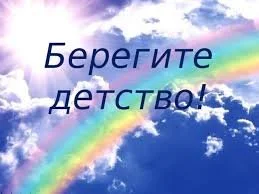
Someone missed the memo: aren’t (gay) rainbows one of the things we’re supposed to be “protecting childhood” from?
The Motherland and Fatherland are not loving mothers and fathers, invested in the personal prosperity of their individual children. On that level of abstraction, children are, indeed, the "future": future soldiers, future workers, and future producers of more children.
Next: Chapter Four: Russia’s Alien Nations: Agents, Spies, and Extraterrestrials